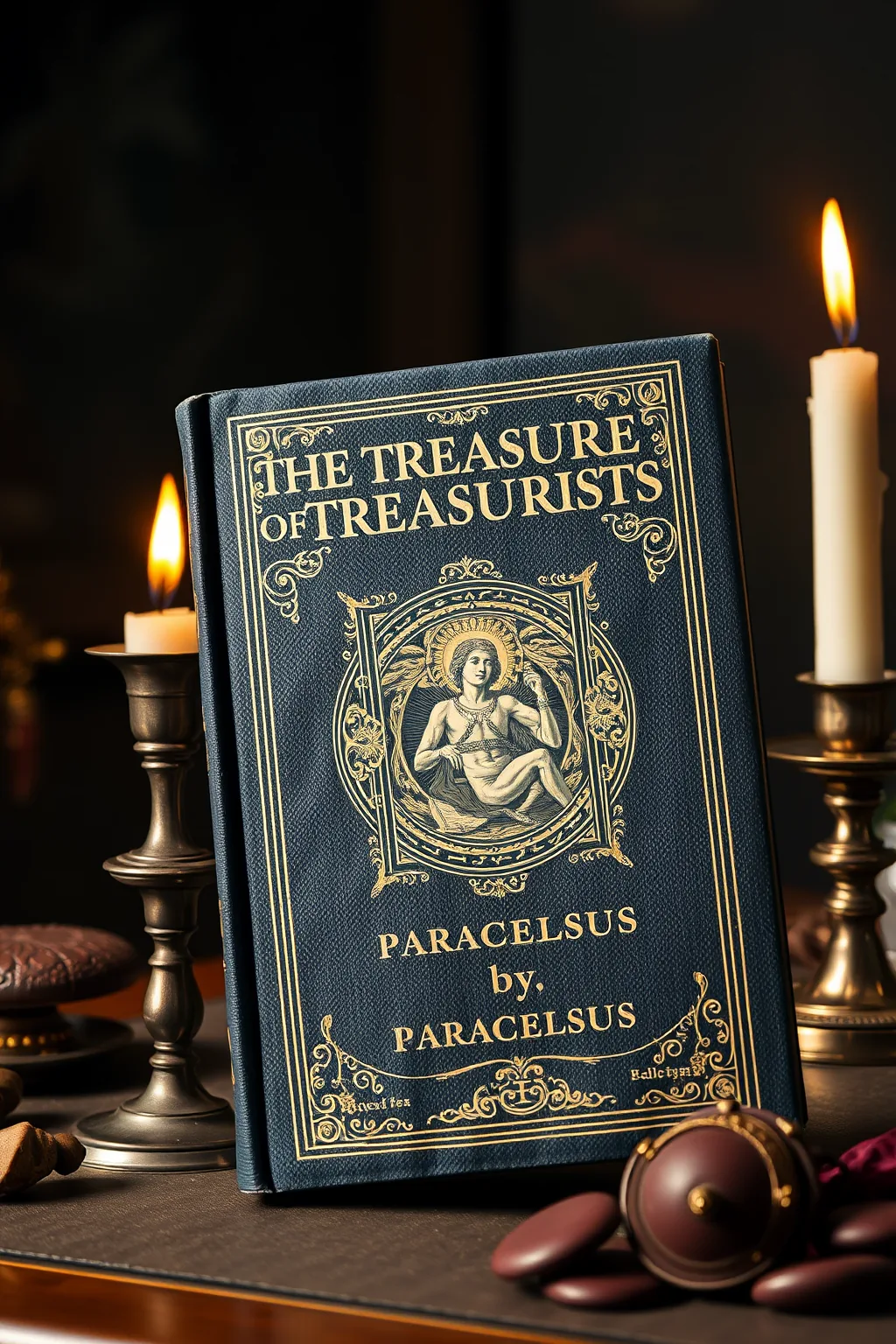
The Treasure of Treasures for Alchemists by Paracelsus
 83
83

The Treasure of Treasures for Alchemists by Paracelsus


Silas Hawthorne (Hermetic Studies Editor) — Paracelsus's 'The Treasure of Treasures' is an indispensable beacon for the serious alchemist. Eschewing mere materialistic pursuits, Paracelsus guides the reader toward the spiritual essence of the Art, emphasizing the vital role of a third, often overlooked, principle. His critique of prior alchemical thought is sharp, yet his revelations, particularly concerning Spagyric methods, are profoundly illuminating. This text is a challenging but rewarding journey for those prepared to engage with its dense symbolism and philosophical depth, offering unparalleled insights into the true nature of transmutation.
📝 Description
83
Paracelsus's 'The Treasure of Treasures for Alchemists' details a third alchemical element beyond Mercury and Sulphur.
Published in the 16th century, Paracelsus's 'The Treasure of Treasures for Alchemists' goes beyond simple material transmutation. It examines the spiritual and philosophical dimensions of the alchemical process, often called the Great Work. Paracelsus, a physician and alchemist, presents concepts that depart from earlier alchemical thought. He introduces a distinct third principle, accessible through the practice of Spagyric Art. The text aims to guide readers in comprehending the cycles of creation and decay in the cosmos. It also seeks to illuminate the symbolic language found in nature, serving as a manual for spiritual refinement and eventual perfection.
This work addresses those seeking deeper knowledge of universal forces and the means to achieve spiritual clarity. It is written for the dedicated student of hermetic philosophy and the practitioner of alchemy. The book connects the individual human experience, the microcosm, with the larger universe, the macrocosm. It invites a reevaluation of existence through its alchemical and spiritual teachings.
This text is a product of the Renaissance alchemical tradition, a period marked by intense interest in both practical chemistry and spiritual philosophy. Paracelsus himself was a controversial figure who sought to reform medicine and alchemy, drawing from Hermeticism, Neoplatonism, and Kabbalistic ideas. His work often challenged established Aristotelian and Galenic doctrines, advocating for a more empirical approach grounded in his unique philosophical framework. 'The Treasure of Treasures' fits within this milieu by proposing a distinct theoretical structure for alchemy, emphasizing its spiritual and microcosmic dimensions.
💡 Why Read This Book?
Uncover the hidden third principle of alchemical transformation that eluded earlier masters. 'The Treasure of Treasures' offers a direct path to understanding Paracelsus's revolutionary approach, revealing the spiritual core of the Great Work. Ideal for dedicated alchemical students, hermetic scholars, and seekers of profound esoteric knowledge who wish to delve into the very essence of material and spiritual perfection.
⭐ Reader Reviews
Honest opinions from readers who have explored this book.
❓ Frequently Asked Questions
What is the 'third principle' Paracelsus refers to?
Paracelsus hints at a crucial third element, beyond the traditional Sulphur and Mercury, which is fundamental to true alchemical understanding and transformation. Its nature is revealed through the Spagyric Art.
Is this book suitable for beginners in alchemy?
While challenging, 'The Treasure of Treasures' is essential for serious students of alchemy. Beginners should approach it with patience and ideally alongside introductory texts on hermeticism and Spagyric principles.
What is the 'Spagyric Art' mentioned?
The Spagyric Art is a specific alchemical method involving the separation, purification, and recombination of plant or mineral substances to extract their vital essence and medicinal properties.
Does this book focus on practical laboratory procedures?
While it alludes to experimental processes, 'The Treasure of Treasures' is primarily a philosophical and spiritual guide to alchemy, emphasizing understanding the underlying principles rather than detailed laboratory instructions.
How does Paracelsus's work differ from other alchemical texts?
Paracelsus's innovation lies in his critique of established alchemical dogma and his emphasis on a more holistic, spiritual, and often medical application of alchemical principles, including the discovery of the 'third principle'.
🔮 Key Themes & Symbolism
The Tripartite Nature of Matter
This theme examines Paracelsus's radical departure from the dualistic view of Mercury and Sulphur. He posits a vital third element, a principle of separation and unification, crucial for true alchemical understanding. This tripartite model challenges traditional paradigms and opens new avenues for contemplating the fundamental building blocks of existence, both material and spiritual. It speaks to a deeper, hidden order within nature, waiting to be revealed through diligent study and practice.
The Spagyric Art as Revelation
Paracelsus champions the Spagyric Art not merely as a technique, but as a method of divine revelation. Through the precise separation, purification, and reintegration of substances, the underlying truths of nature are unveiled. This theme explores how this process mirrors spiritual purification, leading to a deeper understanding of the microcosm and macrocosm. It emphasizes the importance of practical experimentation guided by philosophical insight to uncover hidden knowledge, moving beyond theoretical speculation.
Spiritual Alchemy and Human Perfection
Beyond the transformation of metals, 'The Treasure of Treasures' illuminates the alchemical path to human spiritual perfection. The Great Work is presented as a journey of inner purification, aligning the individual with cosmic principles. Paracelsus challenges physicians and philosophers alike to recognize the interconnectedness of physical health, spiritual well-being, and universal forces. This theme highlights the ethical and metaphysical dimensions of alchemy, urging seekers toward self-mastery and divine union.
💬 Memorable Quotes
Direct passages from the work, attributed to the author.
“The truth is plainly revealed, though it was unknown to Galen or to Avicenna.”
— This highlights Paracelsus's confidence in his discoveries, suggesting that ancient authorities, while respected, missed a crucial alchemical element.
“all the philosophers before me, though they have aimed at it with their missiles, have gone very wide of the mark.”
— A bold assertion of his unique insight, implying that previous alchemical efforts lacked a fundamental understanding or key principle.
“They believed that Mercury and Sulphur were the mother of all metals, never even dreaming of making mention meanwhile of a third”
— This pinpoints the core of his critique: the oversight of a critical, unifying principle in the traditional alchemical framework.
“when the water is separated from it by Spagyric Art the truth is plainly revealed”
— This emphasizes the practical, experimental nature of his method and its power to unveil hidden realities.
“though it was unknown to Galen or to Avicenna.”
— Reinforces his groundbreaking contribution, positioning his knowledge as an advancement beyond even the most esteemed ancient physicians.
🌙 Esoteric Significance
Tradition
This work is a seminal text within the Hermetic and Alchemical traditions, particularly the Paracelsian branch. It bridges the gap between practical, medicinal alchemy (Spagyrics) and the philosophical pursuit of the Great Work. Its esoteric significance lies in its emphasis on the spiritual dimension of material transformation, viewing alchemy as a path to inner purification and cosmic understanding.
Symbolism
The 'three' (Mercury, Sulphur, and the hidden third) are potent symbols representing fundamental cosmic principles of duality, unity, and spirit. The 'water' separated by Spagyric Art symbolizes purity and the extraction of essence. The entire process of separation and recombination is a metaphor for the soul's journey through trials and purification towards divine union.
Modern Relevance
In an age often dominated by materialism, Paracelsus's emphasis on the spiritual essence of matter and the interconnectedness of all things offers profound relevance. His insights into natural medicine and the transformative power of subtle energies resonate with contemporary holistic health movements and ecological consciousness. The quest for inner perfection through understanding natural laws remains a timeless endeavor.
👥 Who Should Read This Book
This important work is essential for serious students of Alchemy and Hermeticism, offering a foundational understanding of Paracelsus's unique philosophy. Scholars of esoteric history will find invaluable context for the development of alchemical thought. Practitioners of Spagyric medicine and advanced alchemists will discover critical insights into purification and transmutation. Seekers of profound spiritual knowledge, who are ready to engage with complex symbolism and philosophical depth, will find 'The Treasure of Treasures' a challenging yet deeply rewarding guide on their path.
📜 Historical Context
Written during the tumultuous Renaissance, a period of intellectual ferment and a resurgence of interest in ancient wisdom, 'The Treasure of Treasures' reflects Paracelsus's radical break from medieval scholasticism. He challenged established medical and alchemical doctrines, drawing inspiration from Hermeticism, Neoplatonism, and early scientific experimentation. This era saw a growing desire to reconcile faith with reason and to explore the hidden forces of nature. Paracelsus, a physician and alchemist, embodied this spirit, advocating for empirical observation alongside mystical insight. His work influenced generations of alchemists, physicians, and philosophers, contributing significantly to the development of modern pharmacology and the esoteric traditions of Western esotericism.
📔 Journal Prompts
Reflect on the 'third principle' Paracelsus alludes to. What might it represent in your own life or spiritual journey?
How does the concept of separation and reintegration in Spagyric Art mirror processes of personal growth or transformation?
Consider Paracelsus's critique of past alchemists. Where might modern seekers be 'going wide of the mark' in their understanding of spiritual or material pursuits?
Explore the connection between the health of the body and the state of the soul as presented by Paracelsus. How does this inform your view of well-being?
If alchemy is about transforming the base into the noble, what 'base' aspects within yourself or society do you seek to transform, and what 'noble' qualities are you striving to manifest?
🗂️ Glossary
Spagyric Art
An alchemical method developed by Paracelsus, involving the separation, purification, and recombination of plant or mineral substances to extract their vital essences and medicinal properties.
Great Work
The ultimate goal of alchemy, often referring to the transmutation of base metals into gold, but more profoundly, the spiritual purification and perfection of the alchemist.
Hermeticism
A philosophical and religious tradition based on the purported teachings of Hermes Trismegistus, emphasizing hidden knowledge, cosmic unity, and the principles of 'as above, so below'.
Microcosm
The belief that the human being (or the small scale) is a reflection or miniature representation of the universe (the macrocosm).
Macrocosm
The entire universe or cosmos, viewed as a single, ordered, and often living entity, which is reflected in the microcosm.
This book appears in 3 collections
🔮 Readers Also Liked
Browse all →









From the “Hermeticism” Collection
View all →









More Free Alchemy & Hermeticism Books
View all →