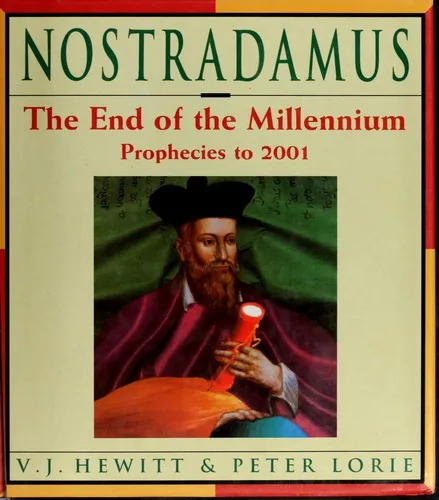
Nostradamus
 75
75

Nostradamus
Hewitt’s "Nostradamus" is a welcome, albeit dry, dissection of the prophet’s enduring mystique. The strength lies in its methodical approach, separating historical fact from interpretive embellishment. While the prose sometimes leans towards academic detachment, the section analyzing the linguistic ambiguities of the quatrains is particularly illuminating. For instance, Hewitt’s careful consideration of how specific phrases could be recontextualized to fit subsequent events highlights the interpretive elasticity that has both sustained and distorted Nostradamus’s reputation. A limitation is the lack of engagement with more recent, speculative interpretations that have gained traction in popular culture since 1992. Nevertheless, for a critical understanding of the historical figure and his work, Hewitt offers a solid foundation.
📝 Description
75
V. J. Hewitt's 1992 study critically examines Nostradamus's prophecies and their historical context.
Published in 1992, V. J. Hewitt's "Nostradamus" offers a critical look at the life and predictions associated with the 16th-century French seer, Michel de Nostredame. The book goes beyond simple collection of his verses, working to place Nostradamus's pronouncements within the specific historical and intellectual climate of his time. Hewitt analyzes the methods employed by Nostredame and evaluates the claims of his predictive powers, presenting a measured view of his lasting influence.
This study is intended for those seriously interested in esoteric history, the study of prophecy, and the Renaissance era. Readers who appreciate the connections between astrology, mysticism, and historical analysis will find a rich amount of information. It is especially useful for individuals seeking a well-supported analysis, rather than sensational interpretations, of Nostradamus's four-line poems.
Hewitt's work emerged in 1992, a time when popular interest in esoteric subjects, including prophecy, saw a resurgence. This period featured numerous popular accounts of Nostradamus, often focused on demonstrating his accuracy with minimal historical scrutiny. Hewitt's book acted as a scholarly counterpoint, drawing on mid-20th century scholarship that began critically assessing the quatrains and their subsequent interpretations, situating Nostradamus within a developing tradition of critical esoteric study.
💡 Why Read This Book?
• Gain a critical perspective on the interpretive challenges of Nostradamus's quatrains, understanding how ambiguity itself became a tool for prophecy validation. • Learn about the historical context of 16th-century prophecy and astrology in France, moving beyond modern sensationalism to grasp the original intellectual climate. • Understand the critical concept of "postdiction" as a lens through which to analyze claims of Nostradamus's predictive accuracy, based on Hewitt's analysis.
⭐ Reader Reviews
Honest opinions from readers who have explored this book.
❓ Frequently Asked Questions
When was V. J. Hewitt's "Nostradamus" first published?
V. J. Hewitt's "Nostradamus" was first published in 1992, a period marked by significant popular interest in esoteric studies and prophetic figures.
What are the primary subjects covered in Hewitt's "Nostradamus"?
The book primarily covers the life, prophecies (quatrains), and historical context of Michel de Nostredame, examining the methods and alleged accuracy of his predictions.
Does the book offer a definitive interpretation of Nostradamus's prophecies?
No, Hewitt's work focuses more on the historical context and interpretive issues surrounding the quatrains, rather than providing a single, definitive interpretation.
What is a 'quatrain' in the context of Nostradamus's work?
A quatrain refers to the four-line verses that form the structure of Nostradamus's prophetic writings, known collectively as the "Centuries."
Is this book suitable for beginners interested in Nostradamus?
Yes, it provides a solid, fact-based introduction that can help beginners distinguish historical analysis from popular speculation about Nostradamus.
What does the book say about Nostradamus's historical accuracy?
The book critically examines claims of accuracy, discussing concepts like postdiction and the inherent ambiguity in the quatrains that allows for retrospective application to events.
🔮 Key Themes & Symbolism
The Ambiguity of Quatrains
Hewitt's work dissects the four-line verses, or quatrains, that constitute Nostradamus's prophetic output. The text emphasizes how the deliberate vagueness, archaic language, and layered symbolism within these verses allowed for a remarkable degree of interpretive flexibility. This ambiguity is presented not as a flaw, but as a key mechanism enabling the prophecies to be applied retrospectively to a vast array of historical events, thereby bolstering Nostradamus's reputation over centuries.
Historical Context and Reception
The book situates Nostradamus within the intellectual currents of the 16th-century Renaissance, a period rife with astrological speculation and religious upheaval. It examines how his work was received by contemporaries and how its interpretation evolved through subsequent eras. Hewitt highlights the shift from initial scholarly engagement to later popular fascination, often divorced from the original context and methods employed by the seer himself in 1555.
Postdiction vs. Prediction
A central theme is the critical distinction between genuine prediction and postdiction. Hewitt explores how many of Nostradamus's purported accurate prophecies are, in fact, examples of postdiction – events interpreted to fit the quatrains after they have transpired. This analysis challenges the notion of Nostradamus as a clairvoyant, framing him instead as a master of allegorical language whose work invites, rather than dictates, specific future outcomes.
The Seer's Method
Hewitt investigates the practical and theoretical underpinnings of Nostradamus's prophetic method. This includes examining his use of astrology, classical texts, and potentially other esoteric traditions. The work aims to understand the approach Nostradamus himself might have employed when composing his visions, moving beyond simple pronouncements of fate to explore the creative and intellectual processes involved in his unique form of foresight.
💬 Memorable Quotes
Direct passages from the work, attributed to the author.
“The quatrains possess a remarkable capacity for reinterpretation.”
— This highlights the core argument that Nostradamus's prophecies are not fixed predictions but rather flexible texts that can be adapted to fit numerous events, a key factor in their enduring appeal.
“The language employed by Nostradamus is intentionally layered and archaic.”
— This refers to the complex linguistic style used in the quatrains, which contributes to their enigmatic nature and allows for multiple readings across different historical periods and cultural contexts.
“Understanding the 16th-century milieu is crucial to assessing the prophecies.”
— This emphasizes the importance of historical context, suggesting that Nostradamus's work must be analyzed within the specific intellectual and social environment of the Renaissance, rather than through a modern lens.
“The legacy of Nostradamus is as much about interpretation as it is about foresight.”
— This captures the essence of Hewitt's critique, arguing that the enduring fame of Nostradamus stems less from verifiable precognition and more from the continuous process of applying his ambiguous verses to unfolding human history.
💡 Key Ideas
Editorial paraphrase of the work's core concepts — not direct quotes.
Historical events often shape the interpretation of prophetic verse.
This paraphrased concept points to the phenomenon of postdiction, where the understanding and perceived accuracy of Nostradamus's writings are heavily influenced by events occurring long after their composition.
🌙 Esoteric Significance
Tradition
Hewitt's work engages indirectly with the Western esoteric tradition, particularly its roots in Renaissance Hermeticism and astrological practices. While Nostradamus himself was primarily an astrologer and physician, his prophetic method draws upon a lineage of divinatory arts and a belief in cosmic influence. The book fits within a tradition of critical inquiry into esoteric figures, seeking to understand their practices and beliefs within their historical and intellectual frameworks, rather than solely accepting them at face value.
Symbolism
The quatrains are rich with symbolic language, often drawing from classical mythology, biblical allusions, and astrological imagery. For instance, animal symbols might represent nations or rulers, while celestial events could signify periods of upheaval or significant change. Hewitt's analysis implicitly touches upon how these symbols, when stripped of their original context, become malleable tools for interpretation, capable of being mapped onto any subsequent historical drama.
Modern Relevance
Contemporary interest in Nostradamus persists, often seen in online communities, alternative history forums, and popular media. While Hewitt's book predates much of the internet's influence, its critical framework remains relevant for dissecting modern interpretations. Thinkers and practitioners who engage with historical divination or explore the psychology of belief and prophecy may find Hewitt's analytical approach valuable for understanding how such figures maintain their allure across centuries.
👥 Who Should Read This Book
• Students of Renaissance history and culture seeking to understand the intellectual climate that produced prophetic figures like Nostradamus. • Esoteric scholars and practitioners interested in a critical examination of divination and prophecy, moving beyond sensationalism to historical analysis. • Comparative religion and philosophy enthusiasts looking to explore the intersection of faith, mysticism, and historical interpretation in Western traditions.
📜 Historical Context
Published in 1992, V. J. Hewitt's "Nostradamus" emerged in an era where interest in apocalyptic literature and prophecy was experiencing a resurgence, partly fueled by New Age philosophies and global anxieties. This period saw a proliferation of popular books that often sensationalized Nostradamus's predictions, frequently without rigorous historical grounding. Hewitt's work aimed to counter this trend by engaging with the critical scholarship that had been developing since the mid-20th century, which sought to contextualize Nostradamus within Renaissance humanism and astrology. While not directly engaging with contemporaries like the historian Frances Yates, whose work on Hermeticism was influential, Hewitt's approach aligned with a broader academic movement to explain figures like Nostradamus by examining their texts and historical circumstances critically. The reception of Nostradamus scholarship has often been bifurcated: academic studies focusing on historical accuracy and textual analysis, and popular interpretations emphasizing predictive power, a divide Hewitt's book navigates by leaning towards the former.
📔 Journal Prompts
The ambiguity of Nostradamus's quatrains and its effect on interpretation.
Michel de Nostredame's position within 16th-century French intellectual life.
The concept of 'postdiction' and its application to prophetic claims.
The historical evolution of interpreting Nostradamus's verses.
The role of symbolic language in prophetic texts like the Centuries.
🗂️ Glossary
Quatrain
A four-line stanza of verse, commonly used by Nostradamus in his prophecies. These verses form the basic unit of his prophetic collection, the "Centuries."
Centuries
The title given to Nostradamus's collected prophecies, which are organized into groups of one hundred quatrains, or "centuries."
Postdiction
The practice of interpreting past events as if they were predicted by a prophecy, often after the events have already occurred, thus appearing to validate the prophecy.
Renaissance Astrology
The practice and belief system surrounding celestial influence on human affairs prevalent during the Renaissance, which informed figures like Nostradamus.
Esotericism
A broad category of spiritual or religious traditions that focus on secret knowledge or practices accessible only to initiated individuals or groups.
Allegory
The use of symbols and metaphorical language to represent abstract ideas or principles, often employed in prophetic and mystical texts.
Divination
The practice of seeking knowledge of the future or the unknown by supernatural means, such as astrology or interpretation of signs.
🔮 Readers Also Liked
Browse all →









More by V. J. Hewitt
All books →
More Free Occult Philosophy Books
View all →