The New Circlemakers
 78
78

The New Circlemakers
Andrew Collins' "The New Circlemakers" offers a compelling argument for viewing crop circles as more than just modern hoaxes or random occurrences. The book's strength lies in its meticulous linking of contemporary formations to the ancient energetic and mythic ley lines of southern England, particularly around sites like Avebury. Collins rightly highlights how these formations often appear in proximity to megalithic monuments, suggesting a continuity of purpose or influence. However, the work occasionally strains to connect disparate phenomena, sometimes presenting suggestive correlations as definitive proof. A particularly striking passage discusses the geometric precision of the circles and their potential relation to astronomical alignments, which Collins interprets as a form of planetary communication. While not definitive, the book provides a valuable perspective for those seeking deeper meaning behind the patterns in the fields.
📝 Description
78
Andrew Collins' 2009 book, The New Circlemakers, connects modern crop circles to ancient English landscapes.
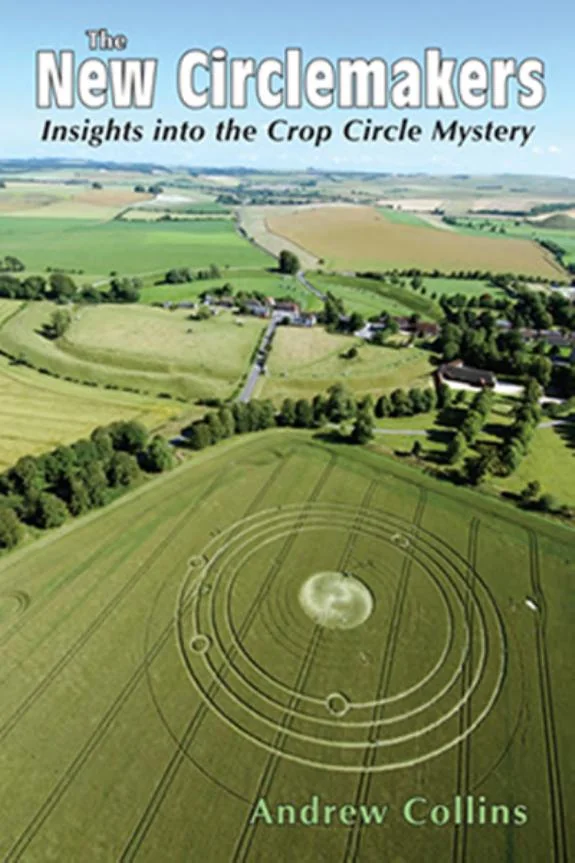
Andrew Collins' 2009 work, "The New Circlemakers," examines crop circles not as isolated modern events but as phenomena linked to southern England's ancient sites. The book posits that these formations share a continuum with places like Stonehenge and Avebury, suggesting connections to older folkloric accounts of aerial events and local fairy lore.
Collins grounds the discussion in the specific geography of southern England, noting that many crop circles appear near Neolithic and Bronze Age activity, particularly on the Salisbury Plain. He highlights the long history of folklore and unexplained aerial sightings in these same rural areas, proposing that a continuity of mystery exists, predating the surge in crop circle reports in the late 20th century.
The central idea is that crop circles might be more than a recent invention; they could be manifestations of an older terrestrial or atmospheric intelligence. Collins considers them as potential signaling devices or markers, perhaps related to ley lines or geomagnetic fields, and explores the possibility of a conscious, creative force behind their creation.
This book fits within traditions that seek to link modern anomalies with ancient earth mysteries and subtle energies. It aligns with researchers who explore consciousness, non-human intelligence, and the Earth's energetic systems, often connecting these to sacred sites and indigenous folklore. Collins' work suggests that phenomena like crop circles are not entirely new but may represent a contemporary expression of enduring terrestrial forces or intelligences that have influenced human perception and spirituality for millennia, particularly in regions rich with megalithic history.
💡 Why Read This Book?
• Understand the geographical and historical resonance of crop circles by exploring their consistent appearance near ancient sites like Stonehenge, a concept detailed in Collins' work. • Investigate the potential link between crop formations and Earth energies, examining Collins' theories on geomagnetic activity and ley lines as conduits for this phenomenon. • Gain a fresh perspective on the symbolism of crop circles, viewing them not as isolated events but as a continuation of ancient patterns and terrestrial intelligence as presented in the book.
⭐ Reader Reviews
Honest opinions from readers who have explored this book.
❓ Frequently Asked Questions
When was Andrew Collins' "The New Circlemakers" first published?
Andrew Collins' "The New Circlemakers" was first published in March 2009, offering a fresh perspective on the crop circle phenomenon.
What is the connection between crop circles and ancient sites according to "The New Circlemakers"?
The book proposes that crop circles are often found in proximity to significant ancient sites in southern England, such as Stonehenge and Avebury, suggesting a link to the landscape's energetic or symbolic significance.
Does "The New Circlemakers" claim crop circles are man-made?
While acknowledging human creation as a possibility, Collins' work primarily explores alternative explanations, focusing on supernatural or intelligent origins connected to the landscape's history and energies.
What role does folklore play in Collins' analysis of crop circles?
Collins integrates local folklore, tales of mysterious lights, and fairy lore associated with crop circle regions, suggesting these historical narratives may hold clues to the phenomenon's origins.
Which specific regions of England are highlighted in the book regarding crop circles?
The book prominently features the landscapes of southern England, particularly the Salisbury Plain and areas around iconic prehistoric sites like Stonehenge, Avebury, and Silbury Hill.
What alternative theories does "The New Circlemakers" present for crop circle formation?
Collins explores theories involving terrestrial intelligence, Earth energies, geomagnetic phenomena, and ancient communication systems, moving beyond simple human causation.
🔮 Key Themes & Symbolism
Ancient Landscapes and Modern Phenomena
The book posits that the modern crop circle phenomenon is deeply intertwined with ancient terrestrial energies and sacred landscapes. Collins meticulously details how many formations appear in close proximity to prehistoric sites like Stonehenge and Avebury in southern England. This geographical correlation suggests that these patterns are not random but are manifestations connected to the energetic ley lines and historical significance of these locations, echoing a continuity of mystery that spans millennia. The work invites readers to reconsider the land itself as a participant in these enigmatic displays.
Earth Energies and Geomagnetic Connections
A core concept explored is the potential role of Earth energies and geomagnetic fields in the formation of crop circles. Collins examines how these natural forces might be harnessed or influenced by an unknown intelligence to create the intricate patterns observed. The work examines theories suggesting that crop circles could be signals or markers related to these energetic grids, drawing parallels with ancient peoples' understanding of terrestrial forces and celestial alignments. This perspective shifts the focus from mere physical causation to a more energetic and subtle interaction with the planet.
Folklore and Mythic Echoes
Collins integrates historical folklore and ancient myths into his investigation of crop circles. He highlights that the very regions where crop circles frequently appear have long been associated with tales of fairies, mysterious lights, and other unexplained aerial phenomena. This suggests that the modern crop circle phenomenon may be a contemporary expression of an ancient, ongoing interaction with non-human intelligences or forces that have been part of human consciousness and local lore for centuries, providing a body of symbolic meaning.
Symbolism and Sacred Geometry
The book analyzes the intricate geometric designs found in crop circles, treating them as a form of sacred geometry. Collins suggests these patterns are not arbitrary but possess a symbolic language, potentially communicating complex information or intentions. By examining the precision and mathematical ratios within the formations, the work proposes that they might represent a form of intelligent communication or planetary art, linking the patterns to ancient cosmologies and the universal principles of design observed in nature and sacred architecture.
💬 Memorable Quotes
Direct passages from the work, attributed to the author.
“The ancient pastures of southern England, haunts of fairies, hobgoblins, and mysterious lights, now grace the majestic crop formations.”
— This statement captures the book's central thesis: linking contemporary crop circles to the deep, often mythical, history of the English countryside, suggesting a continuity of unexplained phenomena.
“Did our ancestors know something about this beguiling, enchanting landscape that we are only beginning to rediscover?”
— This rhetorical question expresses the investigative spirit of the book, prompting readers to consider that ancient knowledge might hold keys to understanding modern mysteries like crop circles.
“Prehistoric landscapes like Stonehenge and Silbury Hill act as ominous backdrops to the crop circle phenomenon.”
— This highlights the geographical focus of Collins' research, emphasizing the deliberate placement of crop circles in areas of profound historical and energetic significance.
“The question remains: are they manmade or supernatural?”
— This direct framing of the central enigma underscores the book's exploration of multiple hypotheses, moving beyond simplistic explanations to consider deeper, perhaps otherworldly, origins.
“The majestic crop formations grace the very same pastures that in the past were the haunts of fairies, hobgoblins, and mysterious lights.”
— This evocative phrasing draws a direct line between the visual evidence of crop circles and the older, folkloric accounts of inexplicable events in the same locations.
🌙 Esoteric Significance
Tradition
Collins' work draws loosely from traditions concerned with terrestrial energies and geomancy, often associated with ley line studies and Earth mysteries. While not strictly adhering to a single lineage like Hermeticism or Theosophy, it aligns with a broader esoteric interest in the Earth as a living, conscious entity. The book explores how ancient cultures may have understood and interacted with these energies, suggesting that crop circles are a modern manifestation of this ancient dialogue, potentially related to a planetary consciousness.
Symbolism
The primary symbols explored are the crop circles themselves, viewed as a form of sacred geometry and intelligent communication. Their geometric precision and recurring motifs are interpreted as a visual language, possibly related to astronomical alignments or energetic patterns. Additionally, the ancient megalithic sites like Stonehenge and Avebury function as symbolic anchors, representing a deep connection to the Earth's history and its energetic grid, suggesting that the circles are placed with deliberate symbolic intent within this context.
Modern Relevance
Contemporary thinkers in fields like consciousness studies, ufology, and archaeoastronomy continue to reference Collins' work. His integrated approach, which bridges folklore, ancient sites, and anomalous phenomena, speaks to those seeking non-reductionist explanations. Practices involving geomancy, dowsing, and the study of Earth energies may find Collins' theories on crop circles as a manifestation of planetary intelligence particularly relevant for understanding subtle environmental forces.
👥 Who Should Read This Book
• Researchers of anomalous phenomena and archaeoastronomy seeking to connect modern mysteries with ancient landscapes. • Enthusiasts of Earth mysteries and ley line theories interested in the energetic significance of geographical locations. • Readers intrigued by the intersection of folklore, mythology, and unexplained aerial events, looking for historical context for modern enigmas.
📜 Historical Context
Published in 2009, "The New Circlemakers" emerged during a period when crop circle research was well-established but often polarized between skeptical debunking and fringe theories. Andrew Collins positioned his work against this backdrop, aiming to provide a more integrated perspective. The era saw continued interest in archaeoastronomy and Earth mysteries, influenced by figures like John Michell and his 1969 book "The View Over Atlantis." Collins' contribution was significant in his deliberate linking of modern crop formations to specific Neolithic sites and their associated folklore, a connection often explored but rarely with such detailed geographical and historical mapping. While not subject to major censorship, the phenomenon itself, and particularly its more 'supernatural' interpretations, existed in a space often dismissed by mainstream archaeology and science, placing works like Collins' in a challenging but fertile intellectual environment.
📔 Journal Prompts
The placement of crop circles near ancient sites like Stonehenge.
Folklore associated with the specific regions where crop circles appear.
The geometric patterns within crop circles as a form of communication.
Personal experiences with mysterious lights or aerial phenomena in rural landscapes.
The concept of Earth energies influencing terrestrial formations.
🗂️ Glossary
Crop Circle
Intricate geometric patterns formed by flattening crops, such as wheat or barley, typically in fields. Their origin is debated, ranging from human-made art to unexplained phenomena.
Ley Lines
Hypothesized straight alignments of ancient sites, natural features, or energy points across the landscape. Often associated with geomantic or spiritual energies.
Geomancy
A form of divination or practice involving the interpretation of Earth energies, patterns in the land, or celestial influences on terrestrial matters.
Archaeoastronomy
The study of how ancient peoples understood celestial phenomena and how this knowledge was incorporated into their cultures, often through monuments and sites.
Megalithic Sites
Prehistoric structures, such as Stonehenge and Avebury, constructed using large stones, often with astronomical alignments and significant cultural or religious purposes.
Terrestrial Intelligence
A concept suggesting that the Earth itself, or specific energies within it, possesses a form of consciousness or intelligence capable of interaction or manifestation.
Sacred Geometry
The study of geometric shapes and proportions considered fundamental to the structure of the universe and often found in religious art, architecture, and natural forms.
This book appears in 1 collection
🔮 Readers Also Liked
Browse all →








From the “Crop Circles” Collection
View all →







More Free Occult Philosophy Books
View all →