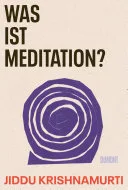
Was ist Meditation?
 73
73

Was ist Meditation?
Krishnamurti’s interrogation of meditation, as presented in this volume, avoids the usual platitudes. He insists on a radical, unmediated seeing of what is, rather than a method to achieve an outcome. The strength lies in his unwavering directness; he compels the reader to confront their own mental landscape without the comfort of familiar spiritual scaffolding. For instance, his discourse on 'the observer and the observed' is particularly sharp, dismantling the dualistic thinking that often hinders true insight. A limitation, perhaps, is that the sheer directness can be demanding, requiring a sustained willingness to question deeply ingrained assumptions about consciousness and self. The work’s insistence on the absence of method, while its greatest asset, might also leave some readers accustomed to structured practices feeling adrift. Nevertheless, it offers a vital corrective to superficial approaches to inner work. It is a challenging, essential text for serious self-inquiry.
📝 Description
73
Jiddu Krishnamurti's 2024 publication directly confronts common meditation misconceptions.
This work by Jiddu Krishnamurti dismantles ritualistic or goal-oriented approaches to meditation. He presents it not as a method for achieving altered states or escaping reality, but as an active, present-moment awareness of consciousness itself. The core practice involves observing the mind's contents—thoughts, emotions, perceptions—without judgment or the desire for control. This stance of pure observation is central to Krishnamurti's teaching.
This book is for anyone questioning their thought processes and the patterns that shape daily life. It appeals to those seeking genuine psychological freedom, not superficial peace. Individuals feeling constrained by conditioning, societal expectations, or internal dialogues will find Krishnamurti's direct inquiry into the mind's mechanics particularly resonant. It addresses the earnest seeker of self-understanding, regardless of prior meditation experience.
Published in 2024, this text stems from Krishnamurti's lifelong engagement with philosophical traditions and his dialogues, notably with physicist David Bohm. His work connects Eastern contemplative insights with Western analytical rigor. The book reinterprets introspective practices, shifting focus from prescribed methods toward a radical self-awareness grounded in the present moment.
Emerging from Krishnamurti's unique interpretations of Eastern thought, this book stands apart from conventional spiritual or psychological frameworks. It draws from traditions that emphasize direct experience and introspection, particularly his dialogues with figures like David Bohm which blended philosophical inquiry with scientific thought. The work challenges established notions of self and consciousness, seeking a radical, unmediated awareness that bypasses dogma and ritual. It offers a path toward self-understanding not through prescribed techniques, but through a profound attention to the workings of one's own mind in the here and now.
💡 Why Read This Book?
• Gain a nuanced understanding of observation as the core of meditation, distinct from goal-oriented techniques, as discussed in relation to Krishnamurti's dialogues with David Bohm. • Discover how to perceive the mechanics of your own conditioning, moving beyond imposed psychological structures by examining the 'observer and the observed' concept. • Cultivate a non-judgmental awareness of your mental content, a direct path to psychological freedom presented as the essence of true meditation.
⭐ Reader Reviews
Honest opinions from readers who have explored this book.
❓ Frequently Asked Questions
What is Jiddu Krishnamurti's core message about meditation?
Krishnamurti posits that meditation is not a technique for achieving a specific state, but an active, choiceless awareness of one's own consciousness and the content of the mind, without judgment or the desire to change it.
How does Krishnamurti's view differ from traditional meditation practices?
He rejects prescribed methods and goals, emphasizing direct perception of psychological patterns and conditioning. His approach is about 'seeing' rather than 'doing' or 'becoming', distinguishing it from practices focused on relaxation or enlightenment.
What is the significance of the 'observer and the observed' in Krishnamurti's work?
Krishnamurti highlights that the perceived separation between the 'observer' (the self) and the 'observed' (thoughts, feelings) is an illusion rooted in conditioning. True insight arises when this division dissolves through pure awareness.
When was Jiddu Krishnamurti most active?
Jiddu Krishnamurti was active as a speaker and writer throughout the 20th century, delivering public talks and dialogues worldwide until his death in 1986. His works continue to be published and studied.
Who were some key intellectual figures Krishnamurti engaged with?
Krishnamurti had significant dialogues with intellectuals such as physicist David Bohm, author Aldous Huxley, and philosopher Jacob Needleman, exploring profound questions of consciousness and human nature.
What is meant by 'conditioning' in Krishnamurti's philosophy?
Conditioning refers to the psychological and social imprints – beliefs, fears, prejudices, habits – that shape our thoughts, feelings, and actions, creating a false sense of self and limiting our perception of reality.
🔮 Key Themes & Symbolism
Choiceless Awareness
This theme centers on the practice of observing one's thoughts, feelings, and perceptions without selection, judgment, or the desire to alter them. Krishnamurti argues that this pure observation, devoid of the 'self' trying to achieve something, is the essence of true meditation. It's about seeing what is, as it is, which inherently dissolves the division between the observer and the observed, leading to a cessation of psychological conflict.
The Dissolution of the Observer
Krishnamurti consistently challenges the concept of a separate, permanent self that acts as the meditator. He suggests that the very act of self-observation, when free from intention or expectation, reveals the illusory nature of this 'observer.' This understanding is crucial for dismantling psychological conditioning, as the perceived 'self' is the primary mechanism through which conditioning operates and perpetuates itself.
Freedom from Conditioning
The book posits that human suffering and conflict stem from deep-seated psychological conditioning—the accumulation of societal norms, beliefs, and past experiences. True meditation, as Krishnamurti describes it, is not about managing or escaping this conditioning, but about understanding its roots through direct perception. This understanding itself is the catalyst for liberation from these ingrained patterns.
The Nature of Thought
Krishnamurti extensively analyzes thought as a process rooted in memory and the past, inherently limited and divisive. He argues that attempting to control or suppress thought through meditation is futile and misses the point. Instead, the focus should be on observing the movement of thought, its origins, and its consequences, thereby revealing its limitations and the possibility of a state beyond its influence.
💬 Memorable Quotes
Direct passages from the work, attributed to the author.
“Meditation is not an escape from the world.”
— This statement reframes meditation away from a tool for disengagement or transcendence. It suggests that genuine meditation involves a heightened awareness of reality, rather than an avoidance of it, implying a deeper engagement with life's challenges.
“The observer is the observed.”
— This core concept challenges the dualistic view of a separate self (the observer) contemplating its own mental content (the observed). Krishnamurti implies that through direct perception, this division collapses, revealing a unified field of consciousness.
“Is it possible to observe without the entity that observes?”
— This question probes the nature of the self and its role in perception. It suggests that the 'self' is a construct that interferes with pure, unmediated awareness, and that true insight begins when this interference ceases.
“Thought is time.”
— This aphorism links the temporal nature of thought to memory and the past. It implies that thought, being a product of what has been, cannot grasp the present moment directly and is inherently bound by the dimension of time.
“When you observe yourself, are you not observing the observer?”
— This rhetorical question pushes the reader to examine the recursive nature of self-observation. It highlights how the act of self-reflection can become another layer of psychological activity, rather than a path to clarity, unless the observer's own nature is understood.
🌙 Esoteric Significance
Tradition
While Krishnamurti engaged with concepts found in Eastern traditions like Vedanta and Buddhism, his work consciously departs from established esoteric lineages. He explicitly rejected the role of guru and any organized spiritual path, including Theosophy, which initially promoted him. His significance lies in offering a direct, non-sectarian path to self-knowledge that bypasses ritual, dogma, and prescribed techniques, aligning more with a radical, existential exploration of consciousness than with specific hermetic or mystical schools.
Symbolism
Krishnamurti's work is notably sparse in overt symbolism, a deliberate choice to avoid the conceptual traps and interpretations that often accompany traditional esoteric systems. Instead of relying on established symbols, he uses direct language to point to the psychological realities of thought, fear, and consciousness. Concepts like 'the observer and the observed' function metaphorically to highlight the inherent dualism in our perception, which he seeks to dissolve through direct awareness, rather than interpreting them as fixed symbolic representations.
Modern Relevance
Krishnamurti's emphasis on mindfulness, the nature of thought, and psychological freedom resonates strongly with contemporary secular mindfulness movements and therapeutic approaches like Acceptance and Commitment Therapy (ACT). Thinkers and practitioners in fields ranging from psychology and neuroscience to contemplative studies continue to draw upon his insights into consciousness, ego-dissolution, and the cessation of suffering, adapting his radical inquiry for modern secular contexts.
👥 Who Should Read This Book
• Individuals questioning the efficacy of traditional meditation techniques and seeking a more direct path to self-understanding. • Students of philosophy and psychology interested in the intersection of Eastern thought and Western analytical approaches, particularly Krishnamurti's dialogues with David Bohm. • Those experiencing psychological distress or conflict who are ready for a profound, non-prescriptive inquiry into the roots of their own conditioning.
📜 Historical Context
Krishnamurti's teachings, particularly his re-examination of spiritual practices like meditation, emerged in the mid-to-late 20th century, a period marked by significant cross-pollination between Eastern philosophies and Western intellectual discourse. Following World War II, there was a growing interest in Eastern thought, partly fueled by figures like Alan Watts and the Beat Generation's embrace of Zen Buddhism. Krishnamurti, however, stood apart from many popularizers. His public dialogues, especially those with physicist David Bohm from the 1960s onwards, sought to integrate scientific inquiry with introspective understanding, challenging traditional spiritual structures and psychological frameworks. Unlike the burgeoning Transcendental Meditation movement or the widespread adoption of Yoga as physical discipline, Krishnamurti's approach was consistently anti-authoritarian and non-dogmatic, demanding a radical, individual inquiry rather than adherence to any guru or system. His initial public emergence dates back much earlier, to the 1920s, but his mature philosophical stance solidified over decades of global lecturing.
📔 Journal Prompts
The nature of the observer: What am I when I am not observing?
Observe the movement of thought without judgment for five minutes.
Identify one instance of your own conditioning influencing your perception today.
What does 'freedom from conditioning' look like in daily action?
Explore the relationship between 'thought' and 'time' in your own experience.
🗂️ Glossary
Choiceless Awareness
The state of observing one's thoughts, feelings, and sensations without judgment, selection, or the intention to change them. It is a state of pure perception, seeing what is without the interference of the 'self'.
Conditioning
The psychological and social imprints, beliefs, fears, and habits that shape an individual's perception and behavior, often creating a false sense of self and limiting freedom.
Observer and Observed
Krishnamurti's concept that the perceived separation between the self (observer) and its thoughts/experiences (observed) is an illusion. True understanding arises when this division dissolves through direct awareness.
Thought
In Krishnamurti's context, thought is primarily seen as a mechanical response rooted in memory and the past, inherently limited and incapable of direct perception of the present moment.
Psychological Freedom
A state of liberation from the constraints of conditioning, fear, and self-imposed limitations. It is achieved not through effort or technique, but through direct insight into the nature of one's own consciousness.
Direct Perception
Seeing or understanding something without the mediation of thought, memory, or interpretation. It is an immediate, unadulterated apprehension of reality.
Time
Krishnamurti distinguishes between chronological (external) time and psychological time (created by thought, memory, and anticipation). He emphasizes that psychological suffering is rooted in this inner sense of time.