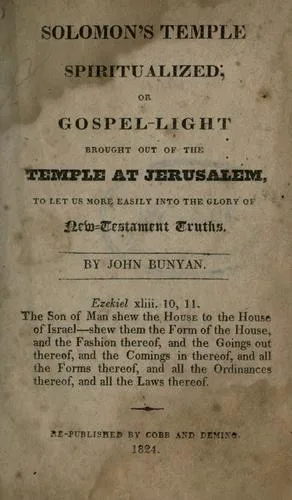
Solomon's temple spiritualiz'd
 79
79

Solomon's temple spiritualiz'd
Bunyan's "Solomon's Temple Spiritualiz'd" offers a compelling, if dense, allegorical framework for understanding the biblical Temple. The book's strength lies in its systematic unpacking of the Temple's symbolism, presenting a coherent spiritual narrative for believers. Bunyan's characteristic directness, honed through his prolific output including "The Pilgrim's Progress," is evident as he maps each architectural element to a facet of the Christian journey. However, the work's primary limitation for modern readers is its unrelentingly didactic tone and the assumed familiarity with Puritan theological concepts and biblical narratives. A specific passage that exemplifies this is Bunyan's treatment of the Ark of the Covenant, which he equates directly with the presence of Christ in the believer's heart, a powerful but potentially exclusive theological assertion. The book serves as a potent reminder of a particular mode of biblical interpretation, but requires sustained engagement.
Verdict: A valuable, if demanding, window into Puritan spiritual exegesis.
📝 Description
79
John Bunyan's "Solomon's Temple Spiritualiz'd" was first published in 1792, long after his death.
This volume is not a guide to ancient architecture but an allegorical reading of the biblical Temple of Solomon. John Bunyan, a prominent Puritan preacher, uses the Temple's structure and furnishings as symbols for spiritual truths and the Christian life. He aims to uncover the inner, spiritual meaning behind the Old Testament descriptions of the Temple.
The book is for readers interested in Puritan theology, Christian allegory, and the symbolic language of scripture. It speaks to those who appreciate historical theological works that connect biblical interpretation with devotional practice. Individuals studying the origins of Christian mysticism or how biblical narratives served spiritual instruction in the post-Reformation era will find it valuable.
Published decades after Bunyan's death in 1688, "Solomon's Temple Spiritualiz'd" comes from a rich tradition of Puritan spiritual writing. This work reflects a common Protestant practice of interpreting Old Testament laws and structures through the lens of Christ's fulfillment in the New Testament.
Bunyan's work fits within the broader esoteric tradition of finding hidden spiritual meaning in physical forms and biblical texts. While rooted in Puritanism, it shares with Christian mysticism the practice of seeing the material world, including biblical accounts, as a veil for divine realities. The allegorical method employed here echoes earlier traditions that sought spiritual correspondences, viewing the Jerusalem Temple not merely as a historical site but as a pattern for the believer's soul and the Church.
💡 Why Read This Book?
• Gain insight into the Puritan method of allegorical interpretation, understanding how figures like John Bunyan saw spiritual truths embedded in Old Testament structures, as demonstrated by his detailed exegesis of the Temple of Solomon's components. • Explore a historical approach to Christian symbolism, learning how concepts like the "Holy of Holies" were understood as representing the believer's direct access to God through Christ, as discussed in the text's spiritualized interpretations. • Appreciate the devotional application of biblical architecture, recognizing how Bunyan transforms the physical Temple into a map for the soul's journey towards spiritual maturity and communion with the divine.
⭐ Reader Reviews
Honest opinions from readers who have explored this book.
❓ Frequently Asked Questions
Is 'Solomon's Temple Spiritualiz'd' about the actual construction of the Temple?
No, the book uses the biblical account of Solomon's Temple as a foundation for spiritual allegory. John Bunyan interprets the physical structure and its elements as symbols representing inner spiritual realities and the Christian life, rather than providing architectural details.
Who was John Bunyan and when did he write?
John Bunyan (1628-1688) was an English Puritan preacher and writer, best known for 'The Pilgrim's Progress'. 'Solomon's Temple Spiritualiz'd' was first published posthumously in 1792, reflecting his theological viewpoints from the late 17th century.
What is the main purpose of spiritualizing the Temple in this book?
The purpose is to reveal the deeper, spiritual meaning behind the Old Testament Temple. Bunyan sought to show how its various parts prefigured Christ, the Church, and the experience of salvation for believers.
Does this book require deep knowledge of the Bible?
While a basic familiarity with the Old Testament accounts of Solomon's Temple is helpful, Bunyan explains his interpretations. However, understanding Puritan theological concepts would enhance the reading experience.
What kind of symbolism does Bunyan use?
Bunyan employs typological symbolism, where elements of the Old Testament (like the Temple) are seen as types or foreshadowings of New Testament realities (like Christ and the Church).
Is this book suitable for beginners in esoteric studies?
It can be, provided the reader is interested in Christian theological allegory and historical religious thought. It's less about occult practices and more about interpreting biblical texts through a spiritual lens.
🔮 Key Themes & Symbolism
The Temple as Inner Sanctuary
Bunyan's central thesis is that the physical Temple of Solomon described in the Hebrew Bible serves as a profound metaphor for the spiritual life of the believer. He systematically dismantles the architectural components—the outer court, the inner court, the Holy Place, and the Most Holy Place—and assigns each a corresponding spiritual meaning. The outer court, for instance, might represent the initial stages of faith and repentance, while the Most Holy Place symbolizes the direct, intimate communion with God achieved through Christ. This interpretation shifts the focus from a historical building to the internal range of the soul, where God's presence is meant to dwell.
Typology and Christocentric Interpretation
The work is deeply rooted in typological exegesis, a method prevalent in early Christianity and revived during the Reformation. Bunyan views the Old Testament Temple and its rituals not as ends in themselves, but as 'types' or prefigurations of New Testament realities, primarily centered on Jesus Christ. The sacrificial system points to Christ's ultimate sacrifice, the High Priest to Christ as the ultimate High Priest, and the Temple itself to Christ as the true dwelling place of God. This Christocentric approach ensures that all interpretations ultimately lead back to the person and work of Jesus.
Spiritual Edification and Practical Piety
Beyond abstract theological discourse, Bunyan aims for the practical spiritual edification of his readers. By understanding the symbolic language of the Temple, believers are encouraged to examine their own spiritual state. The allegorical framework provides a guide for prayer, worship, and growth in holiness. For example, understanding the Temple's cleansing rituals can serve as a call for believers to maintain purity in their own lives. The work thus bridges theological understanding with the imperative for consistent, lived piety in the daily Christian walk.
The Indwelling Spirit
A crucial aspect of Bunyan's spiritualization involves the concept of the Holy Spirit. The presence of God within the Most Holy Place of the physical Temple is interpreted as a symbol of the Holy Spirit's indwelling within the true believer, who becomes a 'temple' of God. This emphasizes the transformative power of the Spirit in enabling believers to live according to God's will and to experience divine presence directly, moving beyond mere outward observance to an internal, spiritual reality.
💬 Memorable Quotes
Direct passages from the work, attributed to the author.
“The Temple, therefore, is the Church, and every true believer is a temple.”
— This statement expresses Bunyan's core argument: the physical structure of Solomon's Temple finds its ultimate spiritual fulfillment in the collective body of believers (the Church) and in each individual Christian, who becomes a dwelling place for the Holy Spirit.
“The Altar... signifies the sacrifice of Jesus Christ.”
— Bunyan uses the altar, where sacrifices were offered in the physical Temple, to represent the atoning sacrifice of Christ. This highlights the centrality of Christ's death for the forgiveness of sins within his allegorical framework.
“The Cherubims that were in the Temple, were to signify the Angels.”
— Interpreting the cherubim figures adorning the Temple, Bunyan connects them to the ministry of angels. This reflects a common theological view of angels as heavenly attendants and messengers, active in God's divine economy.
“The Veil of the Temple… signifies the flesh of Christ.”
— The veil separating the Holy Place from the Most Holy Place, which was torn at Christ's death, is interpreted by Bunyan as symbolizing Christ's physical body. Its tearing represents the opening of a new and living way into God's presence through His sacrifice.
“The Court of the Gentiles… represents the outward profession of religion.”
— Bunyan uses the outermost court, accessible to non-Jews, to symbolize a more superficial or initial engagement with religious practices, contrasting it with the deeper spiritual realities found within the inner sanctums of the Temple.
🌙 Esoteric Significance
Tradition
While rooted firmly in Puritan Protestantism, "Solomon's Temple Spiritualiz'd" engages with esoteric principles through its intense focus on symbolic interpretation and the hidden meanings within sacred texts. It aligns with traditions that see the physical world as a reflection of a spiritual reality, akin to Hermeticism's "As above, so below," though Bunyan's framework is explicitly Christocentric. It departs from more mystical or Gnostic traditions by grounding its symbolism firmly within biblical revelation and orthodox Christian doctrine, rather than speculative cosmology or direct, unmediated mystical experience.
Symbolism
The central symbol is the Temple of Solomon itself, representing the Church and the individual believer as the dwelling place of God. Specific elements carry profound meaning: the Ark of the Covenant symbolizes Christ's presence within the believer; the Altar signifies Christ's atoning sacrifice; the Veil represents Christ's flesh and the access it grants to God's presence; and the Cherubim symbolize angelic ministry. Bunyan systematically decodes these symbols to illustrate the path of salvation and spiritual growth.
Modern Relevance
Contemporary readers interested in spiritual theology, comparative religion, and the history of biblical interpretation find value in Bunyan's work. Scholars of Puritanism and devotional literature utilize it to understand historical approaches to faith. Certain modern Christian contemplative traditions echo Bunyan's emphasis on the indwelling Spirit and the Temple within. Furthermore, its allegorical method can inform esoteric practitioners seeking to understand symbolic systems derived from Abrahamic traditions, albeit requiring careful contextualization within Bunyan's specific theological framework.
👥 Who Should Read This Book
• Students of Puritan theology and 17th-century religious literature, seeking primary source material on biblical interpretation and devotional practice from a key figure. • Readers interested in Christian allegory and symbolism, who wish to understand how biblical structures like the Temple of Solomon were historically interpreted as spiritual maps. • Individuals exploring the history of Western esoteric thought, who want to examine the symbolic and allegorical dimensions present within seemingly orthodox Christian traditions.
📜 Historical Context
Published in 1792, long after John Bunyan's death in 1688, "Solomon's Temple Spiritualiz'd" belongs to the legacy of late 17th-century Puritan thought. This era followed intense religious and political upheaval in England, including the Puritan Revolution. Bunyan's work exemplifies a post-Reformation Protestant approach to biblical interpretation, emphasizing typology and the spiritual application of Old Testament texts. It was a period where theological works were scrutinized; Bunyan himself faced imprisonment for his nonconformist preaching. His allegorical method, while distinct, shared common ground with contemporaries who sought to extract spiritual meaning from scripture, such as John Owen, a prominent theologian of the same era. The work stands as a evidence of the enduring Puritan focus on internal spiritual experience over external ritual, contrasting with the more sacramental theology found in Catholic and some Anglican traditions.
📔 Journal Prompts
The Temple as a symbol for the believer's soul: How does Bunyan's description of the inner courts relate to your personal spiritual practice?
Reflect on the Altar's symbolism in "Solomon's Temple Spiritualiz'd." What does its representation of Christ's sacrifice mean for contemporary understanding of atonement?
Bunyan's interpretation of the Veil: Consider the implications of Christ's flesh as the means to access God's presence.
Analyze the function of the Cherubim in Bunyan's allegorical Temple. What role do divine messengers play in your spiritual life?
The Court of the Gentiles as an 'outward profession': How does this contrast with the deeper spiritual realities Bunyan describes within the Temple?
🗂️ Glossary
Spiritualiz'd
To interpret something (like a physical structure or event) in terms of its inner, symbolic, or spiritual meaning rather than its literal, material form.
Typology
A method of biblical interpretation where persons, events, or institutions in the Old Testament (types) are seen as prefiguring or foreshadowing corresponding realities in the New Testament (antitypes), especially concerning Christ.
Most Holy Place
The inner sanctum of the Tabernacle and Temple, entered only once a year by the High Priest, symbolizing God's immediate presence.
Holy Place
The first chamber of the Tabernacle and Temple, outside the Most Holy Place, containing the altar of incense and the table of showbread.
Cherubims
Angelic beings mentioned in the Bible, often depicted as guardians or attendants of God's presence, featured in the decoration of the Temple.
Altar
A structure upon which sacrifices were offered to God, central to worship in the Old Testament Temple.
Veil
The curtain separating the Holy Place from the Most Holy Place in the Temple, symbolizing the barrier between God and humanity before Christ's sacrifice.
🔮 Readers Also Liked
Browse all →








More by John Bunyan
All books →



More Free Spiritual Development Books
View all →