Jitterbug Perfume
 79
79

Jitterbug Perfume
Robbins' "Jitterbug Perfume" is a novel that truly smells of something else. It’s a daring, often hilarious, and surprisingly poignant exploration of existence itself, refracted through the lens of scent. The premise—a quest for the ultimate perfume that links characters across centuries—is audacious. Robbins’ prose dances with a unique blend of the erudite and the absurd, particularly when describing the sentient pickle, Pancra. The novel’s strength lies in its fearless embrace of the bizarre and its ability to imbue the mundane with profound meaning. However, the sheer density of philosophical digressions and the occasional narrative sprawl can, at times, feel overwhelming, occasionally obscuring the emotional core. The extended discussions on the nature of consciousness and the historical characters' experiences, while fascinating, sometimes detract from the forward momentum. Still, it’s a book that dares to ask big questions with uncommon levity, offering a singular reading experience.
📝 Description
79
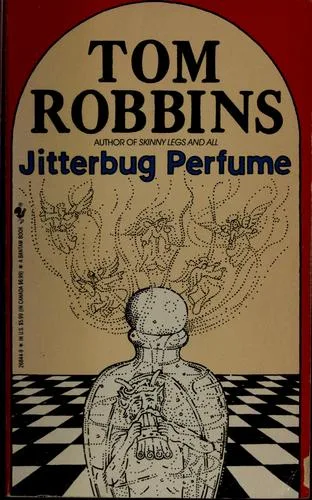
Tom Robbins published Jitterbug Perfume in 1984, a novel that treats scent as a fundamental force.
The novel follows disparate characters across centuries, all connected by their search for an ultimate perfume. These include an 18th-century servant girl, a modern fragrance magnate, and even sentient pickles. The narrative structure weaves these threads together, examining perception, memory, and the nature of existence through the lens of smell. Robbins uses this unique approach to question how we understand reality and our place within it. The book is for readers who enjoy unconventional narratives that blend history, surrealism, and existential thought.
Published in 1984, 'Jitterbug Perfume' touches on ideas of consciousness expansion and alternative philosophies. Its treatment of scent as a spiritual link echoes certain Neoplatonic concepts about emanation and subtle bodies. The novel engages with life's mysteries in a way that reflects a cultural interest in non-rational understanding, a common thread in various esoteric traditions.
💡 Why Read This Book?
• You will learn to perceive the profound metaphysical implications of olfaction, a sense often relegated to the background, as exemplified by the "Great Aromatic" concept, which suggests scent can be a pathway to consciousness itself. • You will gain an appreciation for the potential sentience in the seemingly inanimate, particularly through the character of Pancra the pickle, prompting reflection on the boundaries of life and awareness. • You will experience a unique narrative structure that interweaves historical periods and philosophical musings, illustrating the cyclical nature of existence and the persistent threads of consciousness across lifetimes, as seen in the parallel narratives.
⭐ Reader Reviews
Honest opinions from readers who have explored this book.
❓ Frequently Asked Questions
What is the central philosophical concept in Jitterbug Perfume?
The central concept is the "Great Aromatic," a metaphysical essence of life's fragrance. It suggests that scent is not merely physical but a potent force capable of altering consciousness and revealing deeper truths about existence and interconnectedness.
Who are the main characters and how do they connect?
Key characters include King Victor of Bohemia, his servant girl Aline, and later, the fragrance magnate A.Z. Dehydrated. They are connected across centuries by their search for immortality and the ultimate perfume, illustrating the novel's themes of reincarnation and persistent consciousness.
What historical periods are explored in the book?
The novel spans significant historical periods, notably the late 18th century with King Victor and Aline in Bohemia, and then jumps to the 20th century with A.Z. Dehydrated and the modern-day characters. This allows Robbins to explore the enduring nature of human desires and philosophical questions.
Is Jitterbug Perfume a religious or spiritual text?
While not adhering to any single religion, "Jitterbug Perfume" is deeply spiritual and philosophical. It explores metaphysical concepts like reincarnation, consciousness, and the nature of reality through a unique, often humorous, lens, drawing parallels to various esoteric traditions without explicit affiliation.
What does the book say about immortality?
The book critiques the conventional pursuit of physical immortality, suggesting that true immortality lies in the persistence of consciousness, memory, and the essence of one's being, which can be achieved through profound sensory and existential experiences, as symbolized by the ultimate perfume.
What is the significance of the sentient pickle, Pancra?
Pancra represents Robbins' playful exploration of sentience beyond biological norms. The pickle's consciousness challenges anthropocentric views and underscores the novel's theme that awareness and life's fragrance can manifest in unexpected forms and places.
🔮 Key Themes & Symbolism
The Great Aromatic
Central to the novel is the concept of the "Great Aromatic," an ultimate perfume representing a concentrated essence of life itself. This isn't just a fragrance but a metaphysical force capable of conferring immortality or profound enlightenment. It symbolizes the pursuit of ultimate truth and existence, suggesting that the most profound experiences are tied to the most primal senses. Robbins uses this idea to explore how scent can unlock hidden dimensions of consciousness and memory, connecting individuals across time and space in an olfactory pilgrimage.
Sentience and the Inanimate
Robbins provocatively questions the boundaries of life and consciousness through characters like Pancra, a sentient pickle. This element challenges anthropocentric views, suggesting that awareness can emerge in unexpected forms. The novel implies that the universe is imbued with a latent consciousness, and that even seemingly inanimate objects possess a form of sentience or a unique "fragrance" of existence. This theme invites readers to reconsider their perception of the living world and the interconnectedness of all things.
Cyclical Existence and Reincarnation
The narrative structure, juxtaposing the 18th century with the 20th, highlights the cyclical nature of existence. Characters grapple with past lives and recurring desires, suggesting that consciousness persists and evolves across lifetimes. This concept of reincarnation is not presented as a rigid doctrine but as a fluid, interconnected flow of being. The "Jitterbug Perfume" itself becomes a metaphor for this eternal dance, a scent that transcends mortality and links souls through the ages, emphasizing continuity over finality.
The Power of Scent
Beyond its metaphysical implications, the novel celebrates the sheer power of scent to evoke memory, emotion, and identity. Robbins uses olfactory descriptions to build atmosphere, define characters, and drive the plot. The pursuit of the perfect fragrance becomes a quest for meaning and self-understanding. The book suggests that smell is a direct conduit to the soul, bypassing intellect to tap into deeper, more instinctual aspects of human experience, making it a potent tool for both personal revelation and narrative construction.
💬 Memorable Quotes
Direct passages from the work, attributed to the author.
“The nose knows.”
— A concise, almost proverbial statement highlighting the primacy of smell as a sensory organ, suggesting it possesses an intuitive wisdom or direct access to truth that other senses lack.
“Immortality is the ability to live in the hearts of people who have loved you.”
— This redefines immortality not as physical survival but as a legacy of love and connection. It posits that true lasting existence is found in the impact one has on others, a spiritual continuation rather than biological perpetuity.
“Everything is alive, and everything is alive in the same way.”
— An expression of radical interconnectedness and panpsychism. It suggests a universal animating force or consciousness pervading all existence, blurring the lines between animate and inanimate and promoting a holistic view of reality.
“Perfume is the art that is most closely related to music.”
— This comparison elevates scent to a high art form, linking its ephemeral, evocative, and emotional qualities to those of music. It suggests a shared capacity to stir the soul and transcend literal meaning through abstract composition.
“God is the inventor of the bottle as well as the perfume.”
— This aphorism implies that the divine is responsible for both the container and the contained, the form and the essence, the physical and the metaphysical. It suggests that creation, in its totality, is a divine act.
🌙 Esoteric Significance
Tradition
While not strictly adhering to any single esoteric lineage, "Jitterbug Perfume" echoes themes found in Hermeticism and Neoplatonism concerning the interconnectedness of all things and the subtle energies that bind the cosmos. The concept of the "Great Aromatic" as a life essence and a path to transcendence aligns with alchemical pursuits of potent substances. It also shares Gnostic undertones in its questioning of material reality and the search for hidden, higher truths through sensory and spiritual means.
Symbolism
The "Great Aromatic" serves as a central symbol, representing the ultimate truth, divine essence, or concentrated life force. The act of perfumery itself symbolizes the art of distillation and refinement, both materially and spiritually, akin to alchemical processes. Additionally, Pancra the pickle symbolizes the sentience inherent in all matter, challenging conventional definitions of life and consciousness and pointing towards a universal animating principle.
Modern Relevance
Contemporary interest in mindfulness, sensory awareness, and alternative approaches to well-being resonate with the novel's focus on scent. Thinkers and practitioners exploring consciousness studies, panpsychism, and the intersection of art and spirituality might find Robbins' speculative framework compelling. The book's exploration of interconnectedness also aligns with ecological and holistic philosophies gaining traction in the 21st century.
👥 Who Should Read This Book
• Readers interested in comparative philosophy and esoteric traditions who seek a non-dogmatic exploration of consciousness and metaphysics, appreciating the novel's unique take on scent as a spiritual conduit. • Fans of surreal and absurdist literature who enjoy narratives that blend humor, historical elements, and profound existential questions, particularly those drawn to authors like Kurt Vonnegut or Italo Calvino. • Aspiring writers and artists looking for inspiration in unconventional storytelling, who can learn from Robbins' bold use of metaphor, unique characterization (like Pancra the sentient pickle), and the symbolic power of sensory details.
📜 Historical Context
Published in 1984, "Jitterbug Perfume" arrived amidst a cultural landscape still processing the spiritual explorations and countercultural shifts of the 1960s and 70s. While the New Age movement was gaining momentum, Robbins' work offered a uniquely secular, yet deeply metaphysical, take on consciousness and existence, eschewing New Age jargon for a more direct, often absurdist, engagement with life's big questions. His contemporary, Kurt Vonnegut, also employed dark humor and philosophical musings to critique societal norms and explore humanism, though Robbins leaned more heavily into speculative scent-based metaphysics. The novel's reception was generally positive, appreciated for its originality and wit, though its unconventional themes and structure likely positioned it outside mainstream literary discussions of the era, making it a cult favorite rather than a critical darling of the establishment.
📔 Journal Prompts
The pursuit of the Great Aromatic and its implications for personal transcendence.
Pancra the pickle's perspective on existence and sentience.
The connection between scent, memory, and the cyclical nature of consciousness.
The novel's redefinition of immortality through legacy and connection.
Reflecting on the idea that 'everything is alive, and everything is alive in the same way.'
🗂️ Glossary
Great Aromatic
A metaphysical concept representing the ultimate perfume or concentrated essence of life itself, symbolizing a path to enlightenment, immortality, or profound existential understanding.
Pancra
A sentient pickle who serves as a character in the novel, representing Robbins' exploration of consciousness in unexpected and seemingly inanimate forms.
Olfactory Alchemy
The metaphorical practice of transforming or distilling scents to achieve profound effects, akin to alchemical processes, used here to signify the spiritual and consciousness-altering power of fragrance.
Sentience
The capacity to feel, perceive, or experience subjectively. In the novel, this concept is extended beyond biological life to include objects like pickles.
Cyclical Existence
The philosophical idea that life, consciousness, and events occur in recurring patterns or cycles, often related to concepts of reincarnation and the eternal return.
The Nose Knows
An aphorism within the book suggesting that the sense of smell possesses an intuitive wisdom or direct access to truth that transcends rational thought.
A.Z. Dehydrated
A key character in the modern timeline, a wealthy magnate obsessed with creating the ultimate perfume, representing the drive for immortality and sensory perfection.
🔮 Readers Also Liked
Browse all →









More by Tom Robbins
All books →
More Free Spiritual Development Books
View all →