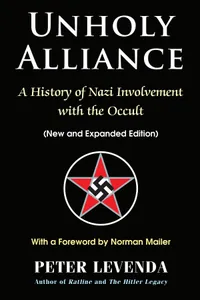
Unholy alliance

 80
80

Unholy alliance
Levenda's "Unholy Alliance" is a dense, ambitious exploration that attempts to map the shadowy connections between occultism and geopolitical machinations. The strength of the book lies in its sheer scope, drawing from a vast array of historical events and esoteric doctrines to construct a compelling, albeit often speculative, narrative. Levenda’s examination of the purported influence of groups like the Thule Society on early 20th-century German politics is particularly detailed. However, the work occasionally suffers from a tendency to present conjecture as established fact, particularly when linking disparate historical figures and movements without sufficient direct evidence. A passage discussing the alleged esoteric motivations behind certain Cold War strategies, while intriguing, feels more like a thought experiment than a grounded historical analysis. Ultimately, "Unholy Alliance" offers a challenging perspective for those interested in the esoteric dimensions of power, but readers should approach its conclusions with a critical eye.
📝 Description
80
Peter Levenda's 2002 book, Unholy Alliance, examines the link between secret societies and political power.
Published in 2002, Peter Levenda's Unholy Alliance investigates the connections between esoteric societies, occult beliefs, and the exercise of political power throughout modern history. The book aims to uncover the influence of certain ideologies, particularly those with roots in esoteric thought, on global events and societal belief systems, often tracing connections that are overlooked by conventional historical accounts.
Levenda's work engages with a tradition of writers who have explored the occult dimensions of historical movements. It delves into how groups like the Thule Society and alleged post-WWII esoteric orders have been interpreted as influential forces. The book is written for readers who are interested in alternative historical perspectives and seek to understand the symbolic and mythological underpinnings of political and social phenomena, moving beyond standard historical narratives.
Unholy Alliance emerges from a lineage of research into the occult roots of historical events and political movements. It engages with the idea that esoteric traditions and secret societies have played a tangible role in shaping world affairs. The book is situated within scholarship that seeks to connect mystical or hidden knowledge systems with observable historical outcomes, questioning purely rational or materialist explanations for significant events.
💡 Why Read This Book?
• Gain insight into the alleged influence of esoteric societies on 20th-century political movements, understanding specific concepts like the Thule Society's purported role in shaping radical ideologies. • Explore the historical connections between Gnosticism and modern political thought, learning how ancient mystical ideas might be reinterpreted and applied to contemporary power structures. • Understand the symbolic underpinnings of conspiracy theories, examining how certain motifs and rituals, originating in older traditions, are allegedly employed within hidden networks.
⭐ Reader Reviews
Honest opinions from readers who have explored this book.
❓ Frequently Asked Questions
What historical periods does Peter Levenda's "Unholy Alliance" focus on?
The book primarily focuses on the late 19th and 20th centuries, examining the rise of esoteric movements and their alleged impact on major political events, particularly in Europe leading up to and during World War II.
Which specific secret societies are discussed in "Unholy Alliance"?
Key societies explored include the Thule Society, the Vril Society, and other alleged occult groups that are often linked to the development of National Socialism and subsequent conspiracy theories.
What is the author's perspective on the relationship between occultism and political power?
Levenda suggests a significant, often hidden, influence of esoteric beliefs and organizations on political events and ideologies. He posits that these hidden forces have played a role in shaping major historical outcomes.
Is "Unholy Alliance" based on factual historical research or speculative theories?
The book blends historical research with speculative interpretation. While it references real historical figures, groups, and events, its central thesis relies on connecting these elements through esoteric doctrines and alleged hidden agendas.
When was "Unholy Alliance" first published?
Peter Levenda's "Unholy Alliance" was first published in 2002, placing it within a period of renewed interest in esoteric history and conspiracy literature.
What kind of esoteric traditions does Levenda draw upon?
Levenda draws upon a range of esoteric traditions, including Gnosticism, Hermeticism, and various forms of occultism and secret society lore that were influential in the late 19th and early 20th centuries.
🔮 Key Themes & Symbolism
Esotericism and Political Movements
The book investigates the alleged intersection of occult doctrines and political ideologies, particularly focusing on the early 20th century. It examines how groups like the Thule Society purportedly utilized esoteric symbolism and beliefs to influence the development of radical political movements. Levenda explores how concepts originating in mystical traditions might be reinterpreted and weaponized within the political arena, suggesting a hidden hand guiding historical events through these obscure channels. The work seeks to uncover the 'unholy alliance' between those pursuing hidden knowledge and those seeking worldly power.
Gnosticism and Modern Ideologies
A significant thread in "Unholy Alliance" is the exploration of Gnosticism's enduring influence on modern thought and political movements. Levenda suggests that certain Gnostic concepts, such as the dualistic worldview and the pursuit of secret knowledge (gnosis) as a means of liberation, have been adapted and employed by various groups throughout history. The book examines how these ancient mystical frameworks might provide a conceptual blueprint for understanding certain political agendas, particularly those that operate outside mainstream rational discourse.
Secret Societies and Hidden History
The work examines the role of secret societies in shaping historical narratives, often positing their existence as orchestrators behind major world events. Levenda scrutinizes alleged connections between various occult orders, including the Thule Society and Vril Society, and their supposed involvement in significant political shifts. The book highlights how these clandestine organizations, through their rituals, symbols, and doctrines, might have provided the ideological underpinnings for actions that profoundly impacted global history, challenging conventional historical accounts.
Symbolism and Archetypes in Power
Levenda analyzes the use and interpretation of symbols and archetypes within esoteric traditions and their alleged application in the pursuit and maintenance of power. The book suggests that ancient symbols, once imbued with spiritual significance, can be repurposed in secular or political contexts to evoke specific psychological responses or to represent hidden agendas. This exploration connects the symbolic language of mysticism with the strategic manipulation of collective consciousness in the political sphere.
💬 Memorable Quotes
Direct passages from the work, attributed to the author.
“Gnostic ideas offered a framework for understanding a world seen as fundamentally flawed, requiring secret enlightenment.”
— This interpretation highlights how the Gnostic worldview, with its emphasis on a corrupt material realm and the necessity of esoteric revelation, provided a lens through which certain historical actors might have viewed and acted upon the world.
“Certain symbols carry a charge that can bypass rational thought, influencing belief and action.”
— This concept emphasizes Levenda's view on the power of esoteric symbolism, suggesting that ancient signs and motifs can retain their potency, capable of affecting individuals and groups on a subconscious or archetypal level, independent of logical comprehension.
“Secret societies acted as conduits for radical ideas, seeding them into the political landscape.”
— This interpretation focuses on the function of clandestine organizations as presented by Levenda, portraying them not just as groups with shared beliefs but as active agents in disseminating challenging concepts that could eventually alter the course of history.
💡 Key Ideas
Editorial paraphrase of the work's core concepts — not direct quotes.
The pursuit of hidden knowledge has always been intertwined with the quest for power.
This paraphrase captures Levenda's core thesis: that esoteric interests and political ambitions are not separate but have historically converged, with occult doctrines potentially serving as a foundation for worldly control.
The history we are taught often obscures the deeper currents of occult influence.
This paraphrase reflects the book's critical stance towards mainstream historical accounts, proposing that conventional narratives fail to acknowledge or deliberately suppress the significant role played by esoteric societies and their ideologies.
🌙 Esoteric Significance
Tradition
The work primarily engages with Western Esotericism, drawing heavily on traditions like Gnosticism, Hermeticism, and the lore surrounding various secret societies of the late 19th and early 20th centuries, such as the Ordo Templi Orientis (OTO) and alleged Nazi occult groups. Levenda positions his work as an attempt to reveal the practical, political applications of these esoteric doctrines, departing from purely philosophical or spiritual interpretations by linking them to concrete historical events and power structures.
Symbolism
Key symbols explored include the Swastika, not merely as a historical emblem but as an ancient symbol imbued with diverse occult meanings potentially appropriated for political ends. The concept of 'Gnosis' itself functions as a symbolic goal—a secret knowledge that offers liberation or power. The idea of the 'hidden hand' or clandestine orchestration represents a pervasive symbolic motif, representing unseen forces directing the course of human events through esoteric means.
Modern Relevance
Contemporary thinkers and practitioners interested in the intersection of mythology, psychology, and political discourse find "Unholy Alliance" relevant. It speaks to modern discussions about the power of narrative, the influence of archetypal imagery in mass media, and the enduring appeal of conspiracy theories. Those studying modern occultism, the history of secret societies, or the philosophical underpinnings of radical ideologies may draw upon Levenda's analyses, though often with critical distance.
👥 Who Should Read This Book
• Researchers of esoteric history and secret societies interested in the alleged links between occultism and 20th-century political movements. • Students of Gnosticism and comparative religion seeking to understand how ancient mystical ideas might have been reinterpreted in modern ideological contexts. • Critical readers of conspiracy literature who wish to engage with a detailed, albeit speculative, examination of hidden power structures and their purported influences.
📜 Historical Context
Peter Levenda's "Unholy Alliance" emerged in 2002, a period marked by widespread public fascination with conspiracy theories and alternative historical interpretations, significantly amplified by the nascent internet. The book taps into a long-standing tradition of esoteric scholarship that seeks to connect mystical movements with tangible political outcomes, a lineage that includes authors like Helena Blavatsky and later figures exploring the occult roots of Nazism. Levenda’s work particularly engages with the intellectual currents surrounding groups like the Thule Society, which gained notoriety for its alleged influence on early 20th-century German politics. This was a time when works exploring secret knowledge and hidden power structures, such as those by authors like Ferdinand Ossendowski, were being re-examined. While mainstream academia largely dismissed such connections as fringe speculation, the public appetite for these narratives, fueled by the post-Cold War era's search for new explanations, was considerable. The book's reception occurred in an environment where the boundaries between historical inquiry and speculative fiction were often blurred.
📔 Journal Prompts
The Thule Society's alleged esoteric doctrines and their potential impact on political movements.
The concept of Gnosis as a driving force behind radical ideologies.
Reflecting on the symbolic power of the Swastika beyond its 20th-century political context.
The historical role of secret societies in disseminating challenging ideas.
Analyzing the archetype of the 'hidden hand' in historical narratives.
🗂️ Glossary
Thule Society
A German occultist and 'völkisch' group founded in Munich in 1918. It is often cited in conspiracy literature as a precursor or influential entity behind the Nazi Party, allegedly promoting esoteric and racial theories.
Gnosticism
A diverse set of religious and philosophical ideas originating in the first few centuries CE. Gnostics believed that salvation came through secret knowledge (gnosis) and often viewed the material world as created by a lesser, flawed deity.
Vril Society
A purported secret society, allegedly connected to the Thule Society, that is said to have explored esoteric and occult theories, including the existence of an ancient subterranean race and powerful energies ('Vril').
Völkisch movement
A broad political ideology in Germany and Austria that emphasized ethnicity, nationalism, and a romanticized, often mystical, view of German folk culture and heritage.
Gnosis
In Gnosticism, gnosis refers to a special, intuitive, often ecstatic knowledge that brings salvation or enlightenment. It is contrasted with empirical or rational knowledge.
Esotericism
Belief systems, practices, and traditions that are characterized by their hidden or inner meaning, often accessible only to a select group of initiates or through specialized study.
Hermeticism
A philosophical and religious tradition based on writings attributed to Hermes Trismegistus. It emphasizes divine wisdom, the interconnectedness of all things, and the pursuit of spiritual knowledge.
🔮 Readers Also Liked
Browse all →









More by Peter Levenda
All books →


More Free Occult Philosophy Books
View all →