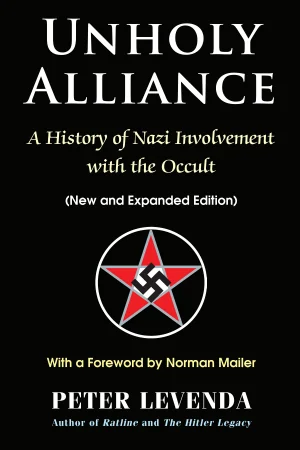
Unholy Alliance
 79
79

Unholy Alliance
Peter Levenda’s Unholy Alliance begins not with abstract theory, but with a chilling personal anecdote: his 1979 detention in Chile by individuals who were neither Chilean officials nor clearly aligned with the ruling regime. This immediate immersion into the book’s core investigation—the post-war survival of Nazi ideology interwoven with occult practices—is its greatest strength. Levenda meticulously unpacks the alleged symbiosis between the Third Reich’s worldview and esoteric traditions, particularly how these ideas might have provided a framework for its radical agenda and subsequent clandestine persistence. A notable limitation is the inherent difficulty in substantiating claims involving secretive organizations, often relying on circumstantial evidence and the interpretation of esoteric symbols. The chapter discussing the alleged activities in the Chilean Andes, stemming from his personal experience, powerfully illustrates the book’s central thesis regarding the potential for occult-infused Nazi elements to persist extraterritorially. Ultimately, Unholy Alliance offers a disquieting perspective on the hidden currents of history.
📝 Description
79
Peter Levenda's 2019 book, Unholy Alliance, investigates the links between Nazi ideology, occultism, and post-war survival.
Unholy Alliance by Peter Levenda is an investigative work that traces connections between Nazism's ideological underpinnings and its post-war survival. Levenda examines alleged links to occult practices and secret societies. His personal experience of being detained and warned away from Chile in 1979 by German nationals, not government agents, sets a tone of urgent inquiry into a dangerous subject.
The book appeals to readers interested in the esoteric dimensions of political history, particularly those who consider occult influences on 20th-century totalitarianism. It is for students of history and mysticism who question official narratives and seek to understand deeper currents that might have shaped world events. Published in 2019, Unholy Alliance revisits the period following World War II, a time rife with speculation about Nazi escape routes and continued clandestine operations. Levenda's investigation into a Chilean colony and torture center in 1979 places the book within a specific historical moment of Cold War tensions and persistent rumors of Nazi networks.
The work postulates that certain occult ideas provided a framework for Nazi ambitions and their post-war continuation. It examines how symbols, rituals, and esoteric philosophies might have been integrated into the Nazi worldview and subsequently propagated through surviving networks, potentially influencing later political and social movements.
This book fits within a tradition of inquiry into the occult dimensions of political history. It examines how esoteric philosophies and secret societies might have intersected with 20th-century ideologies, particularly Nazism. Levenda's work engages with the idea that certain belief systems, beyond conventional political science, could inform or enable extreme political movements and their survival after apparent defeat. It touches on themes often found in literature concerning hidden histories and the influence of non-material forces on historical events.
💡 Why Read This Book?
• Understand the alleged occult underpinnings of Nazi ideology and its post-war continuation, as explored through Levenda's investigation into clandestine networks. • Gain insight into the historical context of 1979 Chile under martial law, a period Levenda personally navigated to uncover these connections. • Examine the potential fusion of esoteric concepts with political movements, a theme vividly presented through Levenda's analysis of Nazi occultism.
⭐ Reader Reviews
Honest opinions from readers who have explored this book.
❓ Frequently Asked Questions
What is the primary focus of Peter Levenda's 'Unholy Alliance'?
The book primarily investigates the alleged connections between Nazi ideology, its post-war survival, and occult ideas and practices. Levenda explores how esoteric beliefs might have influenced Nazism and its clandestine networks.
When and where did Peter Levenda conduct some of his initial investigations for this book?
Levenda traveled to Chile in June 1979, during martial law, to investigate claims about a mysterious colony and torture center in the Andes Mountains linked to these themes.
What personal experience prompted Levenda's investigation in Chile?
Upon arriving in Chile in 1979, Levenda was briefly detained and warned by German nationals, not Chilean officials, that he was not welcome, which spurred his deeper inquiry.
What is the alleged connection explored in 'Unholy Alliance'?
The book posits an 'unholy alliance' between Nazi ideology and occultism, suggesting that esoteric doctrines provided a conceptual basis for Nazi actions and potential post-war continuation.
Who were the individuals that warned Levenda in Chile?
Levenda states that the individuals who detained and warned him in Chile were Germans, not government officials, adding a layer of mystery to their involvement.
What historical period does 'Unholy Alliance' primarily address?
While the book was first published in 2019, its subject matter delves into the post-World War II era, examining the alleged survival and influence of Nazi ideology and occult connections.
🔮 Key Themes & Symbolism
Nazi Occultism
The work critically examines the alleged integration of occult philosophies, symbols, and rituals into the core tenets of Nazi ideology. It posits that these esoteric elements were not merely peripheral but potentially foundational to the movement's worldview, driving its ambitions and providing a framework for its radical agenda. Levenda explores how this perceived 'unholy alliance' may have offered a spiritual or metaphysical justification for Nazi actions and aspirations, extending beyond the conventional understanding of political or military history.
Post-War Nazi Survival
A central theme is the exploration of how elements of Nazi ideology and its associated occult practices may have survived the Third Reich's defeat. The book investigates clandestine networks and rumored havens, such as the alleged colony in the Chilean Andes, suggesting a continued, albeit hidden, influence. Levenda's personal experiences in 1979 Chile serve as a narrative hook, illustrating the persistent, and potentially dangerous, presence of these ideologies and their adherents.
Esoteric Ideological Frameworks
Levenda investigates how occult ideas can be co-opted to form powerful ideological structures, particularly in the context of extreme political movements. The book analyzes the appeal of esoteric doctrines to those seeking radical explanations or justifications for their actions. It questions the boundary between fringe beliefs and mainstream political thought, suggesting that occultism can provide a potent, albeit hidden, engine for historical change and societal disruption.
Personal Investigation and Witness
The narrative is infused with Levenda's own experiences as an investigator, particularly his detention in Chile. This element grounds the speculative nature of the subject matter in lived reality, adding a layer of personal risk and urgency. His firsthand account serves as a proof of the clandestine nature of the subject and the potential dangers involved in uncovering such hidden histories.
💬 Memorable Quotes
Direct passages from the work, attributed to the author.
“He was detained there briefly and released with a warning: 'You are not welcome in this country.'”
— This stark warning, delivered by non-Chilean Germans, underscores the secretive and potentially hostile environment Levenda encountered, emphasizing the clandestine nature of the subjects he was investigating.
“The people who warned him were not Chileans but Germans, not government officials but agents of the as-”
— This fragment from the original blurb points to the mysterious and potentially international character of the forces Levenda encountered, suggesting a network operating outside official state structures.
“The work explores the relationship between Nazi ideology and its post-war survival on the one hand, and occult ideas and practices on the other.”
— This statement clearly defines the book's central thesis: the examination of a supposed 'unholy alliance' between the political extremism of Nazism and the area of the occult.
“Unholy Alliance investigates claims that a mysterious colony and torture center in the Andes Mountains held a key to the relationship between Nazi ideology and its post-war survival.”
— This highlights a specific, intriguing location—a Chilean colony—as a focal point for Levenda's research into how Nazi ideology and occultism may have persisted after World War II.
💡 Key Ideas
Editorial paraphrase of the work's core concepts — not direct quotes.
In June of 1979, Peter Levenda flew to Chile—then under martial law—to investigate claims that a mysterious colony and torture center in the Andes Mountains held a key to the relationship between Nazi ideology and its post-war survival.
This quote captures the book's investigative premise, highlighting Levenda's personal journey into a dangerous geopolitical landscape to uncover alleged links between Nazism, occultism, and post-war survival.
🌙 Esoteric Significance
Tradition
While not strictly adhering to a single esoteric lineage, *Unholy Alliance* draws heavily from discussions surrounding esoteric Nazism, a controversial sub-genre often linking Nazi ideology to Gnostic, Theosophical, and Nordic pagan traditions. Levenda probes how these disparate esoteric concepts might have been synthesized to create a unique, potent ideological framework for the Third Reich, departing from purely academic historical interpretations by focusing on the metaphysical and occult dimensions.
Symbolism
The book likely engages with potent symbols associated with Nazism and occultism, such as the swastika (in its pre-Nazi, various cultural contexts), the SS lightning bolt (Sig runes), and potentially imagery related to Nordic mythology or alchemical concepts. These symbols are examined not merely as historical markers but as carriers of esoteric power or meaning, integral to the alleged occult worldview that underpinned Nazi ambitions and their purported post-war continuity.
Modern Relevance
Contemporary thinkers and practitioners interested in the intersection of political extremism, conspiracy theories, and occultism find resonance in Levenda's work. It speaks to modern concerns about disinformation, the power of fringe ideologies to gain traction, and the historical roots of contemporary extremist movements. Researchers of contemporary esotericism and political occultism may draw upon its analysis of how esoteric narratives can be constructed and disseminated.
👥 Who Should Read This Book
• Students of 20th-century political history interested in non-conventional interpretations of Nazi ideology and its legacy. • Researchers of esoteric traditions and their influence on political movements, seeking to understand the alleged occult dimensions of Nazism. • Readers intrigued by conspiracy theories and clandestine networks, particularly those interested in post-war survival narratives and hidden historical currents.
📜 Historical Context
Published in 2019, Peter Levenda's *Unholy Alliance* revisits the persistent questions surrounding the post-World War II survival of Nazi ideology and its potential entanglement with esoteric beliefs. The book's narrative is anchored by Levenda's personal experience in Chile in 1979, a period marked by Augusto Pinochet's military dictatorship and widespread rumors of Nazi exiles establishing communities. This era was also characterized by intense Cold War paranoia and a global fascination with conspiracy theories, particularly concerning hidden Nazi networks. While authors like Gerald Posner in *Hitler's Death: The Final Enigma* (1999) focused on debunking myths, Levenda examines the ideological and occult dimensions. The book's subject matter intersects with discussions of Thule Society and the Vril Society, esoteric groups often linked, rightly or wrongly, to early Nazi circles. Levenda's work engages with the broader intellectual currents that explore the occult influences on totalitarian movements, contributing to a niche but enduring area of historical inquiry.
📔 Journal Prompts
The warning received in Chile: 'You are not welcome in this country.'
The alleged 'unholy alliance' between Nazi ideology and occult practices.
The concept of post-war Nazi survival networks.
The role of esoteric ideas in shaping political movements.
The investigation into the Chilean colony and torture center.
🗂️ Glossary
Esotericism
A broad category of spiritual, mystical, or magical traditions characterized by their reliance on hidden knowledge, secret teachings, and inner experience, often distinct from mainstream religious or philosophical doctrines.
Occultism
Practices and beliefs associated with the supernatural, the hidden, or the secret, often involving magic, divination, alchemy, and astrology, and sometimes linked to esoteric traditions.
Nazi Ideology
The political and social doctrines of the National Socialist German Workers' Party, characterized by totalitarianism, racial supremacy (especially antisemitism), extreme nationalism, and anti-communism.
Martial Law
The imposition of direct military control over normal civilian functions of government, especially in response to a temporary emergency such as invasion or major natural disaster, or in an occupied territory.
Clandestine Networks
Secret or hidden groups or organizations operating covertly, often for political, intelligence, or criminal purposes, avoiding detection by authorities.
Third Reich
The common name for the period of Nazi Germany from 1933 to 1945, referring to the regime led by Adolf Hitler and the Nazi Party.
Thule Society
A fringe German occultist and Germanic pagan organization founded in Munich in 1918. It is sometimes linked, though often speculatively, to early Nazi circles and their interests in mysticism and racial theories.
This book appears in 1 collection
🔮 Readers Also Liked
Browse all →









From the “Occultism” Collection
View all →





More Free Occult Philosophy Books
View all →