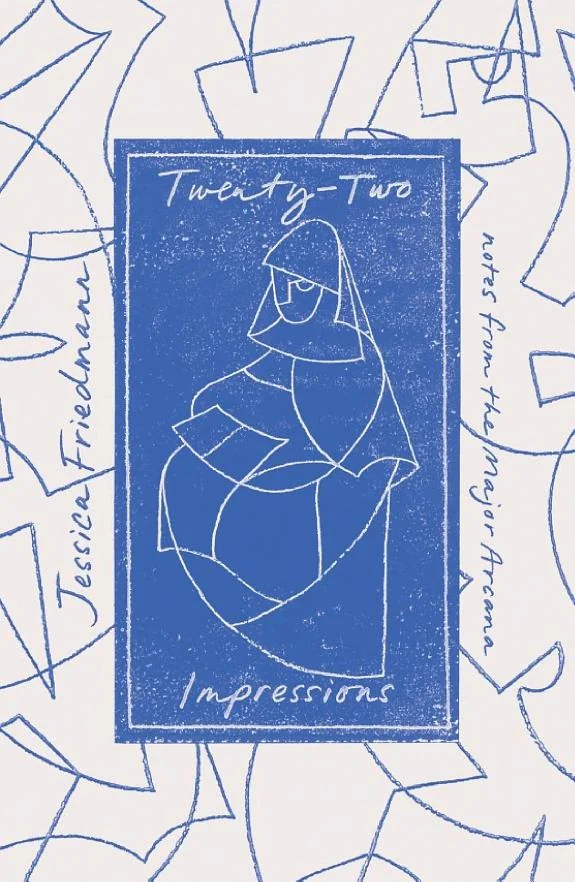
Twenty-Two Impressions
 75
75

Twenty-Two Impressions
Jessica Friedmann’s *Twenty-Two Impressions* offers a refreshing, grounded perspective on the enduring allure of the Tarot de Marseille. Eschewing New Age platitudes, Friedmann instead traces her evolving relationship with the 16th-century deck, grounding its mystical potential in the tangible realities of everyday life. The strength of the collection lies in its lucid prose and the author's keen eye for the subtle ways symbols interact with personal experience. One particularly striking passage discusses the “misrepresentations” of tarot, hinting at the colonial and patriarchal overlays that have shaped its reception. A limitation, perhaps, is that the essayistic structure, while often elegant, can sometimes leave the reader wishing for deeper dives into specific card analyses or historical lineages. Ultimately, Friedmann provides a nuanced, contemporary meditation on an ancient system of seeing.
📝 Description
75
Jessica Friedmann's 2024 book, Twenty-Two Impressions, examines the Tarot de Marseille.
Published in 2024, Twenty-Two Impressions is a collection of essays by Jessica Friedmann. The book focuses on Friedmann's personal engagement with the Tarot de Marseille, a 16th-century card deck significant to occult tarot use. Her personal experience with the cards, from first acquiring a deck to incorporating them into daily life, provides a narrative thread throughout the essays.
This collection suits readers interested in the connections between esoteric symbolism and modern life. It will appeal to those who study tarot, especially the historical Tarot de Marseille, and who prefer an essayistic, poetic style that mixes personal thoughts with intellectual study. People looking to see how old symbolic systems can help understand contemporary issues will find this work relevant.
The Tarot de Marseille, central to this book, has roots in 16th-century Italy and France. This deck represents a key point in tarot image development before the Rider-Waite-Smith deck appeared in the early 20th century. Friedmann's writing discusses this historical deck, its artistic, mythical, and occult aspects, and contrasts it with later versions.
The Tarot de Marseille, originating in the 16th century, stands as a critical historical artifact in the development of tarot imagery. Unlike later decks, its visual language is more directly tied to Renaissance European culture and occult traditions of that era. Friedmann's work revisits this specific deck, drawing connections between its archetypes and contemporary lived experiences. It positions the Tarot de Marseille as a unique lens through which to understand personal meaning-making and symbolic interpretation, separate from more modern, widely circulated tarot systems.
💡 Why Read This Book?
• Gain a practical framework for understanding the Tarot de Marseille beyond divination, inspired by Friedmann's immersion since acquiring her first pack. • Explore the historical evolution of tarot imagery, appreciating the specific context of 16th-century decks and their divergence from later interpretations. • Discover how esoteric symbols, like those found in the Tarot de Marseille, can be applied to navigate the complexities of life in a changing world.
⭐ Reader Reviews
Honest opinions from readers who have explored this book.
❓ Frequently Asked Questions
What is the Tarot de Marseille, and why is it significant in Jessica Friedmann's *Twenty-Two Impressions*?
The Tarot de Marseille is a 16th-century deck, considered foundational for the occult use of tarot. Friedmann uses it as a central point of inquiry, exploring its art, myths, and symbols as they relate to contemporary life.
When was *Twenty-Two Impressions* first published?
*Twenty-Two Impressions* by Jessica Friedmann was first published on October 1, 2024.
What is the primary focus of the essays in *Twenty-Two Impressions*?
The essays focus on the author's personal journey with the Tarot de Marseille, examining its symbolic language, historical context, and its relevance to living in the modern world.
Does the book offer practical tarot reading advice?
While it explores the symbolic depth of tarot, *Twenty-Two Impressions* is primarily an essay collection reflecting on the cards' meaning and personal integration, rather than a how-to guide for readings.
What distinguishes the Tarot de Marseille from other tarot decks mentioned in the book?
The book highlights the Tarot de Marseille's 16th-century origins and its role as the original basis for occult tarot use, contrasting it with later decks and their associated interpretations.
Is *Twenty-Two Impressions* suitable for beginners to tarot?
Yes, the book's approach is accessible, offering a thoughtful exploration of tarot's symbolism and history that can benefit both beginners and experienced practitioners interested in the Marseille tradition.
🔮 Key Themes & Symbolism
Tarot de Marseille as Symbolic Language
This theme centers on the Tarot de Marseille as a visual and symbolic system originating in the 16th century. Friedmann examines how its specific imagery—the archetypal figures, the pip cards, the court cards—functions as a language capable of expressing complex ideas and emotional states. The work explores the historical context of these images, their Renaissance-era roots, and how their visual vocabulary offers a unique lens through which to understand human experience and the world at large. It posits that this ancient deck is not merely a tool for fortune-telling but a rich repository of myth and metaphor.
Personal Integration of Esoteric Practice
Friedmann charts her personal journey with the tarot, illustrating how esoteric tools can become integrated into the fabric of daily life. The book moves beyond theoretical study to explore the lived experience of engaging with symbols, suggesting that consistent interaction with the Tarot de Marseille can foster self-awareness and a deeper connection to one's inner world. This theme highlights the process of making the esoteric accessible and relevant, demonstrating how ancient practices can offer solace, insight, and a unique rhythm to modern existence.
Myth, Symbol, and Misrepresentation
The collection critically engages with the concepts of myth and symbol, particularly concerning the tarot. Friedmann addresses how the meanings and historical understanding of tarot imagery have been subject to various interpretations and, at times, outright misrepresentations over centuries. By focusing on the Tarot de Marseille, she aims to return to a more authentic understanding of these potent symbols, disentangling them from later accretions and exploring their foundational power. This theme underscores the importance of historical accuracy and critical engagement with esoteric traditions.
The Tarot and a Changing World
A core concern of *Twenty-Two Impressions* is the application of tarot symbolism to contemporary challenges. Friedmann explores how the archetypes and narratives within the 16th-century deck can serve as a framework for understanding and responding to the flux of modern life. The essays consider how an ancient symbolic system might offer perspective, resilience, or new ways of seeing amidst societal shifts and personal transformations. It's about finding enduring wisdom within historical imagery to navigate present realities.
💬 Memorable Quotes
Direct passages from the work, attributed to the author.
“The Tarot de Marseille is a 16th-century set of playing cards, the deck on which the occult use of tarot was originally based.”
— This statement firmly establishes the historical and foundational significance of the Tarot de Marseille, setting the stage for Friedmann's focus on this specific deck as the primary subject of her inquiry.
“As tarot became a part of her daily rhythm, Friedmann’s life w...”
— This fragment suggests the book details a personal integration of tarot practice, showing how consistent engagement with its symbols can shape and inform an individual's daily existence and perspective.
“The symbols of the tarot brush up against life in a changing world.”
— This poetic phrase conveys the central thesis: that ancient tarot imagery is not static but actively interacts with and offers commentary on the realities of contemporary existence and societal transformation.
“Friedmann’s life w...”
— Although incomplete, this phrase implies a narrative of personal development and transformation linked to the author's deepening relationship with tarot symbolism and practice.
💡 Key Ideas
Editorial paraphrase of the work's core concepts — not direct quotes.
The unfamiliar images sparked a deep immersion in the art, symbols, myths, and misrepresentations of Renaissance-era tarot.
This quote captures the genesis of Friedmann's exploration, highlighting the initial encounter with the Tarot de Marseille and the subsequent intellectual and symbolic journey it ignited, including a critical look at historical distortions.
🌙 Esoteric Significance
Tradition
This work engages primarily with the Western esoteric tradition, specifically its roots in Renaissance symbolism and the early development of tarot as an occult tool. It situates the Tarot de Marseille as a foundational artifact within this lineage, predating later systematizations like those found in Hermeticism or Theosophy. Friedmann's approach departs from purely divinatory or predictive methods, focusing instead on the symbolic archetypes as a means of understanding consciousness and reality.
Symbolism
Key symbols explored include the Major Arcana figures of the Tarot de Marseille. For instance, the Fool (Le Mat) represents a liminal state of potential and the beginning of a journey, often associated with spontaneity and divine madness. The High Priestess (La Papesse), frequently linked to hidden knowledge and intuition, embodies the mysteries of the unconscious. The World (Le Monde) card signifies completion, integration, and cosmic order, representing the culmination of a cycle within the deck's narrative.
Modern Relevance
Contemporary practitioners of tarot, particularly those interested in the historical Marseille tradition, draw on works like Friedmann's to deepen their understanding. Thinkers exploring the intersection of art, psychology, and esoteric symbolism find her essayistic approach relevant. The book speaks to modern schools of thought that seek to explain and re-contextualize ancient practices for personal growth and philosophical inquiry, moving beyond simplistic fortune-telling.
👥 Who Should Read This Book
• Students of Tarot history: Those seeking to understand the origins and evolution of tarot, with a specific focus on the 16th-century Tarot de Marseille and its divergence from later decks. • Esoteric practitioners: Individuals interested in exploring the symbolic language and archetypal meanings of tarot as a tool for self-reflection and understanding, beyond predictive applications. • Readers of literary essays: Those who appreciate thoughtful, poetic prose that blends personal experience with intellectual inquiry into art, myth, and historical symbolism.
📜 Historical Context
The Tarot de Marseille, a central focus of *Twenty-Two Impressions*, emerged in 16th-century Italy and France, predating the more commonly known Rider-Waite-Smith deck by centuries. This era was a fertile ground for symbolism, alchemy, and burgeoning occult philosophies, often intertwined with Renaissance humanism. The deck's visual style and structure represent a critical stage in the development of tarot imagery before its widespread occult applications were codified, particularly in the 18th and 19th centuries by figures like Eliphas Lévi. Friedmann's work engages with this specific historical lineage, contrasting the Marseille deck's inherent symbolism with later interpretations and popularizations. While not directly engaging with contemporaries like Athanasius Kircher or Giordano Bruno, her exploration of symbolic systems places her work within the broader intellectual current of Renaissance thought and its enduring influence on esoteric traditions.
📔 Journal Prompts
The symbols of the Tarot de Marseille as a language for contemporary life.
Reflecting on the 'misrepresentations' of tarot imagery across history.
How the daily rhythm of engaging with tarot impacts personal perspective.
The Renaissance-era context of the Tarot de Marseille's visual lexicon.
Connecting the archetypal figures to modern challenges and transformations.
🗂️ Glossary
Tarot de Marseille
A specific style of tarot deck originating in 16th-century Italy and France, characterized by its distinct imagery and artistic style, considered foundational for occult tarot traditions.
Major Arcana
The set of 22 trump cards in a tarot deck, each depicting an archetypal figure or concept, representing significant life events and spiritual lessons.
Occult
Relating to mystical, supernatural, or magical powers, practices, and phenomena; often refers to hidden knowledge or esoteric disciplines.
Archetype
A very typical example of a certain person or thing; in psychology and mythology, a universal, inherited pattern of thought or imagery derived from the experience of the species.
Symbolism
The use of symbols to represent ideas or qualities; in the context of tarot, the visual elements and their deeper meanings within the cards.
Renaissance
The period in European history, roughly from the 14th to the 17th century, marked by a revival of classical art, architecture, and literature, and a flourishing of intellectual and artistic inquiry.
Divination
The practice of seeking knowledge of the future or the unknown by supernatural means; tarot is often used for this purpose.
This book appears in 1 collection
🔮 Readers Also Liked
Browse all →








From the “Major Arcana” Collection
View all →









More Free Occult Philosophy Books
View all →