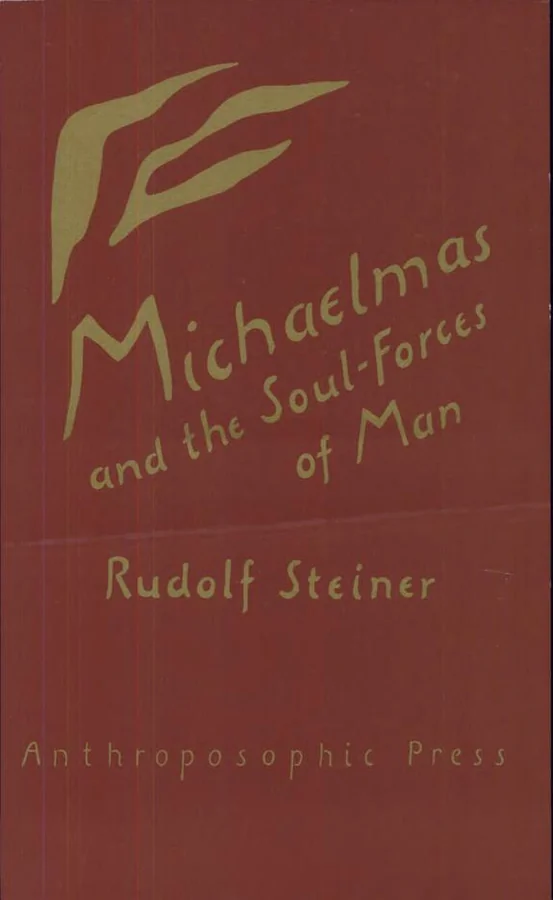
Michaelmas and the Soul Forces of Man
 76
76

Michaelmas and the Soul Forces of Man
Steiner's 1923 lectures on Michaelmas and the soul forces offer a potent antidote to the isolating tendencies of modern life. He directly confronts the 'hermit-like existence' many experience, urging a reconnection with cosmic citizenship through the active engagement with Michaelic forces. The strength of this work lies in its direct, almost urgent, call to spiritual reawakening, framing Michael not as a distant entity but a present helper in our evolution. A particular point of interest is Steiner's explanation of how expanding one's 'horizon of life into the breadth of the world' is not merely metaphorical but a tangible spiritual practice. However, the esoteric terminology, while rich for initiates, can present a steep learning curve for newcomers, requiring careful study of Anthroposophical concepts. The limitation is the density of the material, demanding focused attention. Ultimately, these lectures serve as a vital reminder of our cosmic heritage and the active spiritual forces available to us.
📝 Description
76
In Vienna, September 1923, Rudolf Steiner lectured on the soul forces of man.
These four lectures, delivered in the final week of September 1923, address humanity's need to perceive spiritual realities beyond a limited, earthbound view. Steiner suggests that modern life can isolate individuals, cutting them off from cosmic connections. The talks aim to awaken a broader spiritual awareness, urging listeners to recognize their place as beings connected to the wider universe.
This work is for those who wish to understand the spiritual forces shaping human consciousness and its relationship to the cosmos. It will resonate with readers interested in Anthroposophy, esoteric Christianity, and applying spiritual science to everyday life. Individuals wrestling with materialism and seeking a unified worldview will find it particularly relevant. Steiner encourages a conscious engagement with higher spiritual realities as a way to transcend the constraints of a purely materialistic outlook.
Rudolf Steiner delivered these lectures in 1923, a period marked by significant spiritual inquiry in post-war Europe. As a central figure in esoteric thought, he responded to anxieties about scientific materialism and a perceived loss of spiritual connection. His work presented an alternative cosmological understanding, drawing from Theosophy and earlier traditions while developing his unique Anthroposophy.
💡 Why Read This Book?
• Understand the role of the Archangel Michael as a conscious force in human evolution, as presented in Steiner's lectures from 1923, offering a unique perspective beyond traditional religious interpretations. • Learn practical methods for expanding your 'horizon of life into the breadth of the world,' a key concept for overcoming modern alienation and achieving cosmic awareness. • Discover how to become a 'citizen of the cosmos' by consciously working with specific soul forces, as detailed in these Vienna lectures (CW 223).
⭐ Reader Reviews
Honest opinions from readers who have explored this book.
❓ Frequently Asked Questions
What is the central theme of Rudolf Steiner's 'Michaelmas and the Soul Forces of Man'?
The central theme is the need for humanity to reconnect with cosmic realities and overcome a sense of isolation by actively engaging with the spiritual forces represented by the Archangel Michael, particularly during the Michaelmas season.
When were these lectures by Rudolf Steiner originally delivered?
These four lectures were delivered by Rudolf Steiner in Vienna between September 27 and October 1, 1923.
What does Steiner mean by 'citizen of the cosmos'?
Steiner uses 'citizen of the cosmos' to describe an individual who has developed conscious awareness of their connection to the spiritual worlds and cosmic processes, moving beyond a purely earthly, materialistic perspective.
How does the figure of Archangel Michael relate to human soul forces in Steiner's work?
Steiner presents Michael as a guiding intelligence for humanity's evolution, embodying forces that can help individuals develop their inner capacities and spiritual perception, thereby strengthening their soul forces.
Is 'Michaelmas and the Soul Forces of Man' suitable for beginners in Anthroposophy?
While accessible, the book assumes some familiarity with Anthroposophical concepts. Beginners may benefit from supplementary reading or study groups to fully grasp Steiner's specific terminology and cosmological framework.
What is the significance of Michaelmas in Rudolf Steiner's teachings?
In Steiner's teachings, Michaelmas (around September 29th) is a significant period marking a spiritual turning point, associated with the Archangel Michael and the strengthening of human will and spiritual courage against materialistic forces.
🔮 Key Themes & Symbolism
Cosmic Citizenship
Steiner frames human existence as needing to transcend a purely terrestrial identity to become 'citizens of the cosmos.' This involves understanding and participating in the spiritual realities that govern the universe. The lectures from 1923 emphasize that this is not an abstract ideal but a developmental task achievable through conscious spiritual work, particularly by expanding one's perception beyond the immediate physical environment to encompass the broader cosmic order.
The Role of Archangel Michael
The Archangel Michael is presented as a key spiritual being actively involved in human evolution. He represents forces of courage, clarity, and spiritual insight, particularly potent during the Michaelmas season. Steiner explains that by consciously working with Michaelic energies, individuals can strengthen their soul forces and read through the challenges of modern materialistic consciousness, fostering a direct connection to the spiritual hierarchy.
Overcoming Modern Alienation
Steiner diagnoses a prevalent 'hermit-like existence' stemming from contemporary materialism and a limited worldview. The lectures propose a path to overcome this spiritual isolation by re-establishing a living connection with the cosmos. This involves recognizing and engaging with the invisible spiritual forces that permeate existence, thereby reintegrating the human being into the larger cosmic and spiritual fabric.
Soul Forces and Spiritual Development
The book explores the specific 'soul forces' within human beings and how they are influenced by cosmic rhythms and spiritual beings like Michael. Steiner outlines how through specific contemplative practices and an expanded consciousness, these forces can be awakened and directed towards spiritual growth, enabling individuals to perceive higher realities and fulfill their cosmic destiny.
💬 Memorable Quotes
Direct passages from the work, attributed to the author.
“How shall man, the earth citizen, once more become a citizen of the cosmos?”
— This foundational question sets the stage for the entire lecture series, highlighting the perceived disconnect between humanity's terrestrial existence and its inherent cosmic nature, posing a challenge for spiritual reorientation.
“The expansion of life's horizon into the breadth of the world”
— This phrase captures Steiner's call to move beyond a narrow, self-contained existence. It suggests a conscious effort to perceive and engage with the wider spiritual and cosmic realities that surround and permeate human life.
“The forces of the Archangel Michael... are always present and prepared to help us.”
— This emphasizes Michael's active and accessible role in assisting human spiritual development, portraying him not as a distant deity but as a tangible source of support for those seeking to overcome material limitations.
“Overcome today's hermit-like existence.”
— Steiner uses this powerful metaphor to describe the spiritual isolation and detachment characteristic of modern consciousness, urging readers to break free from this self-imposed confinement.
“The path to becoming true citizens of the cosmos”
— This points towards a practical, evolutionary trajectory rather than a passive state. It implies that achieving cosmic citizenship is an active process requiring dedicated effort and engagement with specific spiritual principles and forces.
🌙 Esoteric Significance
Tradition
Steiner's work builds upon the Western esoteric tradition, particularly drawing from Gnosticism, Hermeticism, and Kabbalah, while synthesizing these with his unique Anthroposophical framework. He reinterprets Christian mysteries and angelic hierarchies through a lens of spiritual science, aiming to provide a scientifically rigorous path to the supersensible, distinct from earlier Theosophical movements.
Symbolism
The Archangel Michael is a central symbol, representing the forces of light, courage, and the spiritual vanguard of human evolution, especially relevant during the autumn season. The concept of 'cosmic citizenship' symbolizes humanity's inherent connection to the universe beyond the physical, a state to be consciously re-attained. The 'horizon of life' metaphorically represents the boundaries of consciousness, which Steiner urges readers to expand into the spiritual realms.
Modern Relevance
Contemporary Anthroposophists and individuals interested in spiritual psychology continue to draw on Steiner's insights into soul forces and cosmic influences. His ideas on overcoming materialism and fostering spiritual awareness are relevant to modern movements seeking holistic approaches to education (Waldorf schools), medicine, and social renewal, offering a counterpoint to purely secular or scientific worldviews.
👥 Who Should Read This Book
• Students of Anthroposophy seeking a deeper understanding of Michaelic forces and their connection to human consciousness, particularly as presented in Steiner's lectures from the 1920s. • Esoteric practitioners interested in developing their inner capacities and spiritual perception, offering specific concepts like expanding the 'horizon of life.' • Individuals grappling with modern materialism and seeking a spiritual framework to reintegrate their understanding of humanity's place in the cosmos.
📜 Historical Context
Delivered in Vienna in 1923, these lectures by Rudolf Steiner occurred during a period of profound social and spiritual flux in post-World War I Europe. Steiner, already a significant figure through his earlier work in Theosophy and the founding of Anthroposophy, was responding to a growing sense of existential unease and the dominance of materialistic scientific thought. Competing schools of thought, such as Spiritualism and various occult revival movements, offered different answers to humanity's spiritual questions. Steiner's approach, rooted in a specific methodology of spiritual research, sought to provide a verifiable path to the supersensible. His contemporary, G.I. Gurdjieff, was also offering challenging spiritual disciplines to Western audiences, though with a distinct emphasis. Steiner's work aimed to equip individuals with the inner faculties to perceive spiritual realities directly, positioning Michaelmas as a key time for cultivating specific soul forces related to cosmic awareness.
📔 Journal Prompts
The earth citizen's path to cosmic citizenship.
Michael's presence as a force for spiritual development.
Expanding the horizon of life beyond physical perception.
The nature of the 'hermit-like existence' in modern consciousness.
Cultivating specific soul forces for cosmic connection.
🗂️ Glossary
Anthroposophy
A spiritual philosophy founded by Rudolf Steiner, seeking to understand the spiritual nature of the human being and the universe through 'wisdom of the human being' (anthropos-sophia).
Archangel Michael
In Steiner's cosmology, a spiritual hierarchy figure embodying forces of courage, clarity, and leadership, vital for human evolution and spiritual awakening, particularly active during the autumn.
Cosmic Citizenship
The state of conscious awareness and participation in the spiritual and cosmic processes of the universe, transcending a purely terrestrial or materialistic viewpoint.
Soul Forces
The specific capacities and energies within the human being that relate to consciousness, feeling, and spiritual perception, which can be consciously cultivated and directed.
Hermetic Existence
A term used by Steiner to describe a narrow, isolated, and self-contained mode of living, characteristic of modern consciousness detached from broader spiritual or cosmic connections.
Michaelmas
A Christian feast day (September 29th) that Steiner imbues with specific spiritual significance related to the Archangel Michael and the strengthening of human will and spiritual courage.
CW 223
Abbreviation for 'Gesamtausgabe' (Collected Works) volume 223, containing the lectures from Vienna, September 27-October 1, 1923.
This book appears in 1 collection
🔮 Readers Also Liked
Browse all →







From the “Anthroposophy” Collection
View all →





More Free Theosophy & Anthroposophy Books
View all →