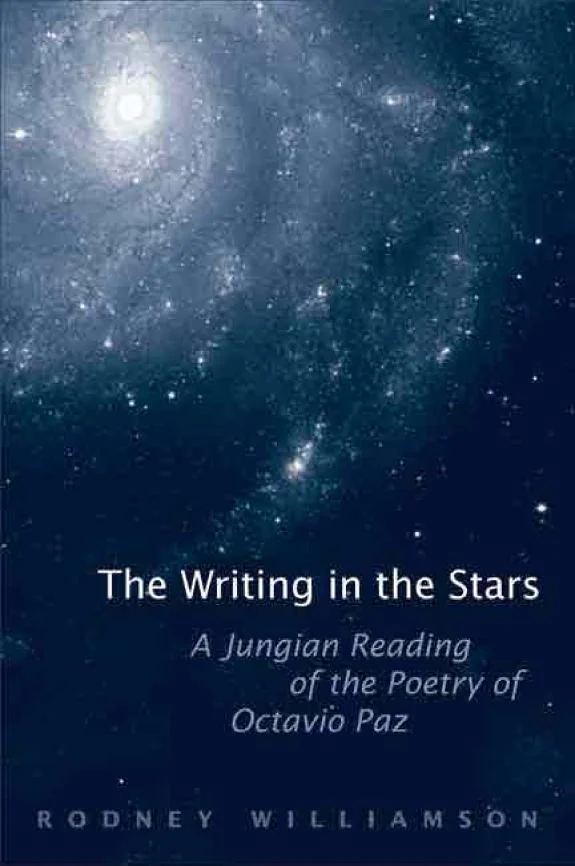
The Writing in the Stars
 81
81

The Writing in the Stars
Rodney Williamson's The Writing in the Stars bravely tackles the ambitious project of bridging the worlds of Octavio Paz's poetry and Carl Jung's analytical psychology. The book’s greatest strength lies in its meticulous textual analysis, meticulously aligning specific images and structural patterns in Paz's major poems with established Jungian concepts. For instance, Williamson's interpretation of Paz's exploration of Mexican identity through the lens of Jungian individuation offers a fresh perspective. However, the work occasionally suffers from an overly dense academic style, which may deter readers not already well-versed in both literary criticism and Jungian theory. A more accessible introduction to some of the more esoteric Jungian ideas might have broadened its appeal. Despite this, the study provides a valuable lens for understanding the psychological underpinnings of Paz's celebrated verse. It is a significant contribution to Pazian scholarship.
📝 Description
81
Rodney Williamson's 2007 book links Octavio Paz's poetry to Carl Jung's psychology.
The Writing in the Stars examines the poetry of Nobel laureate Octavio Paz, proposing a connection between his work and Carl Jung's psychological theories. Rodney Williamson analyzes the structure and imagery in Paz's poems, drawing parallels to Jungian archetypes and concepts. He identifies figures like the Anima, the Shadow, and the Wise Old Man within Paz's writing, explaining recurring symbols such as masks and labyrinths through Jung's ideas of the collective unconscious and individuation. This comparative analysis aims to reveal new interpretations of Paz's literary output. The book is aimed at students and scholars of literature, comparative mythology, and depth psychology. It will also interest readers of post-colonial literature, especially Latin American writers like Paz, and those familiar with Jung's analytical psychology. Williamson's work addresses a gap in criticism that had only previously hinted at Jungian influences on Paz.
This work sits within a tradition of Jungian analysis applied to literature and culture. It follows a path traced by scholars who seek universal patterns and psychological structures in artistic expression. By connecting the symbolic language of Octavio Paz to Jung's concepts, Williamson engages with the broader esoteric interest in the archetypal underpinnings of human creativity and consciousness. The book contributes to understanding how mythic patterns and psychological forces manifest in modern poetry, a pursuit common in depth psychology and comparative mythology.
💡 Why Read This Book?
• Gain a novel analytical framework for Octavio Paz's Nobel Prize-winning poetry by understanding its parallels with Carl Jung's theories, specifically how concepts like the collective unconscious manifest in Paz's use of recurring symbols. • Explore the psychological dimensions of Mexican identity as depicted by Paz, illuminated through a Jungian lens, offering insights beyond conventional literary analysis. • Understand the interplay between literature and psychology by examining how specific archetypal images, such as those related to masks and labyrinths discussed in the book, function in both Paz's writing and Jung's model of the psyche.
⭐ Reader Reviews
Honest opinions from readers who have explored this book.
❓ Frequently Asked Questions
What is the primary argument of Rodney Williamson's The Writing in the Stars?
The book argues that the major poems of Nobel laureate Octavio Paz exhibit significant structural and imagistic connections to the psychological theories of Carl Jung, particularly his concepts of archetypes and the collective unconscious.
When was Octavio Paz born and when did he win the Nobel Prize?
Octavio Paz was born in Mexico City in 1914 and was awarded the Nobel Prize in Literature in 1990.
Does The Writing in the Stars assume prior knowledge of Carl Jung?
While familiarity with Jungian concepts is beneficial, the book aims to explore these connections comprehensively. However, readers with some background in Jung's analytical psychology will likely find the analysis more readily accessible.
What kind of literary analysis does Rodney Williamson employ?
Williamson employs a comparative literary analysis, juxtaposing the structural elements and recurring imagery in Octavio Paz's poetry with established theories from Carl Jung's depth psychology.
What are some recurring images in Paz's poetry discussed in relation to Jung?
The book explores symbols such as masks, labyrinths, and images related to duality and identity, interpreting them through the framework of Jungian archetypes like the Persona and the Shadow.
Who is Octavio Paz and why is his work significant?
Octavio Paz (1914-1998) was a Mexican writer, poet, and diplomat, celebrated for his exploration of Mexican identity, language, and culture, culminating in his 1990 Nobel Prize in Literature.
🔮 Key Themes & Symbolism
Paz's Archetypal Imagery
The work meticulously identifies recurring symbols and motifs within Octavio Paz's poetry that align with Carl Jung's archetypal framework. This includes exploring how Paz utilizes imagery of masks to represent the persona, labyrinths to symbolize the journey into the unconscious, and dualities to reflect internal psychic conflicts, all interpreted through a Jungian lens as expressions of the collective unconscious and the individuation process.
Jungian Individuation in Poetry
Williamson posits that Paz's poetic explorations of identity, particularly Mexican identity, can be understood as a form of psychological individuation. The book examines how Paz grapples with the integration of the conscious and unconscious aspects of the self, mirroring Jung's concept of becoming a whole individual by confronting the shadow and integrating other archetypal forces within the psyche.
Literary-Psychological Synthesis
This book represents a significant effort to synthesize literary criticism with depth psychology. It demonstrates how analytical psychology can provide a powerful interpretive tool for understanding the deeper psychological currents and symbolic language present in complex poetic works, moving beyond surface-level thematic analysis to explore underlying psychic structures.
The Collective Unconscious in Art
The Writing in the Stars explores how Octavio Paz's poetry serves as a conduit for the collective unconscious. Williamson suggests that the universal resonance of Paz's imagery, particularly his engagement with Mexican myths and symbols, taps into shared human psychological patterns described by Jung, making his work a profound expression of humanity's shared psychic inheritance.
💬 Memorable Quotes
Direct passages from the work, attributed to the author.
“The structure and recurring images of Paz's major poems can be illuminated by Carl Jung's ideas.”
— This core statement expresses Williamson's thesis: that a deep, structural connection exists between Paz's poetic output and Jungian psychology, suggesting that Jung's analytical framework offers a key to unlocking new layers of meaning in Paz's work.
“The symbol of the labyrinth in Paz's poetry signifies a descent into the unconscious.”
— This interpretation frames a specific poetic image, the labyrinth, as a symbolic representation of the introspective and potentially perilous journey into the depths of the psyche, a journey central to Jungian analytical psychology.
“A comprehensive study linking Paz and Jung had not yet been undertaken prior to this work.”
— This statement emphasizes the academic novelty and importance of Williamson's research, positioning the book as a pioneering effort to systematically connect two seemingly disparate but ultimately compatible intellectual domains.
“Masks in Paz's work represent the social facade or persona.”
— This specific interpretation connects Paz's recurring use of the mask motif directly to Jung's concept of the persona, the social mask individuals wear, suggesting an underlying psychological exploration of authenticity versus societal expectation in Paz's poetry.
💡 Key Ideas
Editorial paraphrase of the work's core concepts — not direct quotes.
Paz's exploration of identity often reflects Jungian concepts of the persona and shadow.
This paraphrase highlights how the book interprets Paz's poetic treatment of selfhood and societal roles through the lens of Jung's psychological constructs, suggesting that Paz consciously or unconsciously engaged with these fundamental aspects of human personality.
🌙 Esoteric Significance
Tradition
While not explicitly aligning with a single esoteric lineage like Hermeticism or Gnosticism, The Writing in the Stars functions within the broader esoteric tradition of depth psychology's application to cultural and artistic expression. It draws heavily from Jungian psychology, which itself incorporates alchemical symbolism and Eastern philosophies, positioning the book as a bridge between psychological interpretation and the symbolic language often found in esoteric thought.
Symbolism
The book critically examines symbols like the mask and the labyrinth within Paz's poetry. In esoteric traditions, masks can represent illusion or the veiling of true essence, while labyrinths often symbolize the soul's journey or the complex path to enlightenment. Williamson interprets these through a Jungian lens, linking them to the persona and the unconscious, revealing how Paz's work engages with universal symbolic languages of transformation and self-discovery.
Modern Relevance
Contemporary thinkers in fields ranging from comparative mythology to archetypal psychology continue to find value in Williamson's approach. His work informs modern interpretations of Latin American literature through a psychological lens and speaks to practitioners of Jungian analysis seeking to understand the symbolic expressions of the collective unconscious in diverse cultural contexts, including the works of figures like Paz.
👥 Who Should Read This Book
• Literary scholars specializing in Latin American literature, particularly the works of Octavio Paz, seeking a novel analytical framework. • Students and practitioners of Jungian psychology interested in applying archetypal theories to contemporary poetry and cultural analysis. • Readers of comparative literature and mythology who explore the connections between symbolic systems across different cultural and intellectual traditions.
📜 Historical Context
The Writing in the Stars, published in 2007, arrived during a period of robust interdisciplinary scholarship, yet the specific nexus of Octavio Paz's poetry and Carl Jung's analytical psychology remained a relatively underexplored academic territory. Octavio Paz, a towering figure in 20th-century literature and thought, received the Nobel Prize for Literature in 1990, cementing his global intellectual standing. His work, deeply engaged with Mexican culture, language, and history, also showed influences from movements like Surrealism. While literary critics had previously noted Jungian undertones in Paz's writings, Rodney Williamson's book aimed to provide the first comprehensive study. This work emerged in contrast to purely formalist literary criticism, offering a depth psychology approach that sought to uncover the unconscious dimensions of Paz's celebrated verse, engaging with intellectual currents that valued psychoanalytic interpretations of art.
📔 Journal Prompts
The archetypal imagery of the labyrinth in Paz's poetry.
Reflections on the interplay between Octavio Paz's poetic persona and Jung's concept of the mask.
How Paz's exploration of Mexican identity relates to Jungian individuation.
The function of dualities and paradoxes in Paz's work as symbolic of psychic integration.
Connecting the recurring symbols identified in Williamson's analysis to personal symbolic language.
🗂️ Glossary
Archetype
In Jungian psychology, a universal, archaic pattern and image that derives from the collective unconscious and is the psychic counterpart of an instinct. Examples include the Mother, the Hero, the Anima, and the Shadow.
Collective Unconscious
A concept developed by Carl Jung, referring to a part of the unconscious mind that is common to all humanity, containing inherited psychic material and archetypes.
Individuation
In Jungian psychology, the lifelong psychological process by which a person becomes whole and integrated, realizing their unique potential and differentiating from the collective unconscious.
Persona
In Jungian psychology, the social mask or role that an individual presents to the world, often developed to cope with societal expectations and the demands of the external environment.
Shadow
In Jungian psychology, the unconscious or repressed aspects of the personality, often containing traits that the conscious ego does not wish to acknowledge.
Octavio Paz
A prominent Mexican poet, essayist, and diplomat (1914-1998), Nobel Prize laureate in Literature (1990), known for his profound explorations of Mexican culture, identity, and language.
Carl Jung
A Swiss psychiatrist and psychoanalyst (1875-1961) who founded analytical psychology, known for his theories on archetypes, the collective unconscious, and individuation.
This book appears in 1 collection
🔮 Readers Also Liked
Browse all →









From the “Jungian Psychology” Collection
View all →





More Free Occult Philosophy Books
View all →