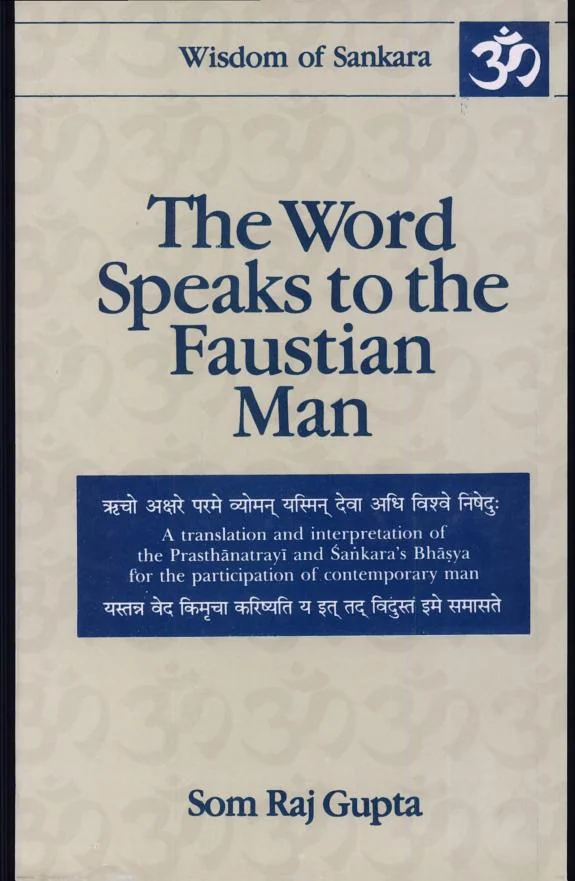
The Word Speak's to the Faustian Man
 82
82

The Word Speak's to the Faustian Man
Som Raj Gupta’s engagement with the Chandogya Upanishad in *The Word Speak's to the Faustian Man* is not a casual introduction; it is an invitation to rigorous contemplation. Gupta asserts that the Upanishad’s ancient pronouncements on Brahman and Atman, often obscured by ritualistic density, possess a startling immediacy for the modern psyche. He masterfully dissects the text, revealing how its exploration of consciousness and selfhood directly confronts what he terms the "pathologies and possibilities" of the contemporary individual. A particularly striking passage discusses the concept of *prana* not merely as breath, but as the vital energetic principle that underpins all existence, directly linking it to our own existential anxieties. The book’s primary limitation, however, lies in its dense academic prose, which occasionally requires significant effort to penetrate. Despite this, Gupta’s meticulous scholarship and unique perspective offer a compelling re-reading of a foundational text. It serves as a rigorous intellectual challenge for those seeking deeper meaning.
📝 Description
82
Published in 1991, The Word Speak's to the Faustian Man examines the Chandogya Upanishad's relevance to modern individuals.
Som Raj Gupta's 1991 book, The Word Speak's to the Faustian Man, offers a scholarly reading of the Chandogya Upanishad. It argues that this ancient text, often seen through a lens of dense ritualism, holds direct insights for contemporary human anxieties. Gupta seeks to demonstrate that these Upanishadic teachings are not historical curiosities but vital resources for understanding modern life.
The book frames its interpretation around the concept of the 'Faustian Man,' representing the modern individual facing existential questions. Gupta applies this perspective to the Chandogya Upanishad, showing how its discussions on self-awareness, consciousness, and the nature of existence speak to present-day challenges and potentials. A key method proposed is 'self-submitting attentiveness' for uncovering the text's layered meanings.
This work positions itself within the study of Vedic texts, specifically the Upanishads, as they intersect with Western philosophical concepts. Gupta bridges the gap between formal Vedic scholarship and the broader esoteric community, which often seeks practical or psychological applications in ancient scriptures. The book engages with the tradition of interpreting these texts not just as theological documents but as guides to inner states and existential understanding, particularly relevant during a period of growing academic and popular interest in Eastern thought.
💡 Why Read This Book?
• Gain a unique interpretative framework for the Chandogya Upanishad, understanding its relevance to the "Faustian Man" as discussed by Gupta. • Explore the concept of "self-submitting attentiveness" as a method for spiritual and psychological insight, as advocated in the book’s analysis of ancient contemplative practices. • Grasp the specific Upanishadic teachings on consciousness and reality that Som Raj Gupta argues directly address modern existential "pathologies and possibilities" that have evaded contemporary notice.
⭐ Reader Reviews
Honest opinions from readers who have explored this book.
❓ Frequently Asked Questions
What is the central thesis of "The Word Speak's to the Faustian Man" regarding the Chandogya Upanishad?
The book argues that the Chandogya Upanishad, despite its archaic language and ritualistic symbolism, speaks directly to the existential concerns of the modern "Faustian Man," revealing profound insights into our contemporary pathologies and possibilities.
Who is the author, Som Raj Gupta, and what is his background?
Som Raj Gupta was an academic and scholar focused on Indian philosophy and religious texts. His work on the Chandogya Upanishad reflects a deep engagement with both traditional interpretations and modern philosophical concerns, as evidenced by the book's 1991 publication.
What does "Faustian Man" signify in the context of this book?
The term "Faustian Man" refers to the modern individual, characterized by a sense of existential unease and a relentless pursuit of knowledge or experience, often leading to internal conflict and a feeling of alienation.
How does the book suggest accessing the deeper meanings of the Chandogya Upanishad?
Gupta emphasizes the practice of "sustained self-submitting attentiveness," a form of deep, undistracted engagement with the text, as the key to unlocking its profound and modernly relevant messages.
Is "The Word Speak's to the Faustian Man" suitable for beginners in Upanishadic studies?
While offering profound insights, the book's dense academic style and complex conceptual framework make it more suitable for readers with some prior familiarity with Indian philosophy or esoteric traditions.
What historical period does the book situate the Chandogya Upanishad within?
The book acknowledges the Chandogya Upanishad as reflecting a "remote and archaic" culture, placing it within the ancient Vedic period of Indian history, distinct from later philosophical developments.
🔮 Key Themes & Symbolism
Archaic Wisdom, Modern Resonance
The work argues against viewing ancient texts like the Chandogya Upanishad as mere historical artifacts. Gupta posits that their "ritualistic and contemplative symbolism," though dense, carries "disturbingly modern notes." He suggests that a dedicated approach, termed "self-submitting attentiveness," allows contemporary readers to recognize their own "pathologies as well as possibilities" reflected in these ancient teachings, challenging the assumption that modern consciousness is entirely divorced from ancient spiritual frameworks.
The "Faustian Man" and Existential Pathology
Gupta employs the concept of the "Faustian Man" to represent the modern individual’s often-unacknowledged psychological and existential struggles. This archetype grapples with alienation, the relentless pursuit of external validation, and a disconnect from deeper meaning. The book proposes that the Chandogya Upanishad offers a counter-narrative, providing ancient perspectives on consciousness and self-realization that can address the root causes of these modern "pathologies."
Hermeneutics of Attentiveness
Central to Gupta's methodology is the idea of "sustained self-submitting attentiveness." This is not passive reading but an active, engaged hermeneutic practice. It requires the reader to shed preconceived notions and allow the text's inherent wisdom to unfold, disclosing subtle layers of meaning. This approach is presented as essential for bridging the gap between the "remote and archaic" culture of the Upanishad and the lived experience of the modern reader.
Consciousness and the Nature of Reality
The Chandogya Upanishad's profound explorations of consciousness (Atman) and the ultimate reality (Brahman) are re-examined through Gupta’s modern lens. The book highlights how these ancient concepts speak to contemporary questions about the self, perception, and the underlying fabric of existence. By focusing on these core metaphysical inquiries, Gupta demonstrates their enduring capacity to offer solace and guidance to those experiencing modern existential crises.
💬 Memorable Quotes
Direct passages from the work, attributed to the author.
“The culture it reflects is remote and archaic, the texture of its ritualistic and contemplative symbolism thick and dense—virtually a closed book for us moderns.”
— This statement captures the initial perception of ancient texts like the Chandogya Upanishad as impenetrable due to their age and complex symbolic language, setting the stage for Gupta's argument that this perception is a barrier to understanding.
“A sustained self-submitting attentiveness, however, discloses its language as resonating disturbingly modern notes.”
— This highlights Gupta's core thesis: dedicated, open-minded study of ancient texts reveals their surprising relevance to contemporary issues, suggesting that the past holds answers to present-day human dilemmas.
“focusing our attention on many of our pathologies as well as our possibilities, pathologies and possibilities that have escaped the notice of us moderns.”
— This emphasizes the diagnostic power of the Upanishad, as interpreted by Gupta, in revealing hidden psychological issues and untapped potentials within the modern individual that have been overlooked by contemporary thought.
“The spirit of quiet hermeneutics that charac”
— This fragment suggests a specific method of interpretation—a gentle, observant, and unforced approach to understanding—is crucial for unlocking the deeper layers of meaning within the text.
“The Chandogya Upanishad: The culture it reflects is remote and archaic, the texture of its ritualistic and contemplative symbolism thick and dense—virtually a closed book for us moderns.”
— This opening sentiment immediately frames the central challenge: how to access the wisdom of ancient scriptures when they appear distant and opaque to contemporary sensibilities, a problem Gupta aims to solve.
🌙 Esoteric Significance
Tradition
This work engages deeply with the Advaita Vedanta tradition, a major school within Hindu philosophy that emphasizes the non-dual nature of reality (Brahman) and the self (Atman). Gupta’s interpretation of the Chandogya Upanishad aligns with this lineage by exploring concepts of ultimate consciousness and the illusory nature of the perceived world. It departs from purely ritualistic or devotional interpretations, focusing instead on the philosophical and psychological implications for the individual seeker.
Symbolism
The text looks at potent Vedic symbols. For instance, the concept of *prana* is explored not merely as breath, but as the vital life force animating all existence, linking it to our existential vitality. The famous metaphor of the "honey" (*madhu*) from the Chandogya Upanishad, where different elements of the cosmos are depicted as components of a divine honey, is reinterpreted to illustrate interconnectedness and the underlying unity of all phenomena, speaking to modern feelings of fragmentation.
Modern Relevance
Gupta's framing of the "Faustian Man" and his focus on "pathologies and possibilities" echo concerns found in modern depth psychology and existential philosophy. Thinkers exploring consciousness studies, transpersonal psychology, and comparative mysticism find value in his approach. His emphasis on contemplative practice as a path to insight aligns with contemporary mindfulness movements and the resurgent interest in contemplative traditions as antidotes to modern alienation and stress.
👥 Who Should Read This Book
• Advanced students of comparative religion and philosophy seeking nuanced interpretations of foundational Vedic texts. • Individuals interested in the intersection of ancient Indian thought and modern existential psychology, particularly those exploring the "Faustian" condition. • Scholars and practitioners of Advaita Vedanta looking for a critical re-examination of the Chandogya Upanishad through a 20th-century philosophical lens.
📜 Historical Context
Published in 1991, *The Word Speak's to the Faustian Man* emerged during a period of burgeoning academic and popular interest in Eastern philosophies, particularly Vedanta and Upanishadic thought. While scholars like Wendy Doniger were producing influential translations and analyses of Hindu texts, Gupta’s work positioned itself with a specific focus on the existential and psychological relevance for the modern Western reader, identified as the "Faustian Man." This approach sought to bridge the gap between rigorous Indological scholarship and the broader esoteric and philosophical inquiry prevalent in the late 20th century. It contrasted with purely historical or theological approaches by emphasizing the text's direct applicability to contemporary human conditions, implicitly engaging with the intellectual currents that questioned the secularization of modern life and sought deeper meaning from ancient wisdom traditions.
📔 Journal Prompts
The "Faustian Man's" confrontation with "pathologies and possibilities": how does this duality manifest in your own life?
Reflect on the meaning of "self-submitting attentiveness" in relation to your engagement with challenging texts or ideas.
Consider the Upanishadic concept of ultimate reality as presented in the Chandogya, and its contrast with your perceived reality.
How might the ancient symbolism of the Chandogya, such as the "honey," offer a new perspective on interconnectedness in your experience?
Examine the "remote and archaic" nature of the Chandogya's culture versus its "disturbingly modern notes" – where do you see this tension in other ancient wisdom traditions?
🗂️ Glossary
Chandogya Upanishad
One of the oldest and most significant Upanishads, a foundational text of Hindu philosophy, particularly Advaita Vedanta, exploring themes of consciousness, reality, and the self.
Faustian Man
A term used to describe the modern individual characterized by a restless, often anxious, striving for knowledge, power, or experience, typically associated with existential unease and alienation.
Self-submitting attentiveness
A method of intense, devoted, and open-minded concentration on a text or subject, aimed at uncovering its deeper, often hidden, meanings and personal relevance.
Pathologies and Possibilities
Refers to the psychological and existential ailments (pathologies) and the untapped potentials or avenues for growth (possibilities) that ancient texts, like the Chandogya Upanishad, can illuminate for modern individuals.
Hermeneutics
The theory and methodology of interpretation, especially the interpretation of biblical texts, wisdom literature, or philosophical writings.
Brahman
In Advaita Vedanta, the ultimate reality, the supreme cosmic spirit, the unchanging, infinite, and absolute ground of all being.
Atman
In Hindu philosophy, the self, the inner essence or soul, often considered identical with Brahman in Advaita Vedanta.
This book appears in 1 collection
🔮 Readers Also Liked
Browse all →![Bidayah al-Hikmah (Arab-English) [The Elements of Islamic Metaphysics]](/img/thumb/bidayah-al-hikmah-arab-english-the-elements-of-islamic-metaphysics-allama-muhammad-husayn-tabatabai.webp)









From the “Upanishads” Collection
View all →






More Free Occult Philosophy Books
View all →