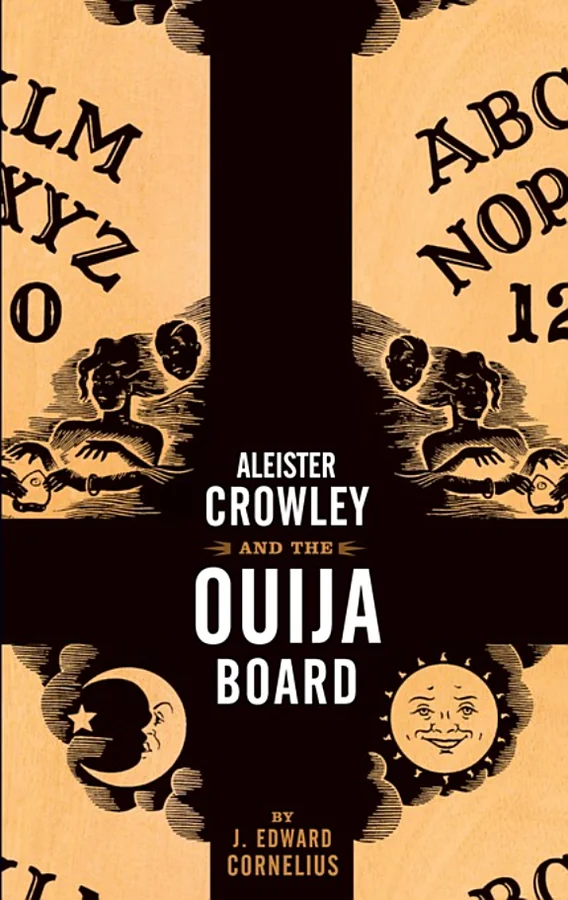
Aleister Crowley and the Ouija Board
 82
82

Aleister Crowley and the Ouija Board
J. Edward Cornelius’s exploration of Aleister Crowley and the Ouija Board provides a necessary corrective to the device’s lurid reputation. Cornelius sidesteps the hysteria, presenting a scholarly yet accessible account of how figures like Crowley viewed the board not as a demonic gateway, but as a sophisticated tool for spiritual exploration. The book’s strength lies in its detailed examination of Crowley’s personal correspondence and writings concerning the Ouija, contextualizing its use within his broader magical philosophy. A minor limitation is the occasional reliance on secondary interpretations of Crowley’s intent, though Cornelius generally grounds these in documentary evidence. The section detailing Crowley’s alleged experiments with Leah H ImportError and the Z-Board in the 1920s offers a particularly concrete example of its application. This work is essential for understanding the practical, often misunderstood, implements of 20th-century occultism.
📝 Description
82
J. Edward Cornelius's 2001 book examines Aleister Crowley's use of the Ouija board.
This work investigates Aleister Crowley's engagement with the Ouija board, moving past its common perception as a parlor game. Cornelius positions the board as a significant tool for ceremonial magicians, detailing its origins and its integration into esoteric practices. The book contrasts sensationalist fears of possession with the Ouija board's potential as a channel for communication and revelation, especially within magical systems.
It is written for serious students of Western esotericism, occult history, and Aleister Crowley's life. The text will appeal to those interested in how divination tools function in ceremonial magic and the historical connections between spiritualism and occultism. Readers will find a critical analysis of the Ouija board's role, distinguishing its esoteric purpose from its mainstream image.
The Ouija board, patented in 1890, appeared during a period of intense spiritualist activity and public interest in the supernatural. This era saw many attempts to understand phenomena like séances. Aleister Crowley, a central figure in occultism from the early 20th century, incorporated various divination methods, including the Ouija board, into his practices and documented them in his writings.
This book sits within the study of Western esotericism, specifically the practical application of divination and consciousness alteration in occult traditions. It connects the historical spiritualist movement with the more formalized magical orders of the late 19th and early 20th centuries. By examining the Ouija board through Crowley's lens, Cornelius places it within a lineage of tools used for spirit communication and self-discovery, distinct from mere fortune-telling.
💡 Why Read This Book?
• Learn the specific methods Aleister Crowley advocated for using the Ouija board as a tool for ceremonial magic, moving beyond mere parlor game assumptions. • Understand the historical milieu of spiritualism and occultism in the late 19th and early 20th centuries, as detailed in the book’s exploration of the Ouija’s patent and early reception. • Gain insight into the concept of the Ouija as a psychometric instrument, a tool for contacting non-physical intelligences, as presented through Cornelius’s analysis of Crowley’s practices.
⭐ Reader Reviews
Honest opinions from readers who have explored this book.
❓ Frequently Asked Questions
What is the historical origin of the Ouija board?
The Ouija board was patented in 1890 by Charles Kennard, with Elijah Bond and William Fuld also playing significant roles in its development and popularization as a commercial product.
How did Aleister Crowley view the Ouija board?
Crowley considered the Ouija board a valuable tool for ceremonial magic, scrying, and communication with entities, advocating for its use within his esoteric system.
Is this book about ghost stories or possession?
While acknowledging popular fears of possession, the book focuses on the Ouija board's application as an occult instrument for communication and spiritual exploration, not sensationalist horror.
What is psychometry in the context of the Ouija board?
In this context, psychometry refers to the Ouija board's purported ability to react to subtle energies or psychic impressions, acting as a conduit for information.
Who is J. Edward Cornelius?
J. Edward Cornelius is an author and researcher specializing in Aleister Crowley and the history of occultism, with this book being a significant contribution to the field.
Does the book include Crowley's own writings on the Ouija board?
Yes, the book integrates and analyzes Aleister Crowley's own writings and discussions concerning the use of the Ouija board as an occult tool.
🔮 Key Themes & Symbolism
The Ouija Board as Occult Instrument
This theme unpacks the transformation of the Ouija board from a parlor game into a sophisticated device for ceremonial magic. Cornelius details how Aleister Crowley and others utilized its perceived ability to contact non-physical intelligences. It explores the mechanics of its use in channeling information, facilitating astral travel, and achieving altered states of consciousness, contrasting this with common fears of demonic influence. The focus remains on its practical application within specific magical frameworks.
Crowley's Magical System and the Ouija
This section examines how the Ouija board integrates into Aleister Crowley's broader magical philosophy and practices. It highlights his systematic approach to occultism and how he adapted tools like the Ouija to fit his goals of spiritual attainment and self-realization. The work discusses Crowley's specific techniques for preparing for and conducting Ouija sessions, emphasizing the importance of intent, visualization, and the magician's will in directing the process.
Historical and Societal Perceptions
The book contextualizes the Ouija board within its historical period, marked by intense spiritualist fervor and early 20th-century occult revival. It contrasts the popular perception of the board as a dangerous, even demonic, artifact with its deliberate use by occultists. Cornelius addresses the societal anxieties and moral panics associated with spiritualism and table-turning, showing how these influenced public opinion and critical reception of the device.
Psychic Phenomena and Communication
Central to the book is the exploration of the Ouija board as a medium for psychic phenomena and interdimensional communication. It discusses concepts such as automatic writing, channeling, and the nature of the entities or intelligences that might be contacted. Cornelius analyzes these occurrences through the lens of occult theory, considering whether the Ouija facilitates contact with external spirits, projections of the subconscious, or archetypal forces.
💬 Memorable Quotes
Direct passages from the work, attributed to the author.
“Crowley's practical application of the Ouija board within his magical system.”
— This interpretation points to the book's focus on how Aleister Crowley, a prominent magician, integrated the Ouija board into his specific ritualistic and magical practices, demonstrating its utility beyond general spiritualism.
“The Ouija board as a psychometric instrument.”
— This refers to the idea presented in the book that the Ouija board can function as a device sensitive to psychic energies or impressions, serving as a tool for divining hidden information.
“Contrasting popular fears with esoteric purpose.”
— This interpretation emphasizes the book's approach to addressing the sensationalist claims and widespread anxieties surrounding the Ouija board, juxtaposing them with its intended use by occult practitioners.
“The Ouija board's origins in the spiritualist movement.”
— This signifies the book's exploration of the historical roots of the Ouija board, placing its invention and early popularity within the context of the late 19th-century spiritualist craze.
💡 Key Ideas
Editorial paraphrase of the work's core concepts — not direct quotes.
The Ouija board's potential for spiritual communication, rather than mere amusement.
This paraphrased concept highlights the core argument that the Ouija board, often dismissed as a toy, possesses genuine potential for esoteric communication when employed with proper intent and knowledge.
🌙 Esoteric Significance
Tradition
This work sits firmly within the tradition of Western Esotericism, specifically focusing on ceremonial magic and the practices associated with figures like Aleister Crowley. It aligns with Hermeticism's emphasis on understanding and manipulating the hidden forces of the universe. The book departs from purely theoretical discussions by focusing on the practical application of a specific, albeit controversial, tool within this lineage, examining its role in consciousness alteration and communication with non-physical realms.
Symbolism
The Ouija board itself can be seen as a symbolic locus of communication between the mundane and the hidden worlds. The planchette, moving across letters and numbers, symbolizes the directed will of the operator or the guidance of external intelligences. The alphabet and numerals represent the totality of manifest knowledge accessible through esoteric means. The act of using the board symbolizes the magician’s attempt to bridge the gap between the conscious and subconscious, or the physical and astral planes.
Modern Relevance
Contemporary practitioners of ceremonial magic, particularly those influenced by thelema and Chaos Magic, may find renewed interest in the Ouija board as a tool for divination and spirit contact, as explored in Cornelius's work. Modern occultists interested in psychonautics and exploring altered states of consciousness through various instruments might revisit the Ouija through this historical and practical lens. The book also speaks to ongoing discussions about the nature of consciousness and the potential for non-local communication.
👥 Who Should Read This Book
• Students of Aleister Crowley: Those seeking to understand the practical aspects of Crowley's magical system and his use of specific implements will find detailed analysis here. • Researchers of Spiritualism and Occultism: Individuals studying the history of divination, spiritualism, and the intersection of popular culture with esoteric practices will benefit from the historical context. • Practicing Magicians and Diviners: Those interested in expanding their repertoire of divination tools and exploring different methods of spirit communication may find practical insights and historical precedent.
📜 Historical Context
Published in 2005, J. Edward Cornelius's work emerged during a period of renewed academic and popular interest in the occult and esoteric traditions of the 20th century. The Ouija board itself, patented in 1890, was a product of the late Victorian spiritualist movement, a time when mediums and séances were widely discussed. This era saw numerous individuals, including figures like Helena Blavatsky and the Theosophical Society, exploring spiritual communication and arcane knowledge through various means. Cornelius’s book positions Aleister Crowley, a central figure in Western magic, as someone who saw the Ouija board not as a mere novelty, but as a functional tool for magical operations. The book implicitly engages with the ongoing scholarly debate about the authenticity of spiritualist phenomena versus psychological explanations, placing Crowley's use of the board within this complex intellectual landscape.
📔 Journal Prompts
Crowley's adaptation of the Ouija board as a psychometric instrument.
The contrast between popular fears and esoteric purpose for the Ouija board.
The mechanics of the Ouija board within ceremonial magic.
The Ouija board's role in communicating with non-physical intelligences.
The Ouija board's historical context within the spiritualist movement.
🗂️ Glossary
Ceremonial Magic
A system of magic that uses elaborate rituals, often involving specific tools, invocations, and symbolic actions, to achieve spiritual or magical goals.
Psychometry
The purported psychic ability to read the history of an object or place by touching it, often interpreted as sensing residual energies or impressions.
Scrying
A form of divination involving gazing into a reflective surface, such as a mirror or crystal ball, to receive visions or information.
Astral Projection
The practice of separating one's consciousness from the physical body to travel in an astral or spiritual form.
Thelema
Aleister Crowley's religious and philosophical system based on his reception of the Book of the Law, emphasizing individual will and spiritual liberation.
O.T.O.
Ordo Templi Orientis (Order of the Temple of the East), a fraternal and initiatory organization founded by Theodor Reuss and later led by Aleister Crowley.
Psychic Phenomena
Events or experiences that are believed to occur independently of the known laws of physics, often related to extrasensory perception or spiritual communication.
This book appears in 1 collection
🔮 Readers Also Liked
Browse all →






From the “Ouija Board” Collection
View all →








More Free Occult Philosophy Books
View all →