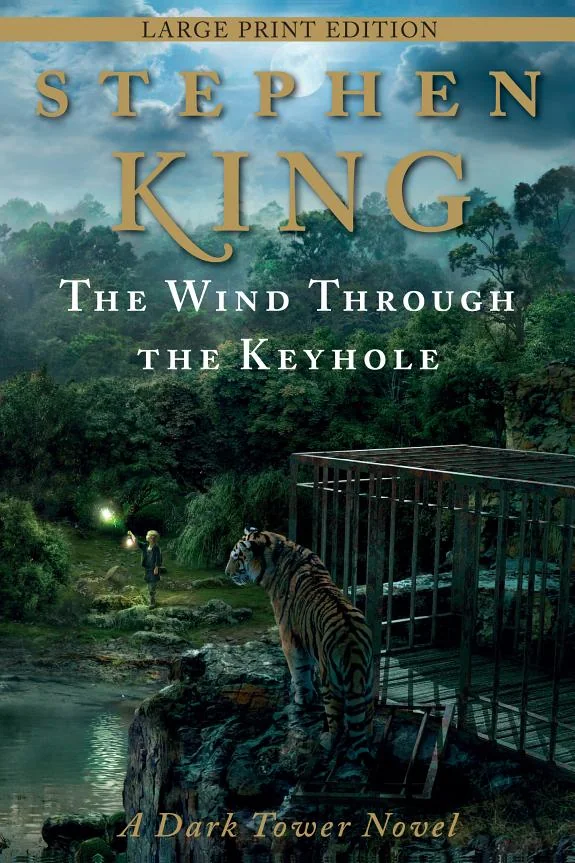
The Wind Through the Keyhole
 80
80

The Wind Through the Keyhole
Stephen King's "The Wind Through the Keyhole" functions as a fascinating, albeit sometimes tangential, addition to the Dark Tower saga. It excels in its meta-fictional framing: Roland Deschain, himself a character deeply shaped by stories, recounts a tale to a terrified boy, effectively demonstrating the power of narrative to both confront and soothe. The story-within-a-story structure is King at his most self-aware. However, the narrative's primary limitation is its placement; while intended to bridge gaps between volumes IV and V, it occasionally feels like a diversion rather than an essential progression. The extended recounting of "The Wind Through the Keyhole" tale, while thematically relevant, can slow the momentum for readers eager to return to Roland's primary quest. The depiction of the 'skin man' is a chillingly effective descent into pure horror, a hallmark of King's early work, but its integration into Roland's immediate predicament feels somewhat secondary to the act of storytelling itself. Ultimately, it's a valuable character study and a testament to King's enduring fascination with the power of the spoken word, though not the most propulsive entry in the series.
📝 Description
80
Stephen King's 2012 novel, The Wind Through the Keyhole, is a story within a story.
This book is a narrative framed by Stephen King's larger Dark Tower series, published in 2012. It presents a tale told by Roland Deschain to a young boy, Bill Streeter, during a blizzard. This meta-narrative structure allows King to explore the nature of storytelling and memory, while also expanding the lore of Roland's ongoing quest for the Dark Tower.
The book is best suited for readers already invested in the Dark Tower saga. Those who appreciate King's tendency to play with narrative devices and stories that examine the act of narration itself will find particular interest. It acts as a pause in the main plot, a moment to look back at Roland's past and the oral traditions of his world.
The Wind Through the Keyhole engages with the concept of 'ka,' Stephen King's term for destiny or fate, a notion present in various traditions that explore predestination and the forces shaping human lives. The narrative's focus on the power of stories to shape reality echoes ideas found in mythopoetic traditions, where narrative itself is seen as a fundamental force. The 'skin man' entity represents primal fears, a recurring motif in occult and folk horror traditions that delve into the darker aspects of the human psyche and the unknown.
💡 Why Read This Book?
• You will learn how the act of storytelling itself can serve as a powerful defense mechanism, as Roland uses tales from his mother's Magic Tales of the Eld to comfort Bill Streeter. • You will experience the narrative power of a story within a story, a technique King employs here to bridge the gap between Dark Tower IV and V, and explore Roland's past. • You will encounter the concept of the 'skin man,' a shape-shifting entity that embodies primal fears, offering a unique perspective on the nature of evil within King's multiverse.
⭐ Reader Reviews
Honest opinions from readers who have explored this book.
❓ Frequently Asked Questions
What is the significance of the title "The Wind Through the Keyhole" within the book?
The title refers to a story told by Roland Deschain. It symbolizes the way the past and forgotten tales can intrude upon the present, much like wind seeping through a keyhole, bringing with it both memories and potential danger.
When was "The Wind Through the Keyhole" originally published?
This novel was first published on August 28, 2012, making it one of the later additions to the Dark Tower series.
Where does "The Wind Through the Keyhole" fit chronologically within the Dark Tower series?
The book is intentionally placed between "Dark Tower IV: Wizard and Glass" and "Dark Tower V: Wolves of the Calla," serving as a narrative interlude that offers character insight into Roland Deschain.
Who is the "skin man" mentioned in the book?
The 'skin man' is a malevolent, shape-shifting entity that Roland Deschain is hunting. It represents a primal, almost folkloric form of evil that preys on the innocent.
Is "The Wind Through the Keyhole" a standalone Stephen King novel?
No, it is an integral part of the Dark Tower series. While it contains a story within its narrative, it is not a standalone work and is best understood within the context of Roland Deschain's larger quest.
What role does Roland's mother play in the story?
Roland's mother is significant because she is the source of the Magic Tales of the Eld that Roland recites. These stories represent a connection to his past and a source of comfort and wisdom.
🔮 Key Themes & Symbolism
The Power of Storytelling
The narrative intricately explores how stories function as more than mere entertainment; they are tools for survival, memory, and emotional resilience. Roland's act of telling the tale of "The Wind Through the Keyhole" to the terrified Bill Streeter highlights this function. The Magic Tales of the Eld, passed down from Roland's mother, represent an oral tradition that offers not just comfort but a framework for understanding the world and confronting darkness. This theme underscores the esoteric idea that narrative can shape perception and even reality.
Confronting Primal Fear
The antagonist, the 'skin man,' embodies a deeply unsettling, shape-shifting evil that taps into ancient fears. This entity represents a force of destruction that operates beyond conventional understanding, forcing Roland to confront not just a physical threat but a manifestation of pure malevolence. The story explores the psychological impact of such encounters, showing how terror can paralyze but also how facing it, often through the lens of recounted tales, can lead to courage and survival.
The Nature of Destiny (Ka)
As with much of the Dark Tower series, the concept of 'ka'—a form of predetermined destiny or fate—pervades "The Wind Through the Keyhole." Roland's hunt for the 'skin man' is presented as part of his larger destiny. The stories within the story often reflect this, exploring cycles of violence and redemption. The narrative suggests that while 'ka' may guide events, individual choices and the narratives we construct about our lives play an important role in how that destiny unfolds.
Memory and the Past
The book is deeply concerned with the weight of memory and the inescapable influence of the past. Roland's own recollections and the stories he tells are intrinsically linked to his identity and his ongoing quest. The 'skin man' itself can be seen as a creature that feeds on or embodies past traumas. The narrative structure, acting as a flashback within a flashback, emphasizes how the past is not merely gone but actively shapes the present, influencing actions and motivations.
💬 Memorable Quotes
Direct passages from the work, attributed to the author.
“Stories can be like a keyhole to another world.”
— This interpretation highlights the core theme of narrative as a portal. The quote suggests that tales offer not just escape but access to different realities, perspectives, and understandings, functioning as a conduit between the mundane and the extraordinary.
“The skin man is a hunter.”
— This simple statement underscores the predatory nature of the antagonist. It frames the 'skin man' not just as a monster but as an active force of malevolence, implying a relentless pursuit that reflects deeper, perhaps existential, threats.
“Roland told him a story his mother used to read to him.”
— This emphasizes the personal and generational transmission of narrative. It connects Roland's present actions to his childhood and highlights the comforting, almost ritualistic power of stories passed down within a family, especially in times of fear.
“Fear can make a man kill, and fear can make a man mad.”
— This interpretation points to the psychological impact of terror. It suggests that extreme fear can override reason and morality, leading to destructive actions, a concept relevant to both the victims and potentially the perpetrators within King's narratives.
💡 Key Ideas
Editorial paraphrase of the work's core concepts — not direct quotes.
Sometimes the only thing that can save you is a good story.
This paraphrased concept captures the redemptive power of narrative. It posits that in the face of overwhelming adversity or despair, the act of engaging with or creating a story can provide the necessary strength and hope for survival.
🌙 Esoteric Significance
Tradition
While not overtly tied to a single esoteric tradition like Hermeticism or Gnosticism, "The Wind Through the Keyhole" draws heavily on archetypal narrative structures found in myth and folklore, which are foundational to many esoteric paths. The concept of 'ka' appeals to ideas of destiny present in various traditions, suggesting a fated path that individuals must navigate. The story-within-a-story format echoes Gnostic creation myths or the layered narratives found in Sufi mysticism, where inner truths are revealed through allegorical tales.
Symbolism
The 'skin man' serves as a potent symbol of the Shadow Self or the Trickster archetype, a primal force of chaos and destruction that must be confronted. The keyhole itself symbolizes a liminal space, a threshold between different realities or states of consciousness, through which hidden knowledge or danger can pass. The Magic Tales of the Eld represent the power of the Akashic records or ancestral wisdom, accessible through oral tradition and memory, offering guidance and protection.
Modern Relevance
Contemporary storytellers and psychologists interested in narrative therapy often cite King's work for its exploration of how stories shape identity and healing. Thinkers examining modern mythology and the evolution of archetypes in popular culture frequently analyze the Dark Tower series, including this installment. The book's depiction of confronting overwhelming evil through narrative also finds echoes in modern approaches to trauma and resilience, where constructing personal narratives is seen as crucial for recovery.
👥 Who Should Read This Book
• Dedicated members of the Dark Tower 'ka-tet' seeking to deepen their understanding of Roland Deschain's past and the intricate lore of King's multiverse. • Students of comparative mythology and folklore interested in how ancient archetypes and narrative structures are reinterpreted in contemporary fiction. • Readers who appreciate meta-fictional techniques and stories that examine the very nature of storytelling and its power to influence perception and reality.
📜 Historical Context
Published in 2012, "The Wind Through the Keyhole" emerged in a literary landscape where meta-fiction and series-based storytelling were well-established. Stephen King himself had been writing the Dark Tower series since "The Gunslinger" (1982), building a dedicated readership over decades. The novel's placement between "Dark Tower IV" and "V" was a strategic move to expand Roland Deschain's character and the world's lore, addressing reader interest in the character's younger years. This period saw continued scholarly engagement with King's work, analyzing his blending of horror, fantasy, and Western genres. While King wasn't directly engaging with a specific philosophical movement like Existentialism in this particular installment, the thematic exploration of fate ('ka'), free will, and the confronting of existential dread aligns with broader philosophical currents that have influenced literature since the mid-20th century. The reception was largely positive from fans, appreciating the return to Roland's backstory and the intricate storytelling.
📔 Journal Prompts
Roland's use of Magic Tales of the Eld to calm Bill Streeter.
The symbolic meaning of the 'skin man' as a representation of fear.
The function of the keyhole as a gateway in the narrative.
The concept of 'ka' as depicted in Roland's journey.
Bill Streeter's role as a witness to the 'skin man's' slaughter.
🗂️ Glossary
Ka
In Stephen King's cosmology, 'ka' is a concept akin to destiny, fate, or a predetermined path that guides individuals and events, often seen as an inescapable force.
Skin Man
A malevolent, shape-shifting entity that Roland Deschain hunts. It represents a primal, folkloric evil capable of great destruction and terror.
Magic Tales of the Eld
A collection of stories that Roland's mother used to read to him. These tales represent a connection to his past and a source of comfort and wisdom.
Ka-tet
A group of individuals whose fates are intertwined by 'ka.' Roland Deschain's primary companions form his ka-tet.
Palace Gate
A specific location within the narrative that serves as a significant threshold or point of transition, often guarded or holding important secrets.
Breaker
Individuals with psychic abilities who can 'break' the beams that hold the Dark Tower together, often manipulated by malevolent forces.
The Dark Tower
The central nexus of all universes, the linchpin holding reality together, which Roland Deschain is sworn to protect and reach.
This book appears in 1 collection
🔮 Readers Also Liked
Browse all →









From the “Shapeshifting” Collection
View all →





More Free Occult Philosophy Books
View all →