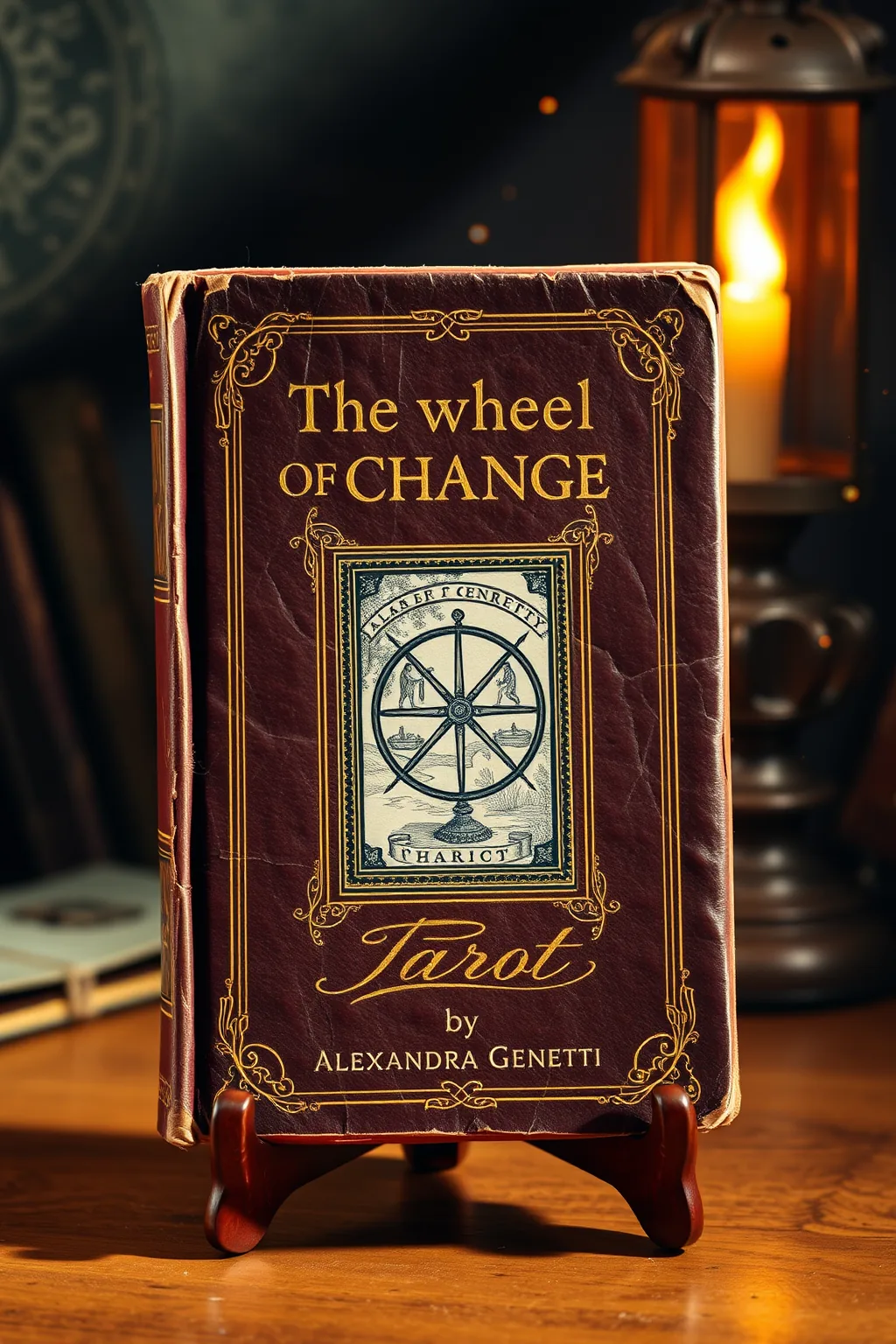
The wheel of change tarot
 73
73

The wheel of change tarot
Alexandra Genetti's 'The Wheel of Change Tarot' attempts to reframe the familiar 78 cards through a lens of perpetual transformation. The strength of the work lies in its consistent application of the cyclical metaphor; it successfully encourages readers to see the Tarot not as a series of discrete messages but as an interconnected flow. Genetti's analysis of the Minor Arcana, often overlooked in favor of the Major Arcana, provides a particularly coherent exploration of how everyday events mirror larger cosmic shifts. However, the book occasionally falters by leaning into abstract language, making specific passages feel less grounded than the core concept suggests. For instance, the discussion surrounding the 'Essence of the Ace' could benefit from more concrete examples of its manifestation beyond generalized 'potential.' It's a valuable addition for those seeking a more philosophical, less predictive, approach to the Tarot.
📝 Description
73
Alexandra Genetti's 2016 book, The Wheel of Change Tarot, examines the Tarot's archetypal narratives through a lens of transformation.
Published in 2016, The Wheel of Change Tarot by Alexandra Genetti positions the Tarot not as a static tool for fortune telling, but as a dynamic system reflecting personal and universal change. The book moves past simple divinatory meanings to focus on the cyclical nature of existence as depicted across the Major and Minor Arcana. Genetti analyzes the cards as points on a continuous cycle of experience, highlighting the interdependence of opposing forces like creation and destruction. The structure of the Tarot, from the Fool's progression to the suit motifs, is examined as a representation of larger cosmic or personal cycles.
This text is best suited for Tarot practitioners who have a grasp of basic card meanings and are looking for a deeper philosophical and psychological engagement. It will be of interest to those exploring the spiritual underpinnings of the cards and their connection to personal growth and life's inevitable shifts. Students of comparative mythology and esoteric symbolism may also find value in Genetti's approach.
The Wheel of Change Tarot emerged in 2016, a time of resurgent interest in esoteric practices. While drawing on Jungian ideas of archetypes, Genetti's work grounds its interpretations in a distinct esoteric philosophy. It contributes to the ongoing systematization of Tarot meanings, a tradition that gained momentum in the late 19th and early 20th centuries, moving beyond purely psychological readings to integrate a broader symbolic and cyclical understanding of the cards.
💡 Why Read This Book?
• Gain a framework for understanding life's transitions through the 'Wheel of Change' concept, seeing each Tarot card as a stage in a continuous cycle, not an isolated event. • Explore the interconnectedness of seemingly opposing forces within the Tarot, as illuminated by Genetti's analysis of card relationships, offering a nuanced perspective. • Re-evaluate the Minor Arcana beyond simple predictive meanings, understanding their role in mirroring larger personal and cosmic cycles as detailed in the 2016 publication.
⭐ Reader Reviews
Honest opinions from readers who have explored this book.
❓ Frequently Asked Questions
What is the core philosophy behind 'The Wheel of Change Tarot'?
The core philosophy views the Tarot as a representation of cyclical change and transformation. It posits that each card illustrates a phase within a continuous flow of experience, mirroring both personal growth and universal shifts.
When was 'The Wheel of Change Tarot' first published?
Alexandra Genetti's 'The Wheel of Change Tarot' was first published in 2016.
Does this book focus on divination or a deeper interpretation?
The book leans towards a deeper, philosophical interpretation of the Tarot, emphasizing archetypal narratives and cyclical transformation rather than simple predictive divination.
Who is Alexandra Genetti?
Alexandra Genetti is the author of 'The Wheel of Change Tarot,' published in 2016. Her work explores esoteric philosophy through the lens of Tarot symbolism.
What is the significance of the 'Wheel of Change' concept?
The 'Wheel of Change' concept frames the Tarot as a dynamic system reflecting the constant flux of life. It highlights the interconnectedness of beginnings, endings, and the ongoing processes of transformation.
Is this book suitable for beginners?
While accessible, the book is best suited for those with some foundational knowledge of Tarot who are looking for a more philosophical and interpretive approach beyond basic divinatory meanings.
🔮 Key Themes & Symbolism
Cyclical Transformation
The central theme is the Tarot as a map of perpetual change. Genetti argues that each card, from the Fool to the World, represents a distinct phase in a continuous cycle of becoming and dissolution. This perspective challenges static interpretations, instead highlighting the interconnectedness of all experiences as points on a larger wheel, mirroring natural rhythms and personal evolution.
Archetypal Narratives
The book examines the archetypal stories embedded within the Tarot. It examines how the Major Arcana, in particular, represent universal human experiences and developmental stages. Genetti interprets these archetypes not as fixed entities but as fluid forces in constant interplay, reflecting the dynamic nature of the psyche and its journey through various existential phases.
Interconnectedness of Opposites
A key concept is the reconciliation of apparent dualities. Genetti explores how the Tarot illustrates the essential unity underlying opposites like creation and destruction, beginnings and endings. This theme emphasizes that transformation arises from the interplay and eventual synthesis of these forces, a core tenet in many esoteric philosophies.
The Minor Arcana as Microcosm
Genetti offers a robust interpretation of the Minor Arcana, often relegated to secondary importance. She frames the suits and their numbered cards as detailed reflections of the larger archetypal cycles, showing how everyday events and challenges mirror the grander arcs of the Major Arcana, providing practical applications for understanding daily life's transformations.
💬 Memorable Quotes
Direct passages from the work, attributed to the author.
“Each card is a moment on the wheel, not a destination.”
— This statement captures the book's core argument: that the Tarot should be understood as a dynamic process of change rather than a collection of static pronouncements or fixed outcomes.
“The Fool's leap is the beginning of every cycle.”
— This highlights the archetypal nature of new beginnings, suggesting that even the most uncertain steps are fundamental to initiating any transformative process or cycle of experience.
“The Ace signifies not just potential, but the seed of inevitable unfolding.”
— This interpretation elevates the Ace beyond simple possibility, framing it as the initial spark of a process that is inherently destined to develop and manifest through subsequent stages.
“The Emperor and Empress embody the balance of structure and nurture.”
— This points to Genetti's analysis of card relationships, illustrating how specific pairings represent the essential interplay between seemingly different forces, such as order and growth, within the larger archetypal landscape.
💡 Key Ideas
Editorial paraphrase of the work's core concepts — not direct quotes.
Change is the only constant, and the Tarot maps its currents.
This paraphrase emphasizes the book's view of the Tarot as a tool for understanding and navigating life's inherent flux, aligning with philosophical traditions that see change as the fundamental nature of reality.
🌙 Esoteric Significance
Tradition
The work draws implicitly from Western Esotericism, particularly its Hermetic and Neoplatonic currents that emphasize cyclical patterns and the macrocosm/microcosm relationship. It departs from strictly Kabbalistic or Gnostic frameworks by focusing on a universal 'wheel' metaphor rather than specific divine emanations or dualistic struggles. Genetti's approach aligns with modern esoteric psychology, viewing the Tarot as a symbolic system for mapping the human psyche's journey through transformation.
Symbolism
The 'Wheel of Change' itself is a central motif, symbolizing cyclical time, destiny, and the constant flux of existence, echoing ancient concepts of fate and cosmic cycles. The Fool's journey represents the archetypal path of individuation and spiritual evolution, initiating each new turn of the wheel. The four suits (Wands, Cups, Swords, Pentacles) are interpreted not just as elements, but as distinct modalities through which change manifests in the material, emotional, intellectual, and spiritual realms.
Modern Relevance
Genetti's emphasis on cyclical transformation and archetypal narratives speaks to contemporary practices in depth psychology and personal development. Modern Tarot practitioners, particularly those engaged in psychological or spiritual growth, find her approach valuable for understanding life's inevitable shifts. Her work informs discussions within contemporary esoteric circles that seek to integrate ancient symbolic systems with modern psychological understanding and self-inquiry.
👥 Who Should Read This Book
• Tarot practitioners seeking a deeper philosophical framework beyond predictive readings, interested in understanding the cards as archetypal stages of transformation. • Students of comparative mythology and esoteric symbolism who wish to explore how cyclical narratives are encoded within a widely recognized symbolic system. • Individuals undergoing significant life changes who are looking for a symbolic language to process and understand the nature of transition and personal evolution.
📜 Historical Context
Alexandra Genetti's 'The Wheel of Change Tarot' arrived in 2016, a period characterized by a significant resurgence of interest in esoteric subjects, particularly among younger demographics engaging with online communities. This era saw a proliferation of Tarot decks and books, moving beyond traditional occult circles into mainstream wellness and self-help culture. Genetti's work positions itself within this broader trend, offering a philosophical rather than purely predictive approach. It emerged in dialogue with earlier 20th-century esoteric thinkers like A.E. Waite and Aleister Crowley, who had already worked to codify Tarot meanings, yet Genetti emphasizes a more fluid, cyclical interpretation. While figures like Joseph Campbell were exploring comparative mythology, Genetti specifically applies these archetypal concepts to the Tarot's structure, contributing to the ongoing academic and popular re-evaluation of Tarot's symbolic language.
📔 Journal Prompts
Reflect on the 'Wheel of Change' as applied to a recent personal transition.
Consider the Fool's journey as the commencement of a new cycle in your life.
Analyze the interplay of structure and nurture represented by the Emperor and Empress cards.
Map the currents of change through the sequence of Aces in the Minor Arcana.
Explore the interconnectedness of opposites as depicted in a specific Tarot spread.
🗂️ Glossary
Wheel of Change
The central concept framing the Tarot as a dynamic system representing continuous cycles of transformation, evolution, and dissolution.
Archetype
Universal, archaic patterns and images that derive from the collective unconscious and are the psychic conditions of man's permanently valid interpretation of the world.
Major Arcana
The 22 trump cards of the Tarot, typically depicting significant life events, spiritual lessons, and archetypal figures.
Minor Arcana
The 56 cards of the Tarot divided into four suits, representing the everyday events, challenges, and experiences of life.
Cyclical Time
A philosophical concept viewing time not as linear progression but as a series of recurring patterns, seasons, or phases, mirrored in the Tarot's structure.
Esoteric Philosophy
A broad category of spiritual or mystical traditions that propose hidden knowledge or wisdom accessible only to a select few, often concerning the fundamental nature of reality and the human spirit.
Transformation
A profound change or metamorphosis, viewed in this context as a fundamental aspect of existence and a key theme explored through the Tarot's symbolism.
🔮 Readers Also Liked
Browse all →









More by Alexandra Genetti
All books →
More Free Divination & Tarot Books
View all →