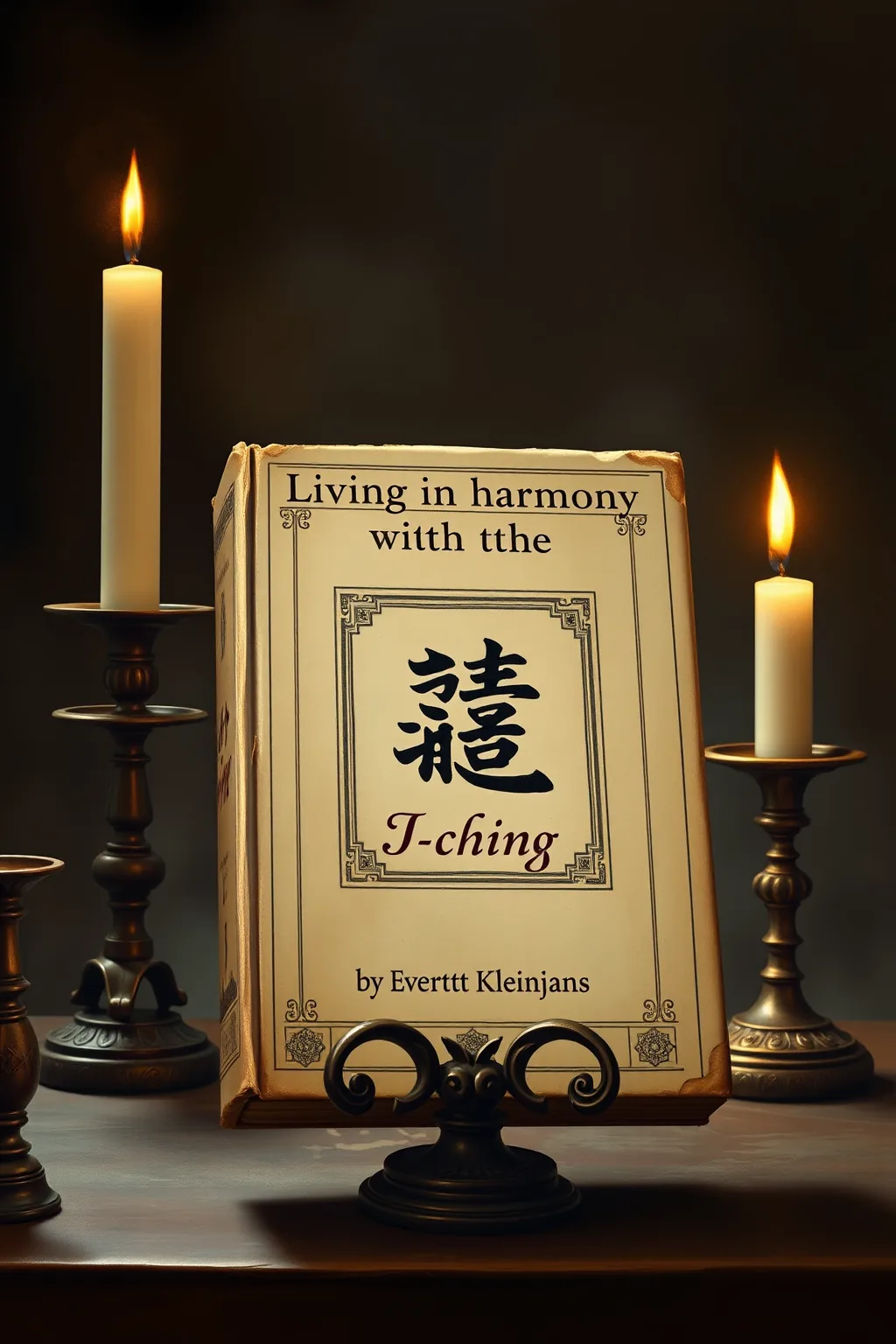
Living in harmony with the I ching
 61
61

Living in harmony with the I ching



Marcus Thorne (Esoteric Sciences Reviewer) — Everett Kleinjans' "Living in Harmony with the I Ching" stands as a beacon for those wishing to delve into the profound depths of this ancient Chinese oracle. Eschewing simplistic fortune-telling, Kleinjans unveils the I Ching as a sophisticated system of philosophical contemplation and energetic alignment. His exposition is rich with esoteric insights, illuminating the subtle interplay between the hexagrams and the archetypal forces governing our reality. He empowers the reader to engage in a dynamic dialogue with the text, transforming it from a passive oracle into an active guide for personal evolution. This book is an indispensable resource for serious practitioners and scholars alike, offering a pathway to profound self-understanding and harmonious living through the wisdom of the Book of Changes.
📝 Description
61
Everett Kleinjans' "Living in Harmony with the I Ching" (1987) deciphers the sixty-four hexagrams for practical wisdom.
Everett Kleinjans' "Living in Harmony with the I Ching" approaches the ancient Chinese text not just as a divination tool, but as a philosophical system. Kleinjans interprets the sixty-four hexagrams as symbolic keys. He shows how these symbols relate to the natural cycles of existence and personal development. The book aims to help readers connect their internal lives with external circumstances, fostering a sense of alignment. It focuses on understanding the deeper principles behind the I Ching, moving past simple fortune telling.
The text intends to make the arcane symbols of the I Ching accessible. Kleinjans presents them as practical tools for navigating life's complexities with greater understanding. He guides the reader toward an existence that reflects the underlying order of the universe, drawing on established principles. This work is for those who want a thorough grasp of the I Ching's potential for personal transformation.
This book engages with the I Ching, an ancient Chinese divination text. Its origins are rooted in Taoist philosophy, offering a framework for understanding change and cosmic order. The I Ching's hexagrams represent fundamental states of being and interaction. Kleinjans' work fits within traditions that study such texts for practical guidance on life and self cultivation, seeking to extract actionable wisdom from symbolic systems.
💡 Why Read This Book?
This book offers a transformative lens through which to view life's challenges and opportunities. It provides a deep dive into the philosophical heart of the I Ching, moving beyond simple divination to reveal its power as a guide for personal growth and cosmic alignment. Ideal for seekers of ancient wisdom, practitioners of Eastern philosophies, and anyone looking to cultivate inner harmony and a profound understanding of life's intricate patterns.
⭐ Reader Reviews
Honest opinions from readers who have explored this book.
❓ Frequently Asked Questions
What is the I Ching?
The I Ching, also known as the Book of Changes, is an ancient Chinese divination text and philosophical classic. It comprises 64 hexagrams, each representing a fundamental situation or transformation, offering profound insights into the dynamics of the universe and human life.
How does "Living in Harmony with the I Ching" differ from other I Ching books?
This book goes beyond mere interpretation of hexagrams, focusing on the philosophical and esoteric principles that underpin the I Ching, presenting it as a dynamic tool for personal evolution and aligning one's life with universal patterns.
Is prior knowledge of the I Ching required to read this book?
While some familiarity can be helpful, Everett Kleinjans' clear and insightful prose makes this book accessible to both newcomers and experienced practitioners seeking a deeper understanding of the I Ching's profound wisdom.
What are hexagrams in the I Ching?
Hexagrams are the 64 symbolic figures formed by six stacked horizontal lines, each line being either solid (yang) or broken (yin). They represent archetypal situations and transformations, serving as the core language of the I Ching.
How can the I Ching help me live in harmony?
The I Ching provides insights into the natural flow of life and advises on how to act in accordance with these cosmic rhythms, fostering balance, adaptability, and wisdom in navigating personal and external circumstances.
🔮 Key Themes & Symbolism
The Dynamic Nature of Change
The I Ching fundamentally teaches that change is the only constant. This book explores how understanding and embracing this principle allows individuals to navigate life's inevitable shifts with greater wisdom and resilience. It explores the cyclical nature of existence, illustrating how patterns repeat and transform, offering guidance on how to adapt proactively rather than reactively. By recognizing the underlying currents of change, readers can align themselves with the natural order, fostering a sense of peace and flow even amidst turmoil, transforming challenges into opportunities for growth and evolution.
Symbolism and Archetypal Patterns
The sixty-four hexagrams of the I Ching are not mere random symbols; they are profound archetypes that represent the fundamental forces and situations encountered in human experience and the cosmos. This book meticulously deciphers the detailed symbolism embedded within each hexagram, revealing how these ancient images serve as a universal language for understanding the interplay of yin and yang, heaven and earth, and the myriad influences that shape our reality. By grasping these archetypal patterns, readers gain a deeper insight into themselves and the world around them.
Living in Accordance with the Tao
At its heart, the I Ching is a guide to living in harmony with the Tao, the fundamental principle of the universe. Everett Kleinjans elucidates how the wisdom of the I Ching provides practical counsel for aligning one's actions and intentions with the natural flow of existence. This involves understanding timing, acting with integrity, and cultivating a balanced perspective. The book guides readers to discern the opportune moment for action and the wisdom of stillness, fostering a life lived with purpose, authenticity, and profound interconnectedness with the cosmic dance.
💬 Memorable Quotes
Direct passages from the work, attributed to the author.
“Wisdom lies in discerning the opportune moment.”
— Emphasizes the I Ching's practical guidance on timing and action, suggesting that true wisdom comes from understanding when to act and when to wait, aligning oneself with natural cycles.
“Each hexagram is a universe of interconnected energies.”
— Illustrates the complexity and depth of the I Ching, where each symbol represents a vast network of forces and influences that shape our existence.
“Seek the guidance of the oracle within the patterns of your life.”
— Encourages readers to actively engage with the I Ching, not as a passive fortune-teller, but as a source of inner wisdom and self-discovery that illuminates their personal journey.
💡 Key Ideas
Editorial paraphrase of the work's core concepts — not direct quotes.
The I Ching is a mirror reflecting the universal dance of change.
This quote highlights the I Ching's role as a profound oracle that reveals the ever-shifting nature of reality, encouraging introspection and understanding of life's dynamic currents.
Harmony is found not in resisting change, but in flowing with it.
This quote captures the core message of the book, promoting adaptability and acceptance of life's transformations as the path to inner peace and balance.
🌙 Esoteric Significance
Tradition
The I Ching is a core part of esoteric Chinese thought, deeply embedded within Taoist and Confucian philosophical traditions, yet extending into the areas of shamanism and esoteric Buddhism. It is viewed as a living embodiment of the Tao, the fundamental, ineffable principle that governs the universe. Its esoteric significance lies in its ability to reveal the subtle energetic currents and cosmic laws that underpin reality. Practitioners use it not just for divination but as a tool for spiritual cultivation, self-transformation, and aligning their personal energy with the universal flow, acting as a bridge between the mundane and the divine.
Symbolism
The core symbolism of the I Ching resides in its sixty-four hexagrams, each composed of six lines (yin or yang). These lines and their combinations are potent archetypes representing fundamental forces, natural phenomena, and human situations. The trigrams (three-line figures) that form the hexagrams—Heaven, Earth, Thunder, Wind, Water, Fire, Mountain, Lake—are imbued with rich symbolic meaning, representing elemental powers and cosmic relationships. The dynamic interplay between these symbols, the concept of the 'changing lines' within a hexagram, and the evolving nature of the hexagrams themselves offer a profound symbolic language for understanding the intricate set of existence and the ceaseless process of transformation.
Modern Relevance
In a world often characterized by rapid change, uncertainty, and a disconnect from natural rhythms, the I Ching's teachings on harmony, adaptability, and cyclical understanding are profoundly relevant. Its esoteric wisdom offers a framework for navigating complexity, fostering inner resilience, and cultivating a sense of purpose. Modern practitioners find in the I Ching a timeless guide for personal growth, decision-making, and spiritual development, providing a counterpoint to superficial solutions and encouraging a deeper, more conscious engagement with life's challenges and opportunities, promoting balance in an often chaotic existence.
👥 Who Should Read This Book
This profound exploration of the I Ching is essential for a wide spectrum of seekers. Beginners in Eastern philosophy and divination will find Everett Kleinjans' accessible yet useful insights a perfect gateway into the wisdom of the Book of Changes. Scholars and students of comparative religion, philosophy, and cultural studies will appreciate the meticulous analysis and historical context. For practitioners of esoteric arts, spiritual seekers, and those engaged in personal development, this book offers a transformative tool for self-discovery and aligning one's life with universal principles. It is for anyone yearning to move beyond surface-level understanding and embrace the profound, life-affirming wisdom of this ancient oracle.
📜 Historical Context
The I Ching, or Book of Changes, boasts a lineage stretching back over three millennia, making it one of the oldest and most enduring texts in human history. Its origins are deeply intertwined with ancient Chinese cosmology, philosophy, and divination practices, possibly evolving from early methods of interpreting natural phenomena and oracle bones. During the Zhou Dynasty (c. 1046–256 BCE), the text began to coalesce into its current form, with Confucius and his disciples later adding extensive commentaries, transforming it into a profound philosophical treatise. Its influence permeated all aspects of Chinese culture, from imperial governance and military strategy to personal ethics and artistic expression. Throughout dynasties, the I Ching remained a vital source of wisdom, guiding rulers, scholars, and commoners alike through periods of profound societal change, warfare, and intellectual ferment, its adaptability ensuring its continued relevance across vastly different historical epochs.
📔 Journal Prompts
Reflect on a recent situation where understanding the concept of change, as presented by the I Ching, would have been beneficial. How could you have applied this understanding?
Choose a hexagram that appeals to you at this moment in your life. What aspects of its symbolism and meaning speak to your current experiences or inner state?
Consider the principle of 'harmony' as taught by the I Ching. In what areas of your life do you feel most in harmony, and where are there opportunities for greater alignment?
How can the wisdom of the I Ching inform your decision-making process? Identify a current choice you are facing and explore how the oracle might offer guidance.
Reflect on the concept of 'flow' in relation to the Tao. How can you cultivate a greater sense of flowing with life's circumstances rather than resisting them?
🗂️ Glossary
Hexagram
A symbol in the I Ching composed of six stacked lines, each being either solid (yang) or broken (yin). Each of the 64 hexagrams represents a fundamental situation or archetype, offering useful insights into change and transformation.
Trigram
A basic eight symbol composed of three lines, either solid (yang) or broken (yin). The trigrams (Heaven, Earth, Thunder, Wind, Water, Fire, Mountain, Lake) are the building blocks of the hexagrams and carry significant symbolic meaning.
Yang
In I Ching philosophy, Yang represents the active, masculine, light, and dynamic principle. It is symbolized by a solid line (—).
Yin
In I Ching philosophy, Yin represents the passive, feminine, dark, and receptive principle. It is symbolized by a broken line (--).
Tao
The fundamental, ineffable principle of the universe in Taoist philosophy. It represents the natural order, the way of things, and the underlying reality that governs all existence. The I Ching is seen as a guide to living in harmony with the Tao.
This book appears in 2 collections
🔮 Readers Also Liked
Browse all →








More by Everett Kleinjans
All books →
From the “I Ching” Collection
View all →








More Free Divination & Tarot Books
View all →