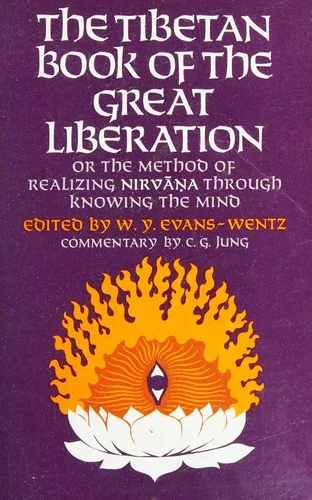
The Tibetan book of the great liberation
 73
73

The Tibetan book of the great liberation
Evans-Wentz's compilation, The Tibetan Book of the Great Liberation, remains a significant, if occasionally dense, entry point into the advanced teachings of Tibetan Buddhism. Its strength lies in presenting the Mahamudra doctrine through primary texts and Evans-Wentz's extensive, though sometimes idiosyncratic, annotations. The inclusion of Padmasambhava’s teachings and commentaries by figures like Karma Chagme provides substantial doctrinal weight. However, the work is not without its limitations. Evans-Wentz’s Theosophical leanings, evident in his interpretations and framing, can sometimes obscure the starkness of the original teachings for readers unfamiliar with that milieu. A particularly illustrative passage is the discussion on the nature of 'emptiness' not as nihilism, but as the unconditioned, boundless awareness – a concept that requires careful contemplation. The book’s enduring value is its comprehensive, albeit scholarly, presentation of a path to liberation that bypasses gradualist methods for direct recognition. It serves as a vital resource for understanding a profound yogic and philosophical system.
📝 Description
73
First published in 1968, The Tibetan Book of the Great Liberation compiles texts on the Mahamudra path.
W. Y. Evans-Wentz's 1968 compilation, The Tibetan Book of the Great Liberation, focuses on the Mahamudra tradition within Tibetan Buddhism. It includes original Tibetan texts, commentaries, and instructions intended to guide practitioners toward spiritual realization. The book aims to provide both the theoretical framework and practical methods for understanding enlightenment as taught in the Great Liberation.
Evans-Wentz's work appeared during a time of growing Western interest in Eastern spirituality, particularly Tibetan Buddhism following events in Tibet. This volume was instrumental in introducing Mahamudra doctrines to a Western readership, serving as an early bridge between esoteric Tibetan teachings and Western philosophical thought. It is designed for serious students of comparative religion, psychology, and mysticism, as well as scholars of religious history and those interested in consciousness and liberation.
This book engages with the Mahamudra tradition, a central teaching in Tibetan Buddhism focused on the direct experience of the mind's nature. It presents concepts related to non-duality and the recognition of inherent awareness, often considered an advanced path. The included texts and commentaries aim to facilitate a practitioner's understanding and realization of these profound states, moving beyond conceptualization to direct insight.
💡 Why Read This Book?
• Gain direct insight into the Mahamudra tradition, a core teaching of Tibetan Buddhism, by studying the specific concepts of Rigpa and the Six Yogas of Naropa as presented by Evans-Wentz. • Understand the historical reception of Tibetan Buddhism in the West through the lens of Evans-Wentz's 1968 publication, noting its place alongside Theosophical interpretations. • Explore the practical application of recognizing the unconditioned mind, detailed in the Bardo teachings and commentaries within the book, for immediate spiritual benefit.
⭐ Reader Reviews
Honest opinions from readers who have explored this book.
❓ Frequently Asked Questions
What is the significance of 'Mahamudra' in The Tibetan Book of the Great Liberation?
Mahamudra, meaning 'Great Seal' or 'Great Gesture,' refers to the ultimate nature of reality and mind. The book presents it as a direct path to liberation, emphasizing the recognition of mind's inherent emptiness and luminosity, a core concept explored throughout the text.
Who was W. Y. Evans-Wentz and what was his role in presenting Tibetan Buddhism?
W. Y. Evans-Wentz was an American occultist and anthropologist who played a pivotal role in introducing Tibetan Buddhist texts to the West. His work, beginning in the early 20th century, focused on translating and annotating works like this one, often with a Theosophical perspective.
When was The Tibetan Book of the Great Liberation first published?
The Tibetan Book of the Great Liberation was first published in 1968, making it a significant introduction to Tibetan Buddhist philosophy for a Western audience during a period of growing interest in Eastern spirituality.
What are the Bardo states discussed in the book?
The Bardo states are intermediate periods experienced between death and rebirth. The book details these transitional phases as crucial opportunities for spiritual progress and liberation, offering specific practices for navigating them.
Does this book include practical meditation techniques?
Yes, the book incorporates practical instructions and commentaries on techniques aimed at cultivating the recognition of the mind's true nature, central to the Great Liberation path. These are often tied to the understanding of Rigpa.
Is The Tibetan Book of the Great Liberation suitable for beginners?
While it contains foundational elements, the book delves into advanced philosophical and yogic concepts of Tibetan Buddhism. Beginners might find it more accessible after some prior study of Buddhist philosophy or through guidance.
🔮 Key Themes & Symbolism
The Nature of Mind (Rigpa)
Central to the Great Liberation is the concept of Rigpa, the primordial, unconditioned awareness. The book explores Rigpa not as a constructed mental state, but as the fundamental ground of all experience, characterized by emptiness, luminosity, and unimpeded awareness. It posits that recognizing this inherent nature is the direct path to enlightenment, transcending conceptualization and dualistic perception. The teachings emphasize that Rigpa is not something to be achieved but to be realized through direct apprehension.
Path to Enlightenment
The volume delineates a specific path to enlightenment within Tibetan Buddhism, distinct from gradualist approaches. This path, embodied by the Mahamudra teachings, stresses the immediate recognition of one's true nature. It involves practices designed to cut through delusion and attachment, leading to the cessation of suffering and the attainment of Buddhahood. The book details the stages and methods required to stabilize this realization, often highlighting the role of a qualified guru.
Bardo and Death
A significant portion of the text addresses the Bardo, the intermediate states between death and rebirth. These transitional periods are presented as critical junctures offering profound spiritual opportunities. The book provides detailed instructions on how to navigate these states, particularly the Chikhai Bardo (moment of death) and the Chönyi Bardo (experience of reality). The aim is to prevent the practitioner from being swept away by karmic forces and instead to recognize the clear light or achieve liberation.
The Role of the Guru
The necessity of a qualified spiritual teacher, or guru, is a recurring theme. The book underscores that the profound teachings on the Great Liberation, particularly the direct transmission of experiential knowledge, can only be effectively imparted by a realized master. The guru's role extends beyond instruction to guiding the disciple through complex spiritual experiences and ensuring the purity of the lineage's teachings.
💬 Memorable Quotes
Direct passages from the work, attributed to the author.
“The mind, when not conceptualizing, is the Dharmakaya.”
— This statement points to the ultimate nature of mind as pure awareness, free from mental constructs and dualities. It suggests that in its natural, unperturbed state, the mind is indistinguishable from the formless, all-pervading reality of the Dharmakaya.
“Liberation is not to be found by going elsewhere, but by realizing the nature of this mind.”
— This highlights the internal focus of the path to enlightenment. It emphasizes that the solution to suffering and the attainment of freedom are not external achievements but are discovered within one's own consciousness through direct realization.
“The Bardo is a mirror, reflecting the karma of past lives.”
— This metaphorical interpretation of the Bardo states suggests they serve as a clear reflection of an individual's past actions and mental imprints. It implies that understanding this reflection is key to reading through the Bardo effectively and avoiding entanglement.
“Recognize that all phenomena are illusory, like dreams.”
— This teaching encourages detachment from the perceived reality of the external world and one's own thoughts. By understanding the dream-like quality of phenomena, one can loosen the grip of attachment and aversion, paving the way for liberation.
“The Great Liberation is the direct recognition of the Unborn.”
— This concise statement expresses the core aim of Mahamudra practice. 'The Unborn' refers to the unconditioned, primordial state of existence that precedes birth and death, and its recognition is presented as the ultimate goal.
🌙 Esoteric Significance
Tradition
This work firmly belongs to the Tibetan Buddhist tradition, specifically focusing on the Mahamudra ('Great Seal') and Dzogchen ('Great Perfection') lineages, which are prominent in the Nyingma and Kagyu schools. Evans-Wentz, however, frames these teachings through a lens influenced by Western esoteric movements, particularly Theosophy, bridging Eastern doctrine with Western occult interests. It represents an early attempt to translate these profound yogic and philosophical insights into a conceptual framework understandable to a Western audience.
Symbolism
Key symbols include the 'Unborn' or 'Primordial Mind,' representing the unconditioned, ground-of-being awareness that underlies all existence. The 'Clear Light' symbolizes the luminous, cognizant aspect of this mind, often revealed at the moment of death or in deep meditative states. The 'Dream' is a potent metaphor for the illusory nature of phenomenal reality, highlighting its impermanence and lack of inherent substance, urging practitioners to see beyond surface appearances.
Modern Relevance
Contemporary Western practitioners of Tibetan Buddhism, particularly those engaged with Mahamudra and Dzogchen, continue to draw upon Evans-Wentz's foundational translations and commentaries. Thinkers and teachers in the 'Western Buddhist' movement, as well as scholars of comparative religion and consciousness studies, find value in this text for understanding the historical transmission of these teachings. Its influence can be seen in modern mindfulness and meditation practices that explore non-dual awareness.
👥 Who Should Read This Book
• Advanced practitioners of Tibetan Buddhism seeking to deepen their understanding of Mahamudra and Dzogchen philosophy beyond introductory texts. • Scholars of comparative religion and Eastern mysticism interested in the historical presentation of Tibetan teachings to the West and Evans-Wentz's unique editorial approach. • Individuals exploring the nature of consciousness and the path to liberation, particularly those drawn to non-dualistic philosophies and contemplative practices.
📜 Historical Context
Published in 1968, The Tibetan Book of the Great Liberation emerged during a key era for Western engagement with Eastern spirituality. The preceding decades had seen a growing interest, fueled by figures like Helena Blavatsky and the Theosophical Society, but the Chinese invasion of Tibet in 1959 and the subsequent diaspora of Tibetan lamas brought a new wave of authentic teachings to the West. Evans-Wentz’s work, building on his earlier publications like 'The Tibetan Book of the Dead,' offered a more detailed exploration of Mahamudra, a complex yogic and philosophical system. This period also saw a burgeoning counter-culture that was receptive to alternative spiritualities, often contrasting with the prevailing Western religious and scientific paradigms. While scholars like Giuseppe Tucci had already been active in Tibetan studies, Evans-Wentz’s approach, influenced by his own esoteric leanings, made these advanced concepts accessible to a broader, though still specialized, audience.
📔 Journal Prompts
The nature of Rigpa as described in the text.
Recognizing phenomena as dream-like, as discussed in the book.
The practitioner's role during the Bardo states.
The guidance provided by a guru for the Great Liberation.
The concept of the Unborn and its implications for ordinary experience.
🗂️ Glossary
Mahamudra
A central teaching in Tibetan Buddhism, meaning 'Great Seal' or 'Great Gesture.' It refers to the ultimate nature of mind and reality, understood as empty, luminous, and unconditioned, offering a direct path to liberation.
Rigpa
In Tibetan Buddhism, particularly Dzogchen and Mahamudra, Rigpa is the innate, primordial awareness or consciousness. It is the fundamental, unconditioned state of mind, characterized by clarity and emptiness, distinct from ordinary conceptual thought.
Bardo
An intermediate state or transitional period, most famously referring to the states between death and rebirth. Tibetan tradition identifies several Bardos, each presenting unique opportunities for spiritual realization or karmic consequence.
Dharmakaya
In Mahayana Buddhism, the highest of the three bodies of a Buddha. It represents the ultimate reality, the unmanifested, formless, all-pervading truth body of Buddhahood, often equated with emptiness and primordial consciousness.
Guru
A spiritual teacher or master, especially in Hinduism and Buddhism. In Tibetan Buddhism, the Guru is considered essential for transmitting esoteric teachings and guiding disciples on the path to enlightenment.
Unborn
A term referring to the primordial, unconditioned nature of reality or mind, which is not subject to birth, death, or causation. Its recognition is a key goal in Mahamudra and Dzogchen practices.
Phenomena
The observable facts or events of the world; all that appears to the senses and mind. In Buddhist philosophy, phenomena are often described as lacking inherent existence and being illusory or dream-like.
🔮 Readers Also Liked
Browse all →








More by W. Y. Evans-Wentz
All books →




More Free Occult Philosophy Books
View all →