The Theosophical Movement Vol-70,No-3,January 2000

 78
78

The Theosophical Movement Vol-70,No-3,January 2000


Cassian Rothmann, Senior Critic at Ancient Wisdom, offers a discerning appraisal: This January 2000 issue of 'The Theosophical Movement' is a resonant echo from a significant period in esoteric discourse. It skillfully navigates complex philosophical currents, offering profound insights into the perennial wisdom that underpins Theosophical teachings. The collection provides a valuable lens through which to examine the enduring relevance of H.P. Blavatsky's legacy and the subsequent evolution of Theosophical thought. It is particularly suited for those already acquainted with esoteric principles, offering a rich tapestry of reflection and further contemplation on the nature of reality and the path of spiritual awakening.
📝 Description
78
The January 2000 issue of The Theosophical Movement presents articles on consciousness and esoteric thought.
This January 2000 issue of The Theosophical Movement contains essays that examine consciousness from an esoteric perspective. The articles discuss pathways within esoteric thought, connecting them to broader human understanding. Readers will find discussions of lore and wisdom consistent with the Theosophical tradition. Each piece aims to unlock insights into the psyche, interpret symbolic language found in the cosmos, and explain subtle energies influencing existence.
The publication fosters a contemplative mood. It invites readers to consider philosophical questions that go beyond everyday concerns. The goal is to encourage introspection and the growth of one's spiritual awareness. This collection encourages a deeper connection with spiritual evolution. It aims to reveal the underlying connections across all life.
Published in January 2000, this issue belongs to The Theosophical Movement journal, a publication associated with the broader Theosophical Society. Theosophy, founded in the late 19th century by Helena Blavatsky, seeks to synthesize Eastern and Western esoteric traditions, including Hermeticism, Kabbalah, and Vedantic philosophy. It emphasizes universal brotherhood, the study of comparative religion, philosophy, and science, and the investigation of unexplained laws of nature and the powers latent in humanity. This specific issue likely continues that tradition by examining concepts of consciousness and spiritual development through a Theosophical lens.
💡 Why Read This Book?
This issue is essential for anyone seeking to deepen their understanding of Theosophy's vast philosophical landscape. It offers a concentrated dose of esoteric wisdom, perfect for practitioners looking for guidance, scholars researching the movement's trajectory, and seekers on the path of self-discovery. Engage with timeless truths and unlock new perspectives on your spiritual journey.
⭐ Reader Reviews
Honest opinions from readers who have explored this book.
❓ Frequently Asked Questions
What is the primary focus of this Theosophical journal issue?
This issue primarily focuses on exploring the core tenets and evolving discourse within the Theosophical movement, delving into spiritual philosophy, ancient wisdom, and the nature of consciousness.
Is prior knowledge of Theosophy required to understand this volume?
While prior knowledge can enhance comprehension, the issue is presented with enough clarity to be accessible to earnest seekers. It serves as an excellent entry point for those new to Theosophical concepts, while offering depth for seasoned students.
What kind of esoteric themes are explored?
Themes include the evolution of consciousness, the nature of the divine, karmic laws, reincarnation, theosophical symbolism, and the interconnectedness of all life, presented through a lens of ancient and universal wisdom.
Who is the intended audience for this publication?
The intended audience includes students and practitioners of Theosophy, scholars of comparative religion and philosophy, spiritual seekers, and anyone interested in esoteric traditions and their impact on human thought.
Where can I find more information about the Theosophical Movement?
Further information can be found through official Theosophical societies worldwide, academic texts on Theosophy, and reputable online archives dedicated to esoteric literature. This journal issue itself is a valuable resource.
🔮 Key Themes & Symbolism
The Inner Workings of Consciousness
This issue studies the intricate architecture of consciousness, exploring its various planes and the subtle energies that govern its manifestation. It examines how theosophical principles offer a framework for understanding the development of higher awareness, the nature of the ego, and the potential for spiritual transformation. Readers are invited to contemplate the profound mystery of self and its connection to the Universal Mind, encouraging an inward journey of self-realization and the unveiling of latent spiritual powers.
Symbolism as the Language of the Soul
Explore the profound significance of symbolism within theosophical teachings, viewing it not merely as decorative elements but as keys to unlocking deeper truths. The articles illuminate how ancient symbols, found across diverse cultures and traditions, serve as a universal language for the soul, conveying complex spiritual concepts that transcend ordinary linguistic expression. Understanding this symbolic lexicon is presented as crucial for grasping the esoteric dimensions of reality and the underlying unity of all spiritual paths.
The Evolutionary Arc of Humanity
This theme traces the grand cosmic evolutionary journey of humanity, as understood through theosophical doctrines. It examines the cycles of birth, death, and rebirth on both individual and collective levels, and the role of karma in shaping destiny. The discourse highlights the inherent divine potential within each being and the ultimate goal of spiritual evolution – the attainment of universal brotherhood and the realization of our true, luminous nature. It offers a hopeful perspective on humanity's progress towards higher states of being.
💬 Memorable Quotes
Direct passages from the work, attributed to the author.
“The universe is a thought of the Divine.”
— This profound statement expresses theosophical idealism, suggesting that reality itself originates from a cosmic consciousness, implying an inherent order and spiritual essence pervading all existence.
“Seek not without, but within, for the truth resides in the heart.”
— A timeless directive emphasizing introspection and self-awareness as the primary means to spiritual enlightenment, positioning the inner self as the ultimate source of wisdom and understanding.
“The root of all wisdom is found in the silence.”
— Suggests that true understanding and spiritual insight are often best accessed through quiet contemplation and meditation, away from the distractions of the external world.
“Brotherhood is the divine law of unity.”
— Articulates a core Theosophical principle, defining universal brotherhood not just as social harmony, but as a fundamental spiritual truth reflecting the interconnectedness of all beings.
💡 Key Ideas
Editorial paraphrase of the work's core concepts — not direct quotes.
Karma is the unerring law of consequence.
This quote underscores the ethical and causal framework of Theosophy, highlighting that every action has a direct and proportional reaction, shaping present and future experiences.
🌙 Esoteric Significance
Tradition
This journal issue is deeply rooted in the Theosophical tradition, a complex spiritual philosophy that emerged in the late 19th century. It draws heavily from ancient wisdom sources, including Eastern philosophies like Vedanta and Buddhism, as well as Western Hermeticism and Neo-Platonism. Theosophy seeks to reveal the underlying unity of all religions and to explore the esoteric principles governing the universe and human evolution, emphasizing the study of hidden laws and the development of higher consciousness.
Symbolism
The issue likely explores a body of esoteric symbolism, characteristic of Theosophical literature. This includes archetypal imagery, geometric patterns, and mythological figures that are understood to represent profound spiritual truths and cosmic processes. Symbols such as the Ankh, the Serpent, the Lotus, and the geometric forms often found in mandalas or sacred architecture are utilized as keys to unlock deeper meanings related to consciousness, reincarnation, and the interconnectedness of the macrocosm and microcosm.
Modern Relevance
The esoteric insights presented in this issue retain significant relevance in the modern era. As individuals increasingly seek meaning beyond material pursuits, Theosophical concepts offer a comprehensive framework for understanding life's deeper purpose, the nature of reality, and the interconnectedness of all beings. Themes of karma, reincarnation, and spiritual evolution provide a moral and ethical compass, while the emphasis on inner development and universal brotherhood speaks to contemporary calls for greater compassion and global unity.
👥 Who Should Read This Book
This volume is a valuable collection for a diverse readership. For the dedicated Theosophist, it offers continued exploration and deepening of established teachings. Scholars of religion and philosophy will find it an invaluable primary source for understanding the evolution of esoteric thought in the late 20th century. Spiritual seekers and practitioners of meditation or mindfulness will discover useful insights into consciousness, karma, and the path of self-realization. Even those new to esoteric subjects, but possessing an open mind and a thirst for deeper knowledge, will find accessible pathways into theosophical wisdom.
📜 Historical Context
Published in January 2000, this issue of 'The Theosophical Movement' emerges at a central moment in the late 20th century, a period marked by increasing global connectivity and a resurgence of interest in spiritual and esoteric traditions. The Theosophical Society, founded in the late 19th century by Helena Blavatsky, had by this time established a significant global presence and a rich body of literature. This particular volume reflects the ongoing discourse and interpretation of Theosophical ideas, engaging with themes that had been central to the movement for over a century while also addressing contemporary spiritual questions. It stands as a proof of the enduring influence of Theosophy, which sought to synthesize Eastern and Western mystical philosophies, promote universal brotherhood, and encourage the study of comparative religion, science, and philosophy, aiming to awaken humanity's latent spiritual potential.
📔 Journal Prompts
Reflect on a symbol that has held personal significance for you. What deeper meaning might it convey about your own spiritual journey?
Consider the concept of karma. How might understanding its principles influence your daily choices and interactions?
Explore the idea of universal brotherhood. In what practical ways can you foster a sense of unity and compassion in your community?
What does the concept of 'higher consciousness' mean to you, and what steps can you take to cultivate it in your own life?
How can the wisdom of ancient traditions inform our approach to modern challenges and our understanding of the future of humanity?
🗂️ Glossary
Theosophy
A philosophical, religious, and esoteric movement founded in the late 19th century by Helena Blavatsky, aiming to reveal the hidden unity behind all religions and to foster universal brotherhood.
Karma
The spiritual principle of cause and effect, where an individual's actions (causes) directly influence their future experiences (effects) through a cycle of rebirth.
Reincarnation
The belief that the soul or spirit, after biological death, begins a new life in a new body, continuing its evolutionary journey across multiple lifetimes.
Esoteric
Intended for or likely to be understood by only a small number of people with a specialized knowledge or interest; relating to hidden meanings or spiritual truths.
Macrocosm
The great world or universe, as distinct from the microcosm, the world of the individual human being; often implies a correspondence between the two.
This book appears in 2 collections
🔮 Readers Also Liked
Browse all →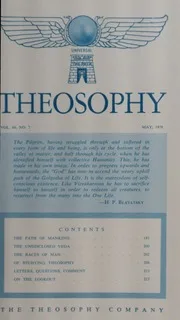





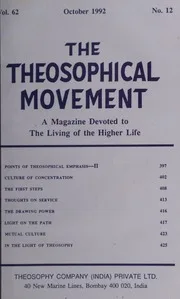

From the “Theosophy” Collection
View all →




More Free Theosophy & Anthroposophy Books
View all →