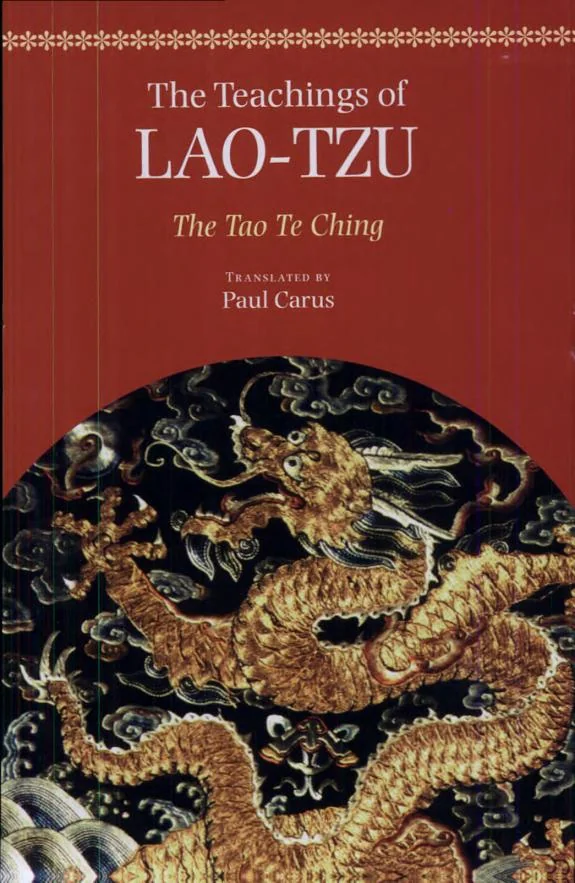
The Teachings of Lao-Tzu
 72
72

The Teachings of Lao-Tzu
Laozi’s *The Teachings of Lao-Tzu* offers a profound exploration of natural principles that, despite its ancient origins, continues to challenge conventional thinking. The text’s strength lies in its paradoxical aphorisms, which compel a re-evaluation of force and control. For instance, Chapter 76’s description of the sage as being "born in the world and able to love all people and set them free" provides a potent image of leadership through non-imposition, a concept starkly different from modern command-and-control structures. However, the sheer density of these aphorisms, particularly in sections detailing the Tao's inscrutability, can feel abstract without substantial commentary or prior exposure to Taoist thought. The work’s enduring relevance is undeniable, urging a return to elemental wisdom in an increasingly complex world. It is a vital text for those seeking to understand the underlying currents of existence.
📝 Description
72
Laozi's Teachings of Lao-Tzu offers aphorisms on existence, governance, and conduct.
This text, attributed to the sage Laozi, is not a story but a collection of sayings. It addresses the nature of reality, how to govern, and how to live. The book aims to help readers grasp the Tao, the fundamental principle behind all things. It speaks to those interested in Eastern thought, spiritual ideas about unity, and leaders who desire a calmer way of ruling. Anyone facing life's contradictions and looking for sensible advice for daily life will find value here.
Laozi is traditionally placed in the 6th century BCE, though scholars debate the text's final shape, suggesting around the 4th century BCE. It appeared in China during a time of much philosophical debate, alongside Confucianism and Mohism. Its teachings provided an alternative to philosophies focused on human structure, instead highlighting natural processes and straightforward living.
The Teachings of Lao-Tzu is a core text of Taoism, a tradition that emphasizes living in accordance with the Tao, the natural order of the universe. It stands apart from other Chinese philosophies like Confucianism by focusing on spontaneity and the inherent patterns of nature rather than social structures or rigid ethics. The concept of Wu Wei, or non-action, suggests aligning with this natural flow to achieve effectiveness without forceful intervention. This approach positions it within esoteric traditions that seek understanding through observation of natural principles and inner cultivation.
💡 Why Read This Book?
• You will learn to apply the principle of Wu Wei to your daily challenges, understanding how yielding can achieve greater results than forceful action, as exemplified in the text's discussions on water's power. • You will gain a new perspective on leadership and societal harmony by examining Laozi's ideas on governance, which prioritize simplicity and non-interference, contrasting sharply with modern political models. • You will encounter the concept of the Tao not as a deity but as an immanent, natural order, fostering a deeper appreciation for interconnectedness and the subtle forces shaping reality, as described in the early chapters.
⭐ Reader Reviews
Honest opinions from readers who have explored this book.
❓ Frequently Asked Questions
When was 'The Teachings of Lao-Tzu' originally published?
While the text's origins are ancient, the specific edition published on 2000-10-03 is a modern iteration. Scholarly consensus places the compilation of the *Tao Te Ching* itself between the 4th and 6th centuries BCE.
Who is Laozi and what is his connection to the Tao Te Ching?
Laozi is traditionally considered the author of the *Tao Te Ching* (The Teachings of Lao-Tzu). He is revered as a central figure in Taoism, though his historical existence and the precise authorship of the text remain subjects of academic debate.
What does 'Wu Wei' mean in the context of Laozi's teachings?
Wu Wei translates to 'non-action' or 'effortless action.' It signifies acting in accordance with the natural flow of the Tao, without unnecessary striving or force. It's about aligning one's actions with the inherent patterns of the universe.
Is 'The Teachings of Lao-Tzu' a religious text?
It is considered a foundational text of Taoism, a philosophy and religion. While it contains spiritual and philosophical wisdom, its approach is often described as more philosophical and observational than strictly devotional.
How does Laozi's philosophy compare to Confucianism?
Laozi's philosophy emphasizes naturalness, simplicity, and yielding (Taoism), whereas Confucianism focuses on social order, ethics, ritual, and duty. They represent distinct yet influential currents in ancient Chinese thought.
What is the concept of the Tao?
The Tao, or 'the Way,' is the fundamental, ineffable principle underlying all existence. It is the source, the process, and the order of the universe, which cannot be fully described or grasped by the intellect but can be understood through intuition and experience.
🔮 Key Themes & Symbolism
The Nature of the Tao
This theme explores the ineffable 'Way' that governs the universe. The text emphasizes that the Tao is the unnamable source of all things, beyond human comprehension yet intimately present in every aspect of existence. It is described as formless, eternal, and the mother of creation. Understanding the Tao involves recognizing its subtle influence and aligning oneself with its natural flow, moving away from artificial constructs and intellectual rigidity.
Wu Wei: Effortless Action
Central to Taoist practice, Wu Wei is the principle of acting in accordance with the natural course of events. It is not passivity but a dynamic state of non-striving, where actions are spontaneous, effective, and free from ego-driven effort. The text uses metaphors like water, which yields yet can wear away stone, to illustrate Wu Wei's power. Embracing Wu Wei leads to greater efficiency and harmony in personal conduct and governance.
Simplicity and Humility
Laozi advocates for a return to simplicity, rejecting excessive desires, knowledge, and societal complexities. Humility is presented as a virtue that allows one to remain grounded and open. By embracing humility, individuals can avoid the arrogance that leads to error and discord. This theme encourages a shedding of pretense and a focus on the essential, fostering contentment and inner peace.
The Balance of Opposites
The text frequently refers to the interplay of complementary forces, such as Yin and Yang. It posits that true understanding comes from recognizing that seemingly opposing concepts—like being and non-being, or strength and weakness—are interdependent and essential parts of a larger whole. This perspective encourages acceptance of paradox and a holistic view of reality, moving beyond simplistic dualistic thinking.
💬 Memorable Quotes
Direct passages from the work, attributed to the author.
“The Tao that can be told is not the eternal Tao.”
— This opening aphorism immediately establishes the ineffable nature of the Tao. It suggests that any attempt to define or fully articulate the ultimate reality will fall short, pointing towards a direct, intuitive understanding rather than intellectual grasp.
“To the mind that is still, the whole universe surrenders.”
— This points to the power of inner stillness and mental clarity. When the mind is not agitated by desires or distractions, it can perceive and align with the underlying order of the universe, leading to a state of harmony and efficacy.
“He who knows does not speak. He who speaks does not know.”
— This aphorism reflects the Taoist distrust of superficial knowledge and emphasis on inner wisdom. True understanding is often silent and intuitive, while excessive speech can indicate a lack of genuine insight or an attempt to mask ignorance.
“The best fighter is never angry.”
— This illustrates the effectiveness of calm, strategic action over reactive aggression. It suggests that true strength lies in self-mastery and the ability to act decisively without succumbing to emotional turmoil, a hallmark of Wu Wei.
💡 Key Ideas
Editorial paraphrase of the work's core concepts — not direct quotes.
Nature does not hurry, yet everything is accomplished.
This quote expresses the principle of Wu Wei. It highlights the efficiency and efficacy of natural processes, implying that by acting in harmony with the Tao's rhythm, one can achieve profound results without the stress of forced effort.
🌙 Esoteric Significance
Tradition
The Teachings of Lao-Tzu is a foundational text of philosophical and religious Taoism, a major tradition within Chinese esotericism. It departs from many Western esoteric lineages by emphasizing immanence over transcendence, focusing on the natural order of the cosmos rather than a separate divine creator. Its lineage is distinct, emphasizing harmony with the 'Way' (Tao) as the ultimate spiritual goal, differing from Hermeticism's focus on correspondence or Gnosticism's emphasis on hidden knowledge for salvation.
Symbolism
Key symbols include water, representing adaptability, yielding strength, and purity – it flows and conforms yet can erode the hardest substances. The uncarved block (Pu) symbolizes primal simplicity and potential before external forces impose form or definition. The infant represents innocence, naturalness, and a state free from ego and societal conditioning, embodying the ideal state of being aligned with the Tao.
Modern Relevance
Contemporary thinkers and practitioners across various disciplines draw upon Laozi's teachings. The concept of Wu Wei influences discussions on leadership, mindfulness, and sustainable living. Its emphasis on non-duality and natural flow speaks to modern spiritual movements, ecological philosophies, and even psychological approaches that advocate for acceptance and reduced ego-driven striving. It remains a touchstone for understanding holistic systems and balanced living.
👥 Who Should Read This Book
['• Students of comparative philosophy and religion seeking to understand the core tenets of Taoism and its historical context alongside other ancient schools of thought.', '• Spiritual seekers interested in non-dualistic perspectives and practices that emphasize natural harmony, inner peace, and effortless living.', '• Leaders and policymakers looking for alternative models of governance and social organization based on principles of simplicity, yielding, and alignment with natural processes.']
📜 Historical Context
Emerging during China's turbulent Spring and Autumn and Warring States periods (roughly 771-256 BCE), *The Teachings of Lao-Tzu* (*Tao Te Ching*) offered a philosophical counterpoint to the increasingly structured and hierarchical systems proposed by thinkers like Confucius. While Confucianism emphasized social order, ritual, and ethical conduct, Laozi's text championed naturalness, simplicity, and effortless action (Wu Wei). The work’s traditional attribution to Laozi, a contemporary of Confucius, places it within a vibrant intellectual milieu. Its compilation likely occurred over centuries, with its final form solidified around the 4th century BCE. The text’s ideas, focused on the Tao as an underlying cosmic principle, provided a framework for understanding the universe through natural flow rather than human decree, influencing Daoism and Chinese culture profoundly.
📔 Journal Prompts
The Tao's nature as indescribable and eternal.
Applying Wu Wei to a current personal or professional challenge.
Reflecting on the virtue of humility as presented by Laozi.
The interdependence of opposites (e.g., success/failure, light/dark).
The ideal of the 'uncarved block' in relation to personal identity.
🗂️ Glossary
Tao (or Dao)
The fundamental, ineffable principle that underlies all reality. It is the natural order, the source, and the way of the universe, often translated as 'the Way.'
Wu Wei
Literally 'non-action' or 'effortless action.' It signifies acting in accordance with the natural flow of the Tao, without excessive striving, force, or ego-driven intervention.
Pu (the Uncarved Block)
A symbol representing primal simplicity, naturalness, and the state of existence before being shaped by external influences, desires, or societal constructs.
Yin and Yang
Complementary, interdependent forces that represent the dualistic yet unified nature of reality. Yin is often associated with passive, dark, and feminine qualities, while Yang is active, light, and masculine.
Sage (Sheng Ren)
An enlightened individual who embodies the principles of the Tao, living in harmony with its natural flow, characterized by wisdom, humility, and effortless action.
De (Te)
Often translated as 'virtue' or 'power,' it refers to the manifestation of the Tao within individuals and things; one's inherent nature or moral force when aligned with the Tao.
The Ten Thousand Things
A Taoist expression referring to all phenomena and beings in the manifest universe, all of which arise from and return to the Tao.
This book appears in 1 collection
🔮 Readers Also Liked
Browse all →









From the “Taoism” Collection
View all →





More Free Occult Philosophy Books
View all →