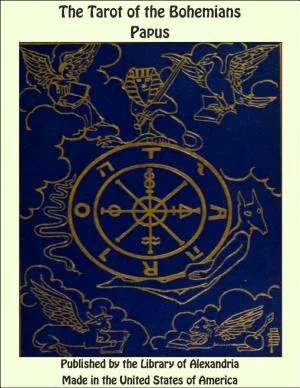
The Tarot of the Bohemians
 71
71

The Tarot of the Bohemians
Papus's "The Tarot of the Bohemians" is less a gentle introduction and more an immersion into a complex, systematized vision of the Tarot. Its strength lies in its ambitious attempt to forge a comprehensive esoteric framework, linking the cards to Kabbalah, ancient Egyptian symbolism, and a grand evolutionary narrative. The detailed breakdown of each card, connecting numerology, Hebrew letters, and philosophical concepts, provides a dense but rewarding analytical structure. However, the sheer density can be overwhelming, and the author's confident assertions, while compelling, often lack explicit, verifiable sourcing within the text itself, requiring significant reader diligence to untangle. A particularly striking element is the mapping of the 22 Major Arcana onto the Hebrew alphabet, a foundational technique for many subsequent esoteric interpretations. While not always an easy read, it remains a significant artifact of esoteric thought. It offers a detailed map, though the terrain it describes demands independent exploration.
📝 Description
71
Published in 1889, Papus's "The Tarot of the Bohemians" reinterpreted the Tarot beyond simple fortune-telling.
This 1889 work by Papus, originally titled "Le Tarot des Bohémiens," offers a detailed esoteric reading of the Tarot. It moves past basic cartomancy, presenting the Tarot as a symbolic language linked to ancient Egyptian lore and Kabbalistic ideas. Papus analyzes each card, connecting its visuals and numbers to spiritual growth, psychological patterns, and universal laws.
"The Tarot of the Bohemians" is intended for those seriously studying Western esotericism, occultism, and comparative religion. It suits readers who want to grasp the Tarot as a complete philosophical and spiritual system, not just a divinatory tool. Those interested in the history of occult movements, especially from the late 19th and early 20th centuries, will find its historical setting and the author's position within it valuable.
Papus's book appeared in the late Victorian era, a time of heightened interest in spiritualism and occult revival. It emerged alongside thinkers like Eliphas Lévi and groups such as the Hermetic Order of the Golden Dawn. The work contributed to making Tarot studies more intellectual and popular, aiming to elevate it to a form of sacred knowledge.
💡 Why Read This Book?
• Understand the Tarot as a symbolic language: Learn how Papus connects the 22 Major Arcana to Kabbalistic principles, numerology, and ancient wisdom, moving beyond simple divination to a philosophical system. • Explore late 19th-century occultism: Gain insight into the intellectual currents and esoteric revival that shaped modern occult studies, placing Papus within his historical milieu. • Develop a structured approach to Tarot study: Discover Papus's method for analyzing card meanings through correspondences, enabling a deeper, more analytical engagement with the Tarot.
⭐ Reader Reviews
Honest opinions from readers who have explored this book.
❓ Frequently Asked Questions
When was "The Tarot of the Bohemians" originally published?
The original French edition, "Le Tarot des Bohémiens," was first published in 1889, making it a foundational text in the modern esoteric study of the Tarot.
What esoteric traditions does Papus draw upon in this book?
Papus heavily integrates Kabbalistic principles, particularly the Tree of Life, and references ancient Egyptian symbolism. He also positions the Tarot within a broader Hermetic and Gnostic framework.
How does Papus interpret the 22 Major Arcana?
He interprets them as keys to universal principles and stages of spiritual evolution, systematically assigning them Hebrew letters, numerological values, and divine correspondences.
Is "The Tarot of the Bohemians" suitable for beginners?
While foundational, the book is dense and assumes a certain familiarity with esoteric concepts. Beginners might find it more accessible after initial study of Tarot basics or Kabbalah.
What is the significance of the 'Bohemians' in the title?
The title refers to the supposed ancient Egyptian origin of the Tarot, linking it to the Romani people (often historically called 'Bohemians') who were thought to have preserved this ancient wisdom.
What role does numerology play in Papus's Tarot system?
Numerology is central, with each card's meaning derived from its numerical value and its position within the sequence, linking it to cosmic laws and stages of development.
🔮 Key Themes & Symbolism
Tarot as Sacred Science
Papus argues that the Tarot is not merely a tool for fortune-telling but a profound symbolic language encoding universal truths. He meticulously reconstructs its origins, linking it to ancient Egyptian priesthoods and the Kabbalah. The book presents the 22 Major Arcana as a complete cosmology, mapping them onto the Tree of Life and assigning them Hebrew letters, demonstrating a systematic, scientific approach to understanding spiritual realities. This elevates the Tarot from a deck of cards to a philosophical text useful the path of initiation and cosmic order.
Kabbalistic Correspondences
A core part of Papus's interpretation is the integration of the Tarot with Kabbalistic mysticism. He systematically assigns each of the 22 Major Arcana to one of the 22 letters of the Hebrew alphabet, which in turn connect to the paths on the Tree of Life. This framework allows him to explore the numerical and symbolic relationships between the cards, the Sephirah, and the divine emanations, providing a structured method for deciphering hidden meanings and understanding the flow of divine energy.
Symbolic Language of the Universe
Papus views the Tarot as a universal language, a 'hieroglyphic book' that mirrors the structure of the cosmos and the human soul. Each card's imagery, number, and associated concepts are presented as keys to unlocking deeper levels of understanding about creation, consciousness, and spiritual evolution. The book encourages readers to see the world through this symbolic lens, recognizing patterns and correspondences that reveal the underlying unity of all things, from the macrocosm to the microcosm.
Spiritual Evolution and Initiation
The Tarot, according to Papus, outlines a path of spiritual development and initiation. The sequence of the Major Arcana represents stages of the soul's journey, from its initial descent into material form to its ultimate ascent toward divine consciousness. By studying the cards and their interrelationships, individuals can gain self-knowledge, understand the challenges and lessons inherent in life, and progress on their own path of spiritual enlightenment.
💬 Memorable Quotes
Direct passages from the work, attributed to the author.
“The Tarot is a book of symbols that contains the fundamental principles of all sciences.”
— This statement captures Papus's central thesis: that the Tarot is not just a divinatory tool but a comprehensive symbolic system encoding universal knowledge across various disciplines.
“The twenty-two letters of the Hebrew alphabet form the basis of the twenty-two Tarot cards.”
— This highlights the crucial Kabbalistic framework Papus employs, linking the Tarot's structure directly to the sacred alphabet, a core element in many Western esoteric traditions.
“Each card is a word, and all the cards together form the divine word.”
— This metaphor illustrates the hierarchical and interconnected nature of the Tarot within Papus's system, suggesting that individual symbols build towards a unified, cosmic revelation.
“The Tarot contains the secrets of the past, present, and future.”
— This reflects the traditional association of the Tarot with divination, but within Papus's context, it implies access to hidden knowledge and a deeper understanding of temporal and spiritual processes.
“The Bohemians are the true inheritors of the ancient Egyptian mysteries.”
— This refers to Papus's theory about the origin and transmission of Tarot wisdom, linking it to the Romani people and suggesting a hidden lineage preserving ancient esoteric knowledge.
🌙 Esoteric Significance
Tradition
Papus's work is deeply embedded within the Western Esoteric Tradition, particularly drawing from Hermeticism and Kabbalah. He sought to synthesize these traditions, presenting the Tarot as a key that unlocks both the Kabbalistic Tree of Life and ancient Egyptian mysteries. His approach is systematic and intellectual, aiming to establish the Tarot as a 'sacred science' akin to mathematical or astronomical principles, aligning with the broader Hermetic goal of understanding the correspondence between the macrocosm and microcosm.
Symbolism
Central to the book's symbolism is the mapping of the 22 Major Arcana onto the 22 Hebrew letters, which correspond to the paths on the Kabbalistic Tree of Life. For instance, 'The Fool' (0 or 22) is linked to 'Aleph' (א), representing air, beginnings, and the initiate's journey. 'The Magician' (I) is associated with 'Beth' (ב), the second letter, signifying a builder or creator, and embodying active manifestation. Papus interprets these correspondences to reveal profound truths about cosmic forces and spiritual progression.
Modern Relevance
Papus's systematization of the Tarot, particularly its integration with Kabbalistic structures, profoundly influenced subsequent occult authors and practitioners. Thinkers and groups within modern Western Esotericism, including many Tarot readers and teachers, continue to rely on or adapt his correspondences. His attempt to create a comprehensive Tarot philosophy laid groundwork for later works that explore the psychological and archetypal dimensions of the cards, making "The Tarot of the Bohemians" a foundational text for understanding contemporary esoteric Tarot study.
👥 Who Should Read This Book
• Students of Western Esotericism: Individuals seeking to understand the historical development and intellectual underpinnings of modern occultism, particularly the role of the Tarot. • Kabbalah Enthusiasts: Those interested in exploring the practical application of Kabbalistic principles to symbolic systems like the Tarot, gaining a structured interpretive framework. • Serious Tarot Researchers: Readers who wish to move beyond basic divination and explore the philosophical, symbolic, and historical dimensions of the Tarot as a complex esoteric text.
📜 Historical Context
Published in 1889, "The Tarot of the Bohemians" by Papus (Gérard Encausse) emerged during a fervent period of occult revival in late 19th-century Europe. This era saw widespread fascination with spiritualism, theosophy, and esoteric philosophies, fueled by figures like Helena Blavatsky and the resurgence of interest in Hermeticism and Kabbalah. Papus was a central figure in French occultism, co-founding the Hermetic Order of the Golden Dawn's French branch and contributing significantly to the intellectualization of occult studies. His work aimed to present the Tarot not as a folk divination tool, but as a profound scientific and philosophical system rooted in ancient traditions. It arrived shortly after the influential interpretations by Éliphas Lévi in the mid-19th century, further solidifying the Tarot's place within esoteric discourse and influencing subsequent generations of occultists and mystics.
📔 Journal Prompts
How does Papus's attribution of Hebrew letters to Tarot cards alter your perception of their meanings?
Reflect on the idea of the Tarot as a 'sacred science'; what scientific principles might it embody?
Consider the 'Bohemian' connection Papus makes; what does this suggest about the transmission of esoteric knowledge?
How does the concept of spiritual evolution, as presented through the Major Arcana, apply to your own life journey?
Compare Papus's systematic approach to other Tarot interpretations you are familiar with.
🗂️ Glossary
Kabbalah
A system of Jewish mysticism that explores the divine nature and creation through esoteric interpretations of scripture, often utilizing the Tree of Life diagram and numerical symbolism.
Major Arcana
The 22 trump cards of the Tarot deck, typically representing significant life lessons, archetypal figures, and spiritual milestones in esoteric interpretations.
Tree of Life
A central diagram in Kabbalah, consisting of ten Sephirah (emanations or spheres) and 22 paths, used to map divine consciousness, creation, and the spiritual journey.
Hermeticism
A philosophical and religious tradition based on the purported teachings of Hermes Trismegistus, emphasizing concepts like 'as above, so below' and the interconnectedness of the universe.
Esotericism
Systems of thought and practice concerned with hidden or inner knowledge, often involving spiritual disciplines, symbolism, and a belief in unseen realities or forces.
Cartomancy
The practice of divination or fortune-telling using a deck of cards, particularly the Tarot.
Symbolic Language
A system of communication that uses symbols, images, and allegories to convey deeper meanings beyond their literal interpretation.
This book appears in 1 collection
🔮 Readers Also Liked
Browse all →







From the “Tarot” Collection
View all →







More Free Occult Philosophy Books
View all →