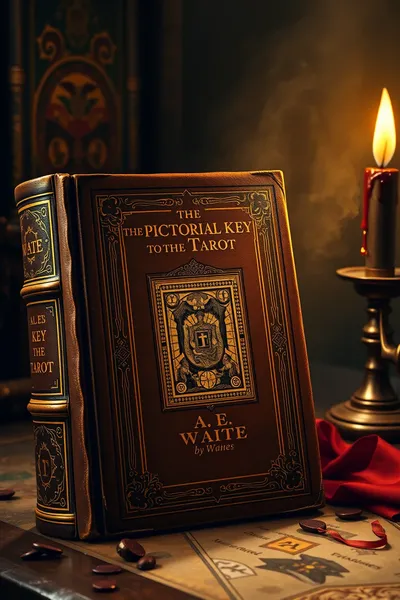
The SYMBOLISM of the TAROT: Philosophy of Occultism in Pictures and Numbers
 80
80

The SYMBOLISM of the TAROT: Philosophy of Occultism in Pictures and Numbers
P. D. Ouspensky's The SYMBOLISM of the TAROT is a challenging but ultimately rewarding treatise for those who approach the cards not as parlor tricks but as a profound philosophical grammar. Ouspensky, writing with a characteristic intellectual austerity, insists that the true study of occultism is the study of symbolism itself, a "language of the Initiates" requiring rigorous mental discipline. He eschews simplistic divinatory interpretations in favor of a systematic exploration of how numbers and images function as vehicles for universal principles. A particular strength lies in his insistence on developing a "sense of symbols," a faculty he argues can be cultivated. However, the book's density and Ouspensky's unyielding focus on abstract philosophy might alienate readers seeking practical application or historical context on specific Tarot decks. The work's value lies in its uncompromising demand for intellectual engagement with the symbolic form. It’s a demanding but essential text for understanding the philosophical architecture behind occult symbolism.
📝 Description
80
Published in 2008, P. D. Ouspensky's The Symbolism of the Tarot examines occultism through symbolic language.
This book examines the esoteric principles behind the Tarot, focusing on P. D. Ouspensky's philosophical interpretation. Ouspensky argued that understanding occultism requires understanding symbolism, a practice he believed demanded specific mental discipline to grasp the "language of the Initiates." The work analyzes how images and numerical values within the Tarot serve as conduits for perceiving hidden forces in both the natural world and human consciousness. It is not a manual for fortune-telling but a study of the Tarot as a symbolic system.
Serious students of esoteric philosophy and occultism seeking a structured intellectual approach to symbolic systems will find this volume valuable. It appeals to those who see the Tarot as a symbolic representation of existence, rather than solely a divinatory instrument. Readers interested in comparative mysticism, the history of Western esotericism, and the philosophical foundations of occult traditions will encounter ample material for consideration. The book is especially useful for individuals aiming to cultivate a "sense of symbols" through focused mental effort, as Ouspensky recommended.
Ouspensky's work engages with Western esotericism, particularly traditions that developed in the late 19th and early 20th centuries. His views on symbolism and occultism were shaped by figures like G. I. Gurdjieff and the Theosophical movement, yet he formulated his own philosophical framework. This book comes from a lineage that aimed to reframe ancient ideas for contemporary audiences, often in response to prevailing scientific and religious thought. The study of Tarot symbolism itself had become prominent among occultists such as Eliphas Lévi and Papus in the decades prior.
💡 Why Read This Book?
• You will learn the necessity of cultivating a "sense of symbols" as a core tenet of occult study, moving beyond superficial interpretations of esoteric systems. • Gain an understanding of P. D. Ouspensky's philosophical framework, which views "occultism and symbolism" as nearly synonymous, demanding a specific mental training for comprehension. • Discover how the Tarot's "pictures and numbers" are presented not for prediction but as components of a universal symbolic language, as articulated in the book's initial publication year of 2008.
⭐ Reader Reviews
Honest opinions from readers who have explored this book.
❓ Frequently Asked Questions
Is P. D. Ouspensky's book about learning to read Tarot cards for fortune-telling?
No, The SYMBOLISM of the TAROT focuses on the philosophical and occult significance of the cards. Ouspensky treats them as a symbolic language for understanding universal principles, not as a tool for predicting future events.
What does Ouspensky mean by the "language of the Initiates" in relation to the Tarot?
Ouspensky uses this term to describe the symbolic system of the Tarot, which he believes requires special mental training to comprehend. It's a hidden language accessible through understanding its symbolic structure and numerical correlations.
How does the book connect occultism and symbolism?
Ouspensky asserts that the terms are almost interchangeable when used correctly. He argues that comprehending occultism is impossible without understanding symbolism, as symbols are the primary means through which esoteric knowledge is conveyed and understood.
What kind of "special training of the mind" does Ouspensky suggest for understanding Tarot symbolism?
He implies a disciplined, systematic approach to perception and thought, aimed at developing a "sense of symbols." This involves moving beyond ordinary ways of thinking to grasp the deeper, hidden meanings embedded in symbolic forms.
When was P. D. Ouspensky's work on Tarot symbolism first published?
The SYMBOLISM of the TAROT: Philosophy of Occultism in Pictures and Numbers was first published on July 31, 2008, making it a relatively modern engagement with classic esoteric themes.
Does the book discuss specific Tarot card meanings in detail?
While it uses the Tarot as its subject, the book is more concerned with the underlying philosophical principles and the nature of symbolism itself, rather than providing a comprehensive guide to the interpretation of individual cards.
🔮 Key Themes & Symbolism
Symbolism as Esoteric Language
Ouspensky posits that symbolism is not merely decorative but the fundamental language of occultism. He argues that true comprehension of hidden forces requires developing a specific "sense of symbols," a faculty that allows one to perceive the deeper connections and meanings encoded in images and numbers. This perspective elevates the Tarot from a simple card game to a complex cipher for universal truths, demanding rigorous intellectual discipline from the student.
Occultism and Mental Discipline
The work stresses that engaging with occult philosophy necessitates a "special training of the mind." Ouspensky contrasts this with ordinary learning, suggesting that understanding the "language of the Initiates" involves cultivating a new way of perceiving reality. The book advocates for a disciplined approach to developing this symbolic intuition, treating the Tarot as a practical tool for this internal development rather than a passive object of study.
Tarot as Philosophical Codex
Rather than focusing on divination, Ouspensky presents the Tarot as a philosophical codex, where "pictures and numbers" represent fundamental principles of existence. Each element is imbued with meaning that, when understood correctly, unlocks insights into the hidden workings of nature and consciousness. The book's approach is to decode this symbolic structure, revealing its philosophical depth and its utility for esoteric study.
The Nature of Hidden Forces
The SYMBOLISM of the TAROT explores how symbolic representations serve as gateways to understanding "hidden forces." These forces are not necessarily supernatural but refer to the subtle, underlying laws and energies that govern the universe and human psychology. By deciphering the symbolic language of the Tarot, students can begin to perceive and potentially work with these forces, aligning themselves with deeper cosmic principles.
💬 Memorable Quotes
Direct passages from the work, attributed to the author.
“if the words occultism and symbolism are correctly used, they mean almost one and the same thing.”
— This core assertion frames the book's entire thesis: that the study of the hidden (occultism) is fundamentally the study of its symbolic expression. It implies that understanding symbols is not a secondary skill but the primary method for engaging with esoteric knowledge.
“Symbolism cannot be learned as one learns to build bridges or speak a foreign language...”
— This highlights the unique nature of symbolic understanding. It suggests that grasping symbolism requires a different kind of learning—one that involves developing intuition and a specific perception, rather than memorizing facts or mastering technical procedures.
“Special training of the mind is necessary in order to comprehend the "language of the Initiates..."”
— This emphasizes the rigorous, disciplined approach required. Ouspensky implies that ordinary consciousness is insufficient for decoding esoteric symbolism, necessitating a deliberate cultivation of mental faculties to access deeper layers of meaning.
“There are many methods for developing the "sense of symbols" in those who are striving to understand the hidden forces of Natur[e].”
— This indicates that the book is part of a broader tradition of esoteric pedagogy. Ouspensky presents the Tarot as one means among many to achieve this crucial development of symbolic perception, essential for understanding the universe's subtle workings.
“The SYMBOLISM of the TAROT: Philosophy of Occultism in Pictures and Numbers”
— This full title captures the book's purpose: to examine the Tarot not just as symbolic images but as a philosophical system deeply intertwined with occult principles, using both visual representation and numerical structure as its foundation.
🌙 Esoteric Significance
Tradition
Ouspensky's work fits within the broader Western Esoteric Tradition, specifically drawing from Hermetic and Kabbalistic currents that view symbolism as a key to understanding cosmic order. It departs from purely divinatory applications of the Tarot, aligning more with philosophical and psychological interpretations favored by schools emphasizing spiritual development and the nature of consciousness, such as the Fourth Way with which Ouspensky was associated.
Symbolism
The book highlights the symbolic significance of numerical correspondences (e.g., the sequence of Major Arcana) and archetypal imagery (e.g., The Fool, The Magician). Ouspensky treats these not as static meanings but as dynamic principles representing stages of consciousness, universal laws, and the relationship between the microcosm and macrocosm, as understood within esoteric traditions.
Modern Relevance
Contemporary practitioners of Western esotericism, particularly those interested in psychological archetypes and symbolic systems beyond simple fortune-telling, find Ouspensky's approach highly relevant. His emphasis on developing a "sense of symbols" continues to influence modern Tarot study, encouraging a deeper, more philosophical engagement with the cards as tools for self-understanding and spiritual inquiry.
👥 Who Should Read This Book
• Students of P. D. Ouspensky's philosophical system seeking to understand his views on symbolic language and its role in esoteric development. • Serious Tarot enthusiasts who wish to move beyond divinatory practices to explore the cards as a profound philosophical and psychological framework. • Scholars of Western Esotericism interested in the intellectual history of Tarot interpretation and its connection to occult philosophy in the early 20th century.
📜 Historical Context
P. D. Ouspensky's exploration of Tarot symbolism emerged from the fertile ground of early 20th-century esoteric thought, a period marked by intense interest in Western esotericism, occultism, and comparative religion. While the book's first publication date is 2008, its intellectual lineage traces back to figures like Eliphas Lévi and Papus, who were instrumental in reviving and reinterpreting Tarot symbolism for occult purposes in the late 19th century. Ouspensky himself was significantly influenced by G.I. Gurdjieff and the Fourth Way, a school of thought that emphasized practical psychological and spiritual development, often through symbolic systems. This work can be seen as engaging with, yet distinct from, the more Theosophical interpretations prevalent at the time, offering a more philosophically rigorous and psychologically focused analysis. The academic and popular reception of such works often varied, with some embracing them as profound spiritual texts while others viewed them with skepticism, reflecting broader societal debates about the nature of knowledge and belief.
📔 Journal Prompts
The "language of the Initiates" as described by Ouspensky: how might ordinary language fail to convey esoteric truths?
Cultivating a "sense of symbols": What practices beyond studying the Tarot might help develop this faculty?
The inherent connection between "occultism and symbolism": Reflect on an example where a symbol unlocked a deeper understanding for you.
The Tarot's "pictures and numbers" as a philosophical system: How does this perspective differ from viewing the Tarot as a predictive tool?
Interpreting "hidden forces": How can symbolic understanding illuminate forces that are not immediately apparent in everyday life?
🗂️ Glossary
Occultism
The study of hidden or secret knowledge, particularly concerning supernatural, mystical, or magical forces and phenomena. In Ouspensky's view, it is intrinsically linked to the understanding of symbolism.
Symbolism
The use of symbols to represent ideas or qualities. For Ouspensky, it is the fundamental language through which esoteric truths are conveyed and understood, requiring specific training to interpret.
Language of the Initiates
A term used by Ouspensky to denote the symbolic and philosophical system of the Tarot, which he believed requires special mental training and a developed "sense of symbols" to comprehend.
Sense of Symbols
A cultivated faculty for perceiving and understanding the deeper, hidden meanings encoded within symbolic representations, essential for grasping esoteric principles.
Hidden Forces
Subtle, underlying principles, energies, or laws that govern the universe and consciousness, which Ouspensky suggests can be understood through the study of symbolism, particularly the Tarot.
Pictures and Numbers
Refers to the two primary components of the Tarot's symbolic structure as analyzed by Ouspensky: the visual imagery of the cards and their inherent numerical values, both conveying philosophical meaning.
Philosophy of Occultism
The intellectual and conceptual framework underlying esoteric practices and beliefs. Ouspensky's work explores this philosophy specifically through the symbolic lens of the Tarot.