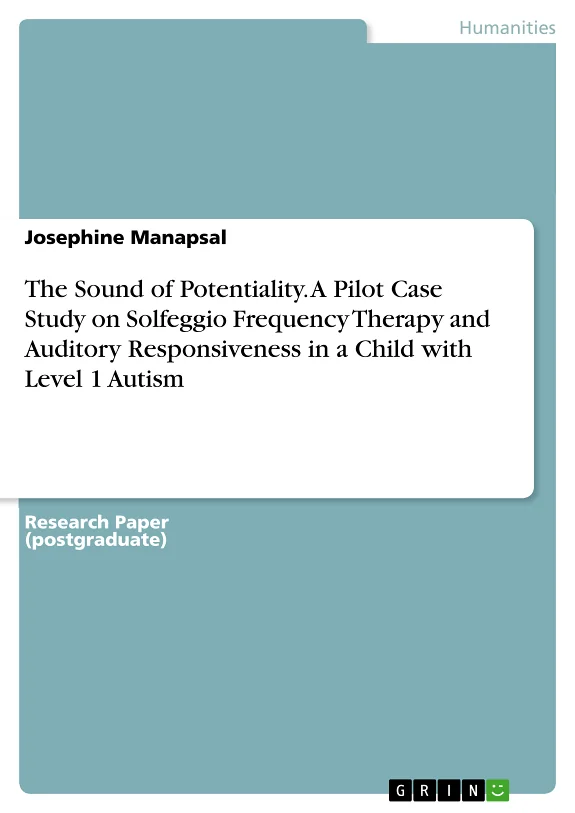
The Sound of Potentiality. A Pilot Case Study on Solfeggio Frequency Therapy and Auditory Responsiveness in a Child with Level 1 Autism
 79
79

The Sound of Potentiality. A Pilot Case Study on Solfeggio Frequency Therapy and Auditory Responsiveness in a Child with Level 1 Autism
Josephine Manapsal's "The Sound of Potentiality" offers a focused examination of a specific therapeutic intervention for a child with Level 1 Autism. The strength of this pilot study lies in its precise methodology, detailing the integration of Solfeggio frequencies with the Tomatis Method. Manapsal's work provides a clear, if preliminary, account of observed improvements in auditory processing and vocal flexibility. However, the case study's inherent limitation is its narrow scope; generalizing these findings requires broader, controlled research. A particularly compelling section details the child's increased engagement with rhythmic elements following the intervention, suggesting a tangible effect. While not a definitive treatise, this paper serves as a valuable, early exploration into sound therapy's potential for ASD.
📝 Description
79
In 2025, Josephine Manapsal published a pilot study on Solfeggio frequencies and autism.
This 2025 postgraduate research paper details a pilot case study. It examines how Solfeggio frequencies, combined with the Tomatis Method, might help a child with Level 1 Autism Spectrum Disorder. The study looks at auditory responsiveness, vocal flexibility, rhythmic coordination, and emotional regulation. It suggests that specific sound interventions, especially Solfeggio pitches, could affect neural pathways and behavior in children with ASD.
The work is for researchers, therapists, and parents seeking alternative methods to support children with ASD. It touches on the connection between auditory processing, sound therapy, and developmental psychology. The research builds on earlier work in auditory training and sound therapies, with the integration of Solfeggio frequencies for ASD representing a newer focus on energetic and vibrational healing.
This study engages with a developing interest in the energetic and vibrational aspects of healing, a current within alternative therapeutic traditions. While the Tomatis Method has historical roots in auditory training, its combination with Solfeggio frequencies for developmental support aligns with contemporary esoteric practices that explore the influence of specific sound vibrations on the human energetic system. It reflects a movement beyond purely physical or psychological explanations toward a consideration of subtle energies and their potential therapeutic applications.
💡 Why Read This Book?
• Learn about the specific application of Solfeggio frequencies and the Tomatis Method in a case study from 2025, offering a contemporary look at auditory interventions for ASD. • Understand how targeted sound therapies, as explored in this research, might improve vocal flexibility and rhythmic coordination in children with Level 1 Autism. • Gain insight into the potential for sound-based approaches to influence emotional regulation, a critical area for individuals on the Autism Spectrum, as presented in the study's findings.
⭐ Reader Reviews
Honest opinions from readers who have explored this book.
❓ Frequently Asked Questions
What is the primary research question addressed in "The Sound of Potentiality"?
The paper investigates whether Solfeggio frequency therapy, combined with the Tomatis Method, can enhance auditory processing, vocal flexibility, rhythmic coordination, and emotional regulation in a child with Level 1 Autism Spectrum Disorder.
When was "The Sound of Potentiality" first published?
The research paper was first published on July 22, 2025.
What specific therapeutic methods are combined in this study?
The study integrates Solfeggio frequency exercises with principles and techniques from the Tomatis Method.
What are Solfeggio frequencies?
Solfeggio frequencies are a set of ancient musical tones, often associated with specific spiritual or healing properties, that are believed to have beneficial effects on the mind and body.
Who is the author of this case study?
The author of "The Sound of Potentiality" is Josephine Manapsal.
What is the main subject area of this research?
The primary subject area is Developmental Psychology, with a focus on therapeutic interventions for Autism Spectrum Disorder.
🔮 Key Themes & Symbolism
Auditory Processing Enhancement
The research posits that specific sound frequencies, notably Solfeggio tones, can stimulate and refine auditory pathways. By focusing on the child's responsiveness to these frequencies, the study explores how targeted auditory input might improve the brain's ability to process sound, a common challenge for individuals with ASD. This includes understanding how structured sound can lead to better comprehension and interaction with auditory environments.
Vocal and Rhythmic Development
A significant aspect of the study involves observing improvements in vocal flexibility and rhythmic coordination. The integration of the Tomatis Method, known for its focus on listening and vocalization, alongside the structured patterns of Solfeggio frequencies, is examined for its potential to encourage more nuanced vocal expression and a better sense of rhythm. This theme examines how sound therapy can unlock developmental capacities.
Emotional Regulation Through Sound
The paper investigates the profound connection between sound and emotional states. It explores how the application of specific Solfeggio frequencies might act as a regulatory mechanism, helping to modulate the child's emotional responses. The study examines whether consistent exposure to these therapeutic sounds can lead to a more stable emotional baseline and improved self-regulation skills.
Integration of Therapeutic Modalities
This theme centers on the innovative combination of two distinct therapeutic approaches: Solfeggio frequency therapy and the Tomatis Method. The research highlights the synergistic potential when these methods are applied concurrently. It seeks to understand how their combined application might offer a more comprehensive intervention than either modality alone for addressing the many-sided needs of a child with Level 1 ASD.
💬 Memorable Quotes
Direct passages from the work, attributed to the author.
“Enhancing auditory processing through specific frequency interventions.”
— This concept highlights the study's core hypothesis: that tailored sound frequencies can directly improve how the brain interprets and responds to auditory stimuli, a key area of focus for ASD support.
“The Tomatis Method's role in vocal and rhythmic development.”
— This refers to the established practice of using modified sound to stimulate listening and vocal abilities, which the study integrates with Solfeggio frequencies to explore broader developmental gains.
“Solfeggio frequencies as a tool for emotional modulation.”
— This captures the research's aim to explore the potential of specific ancient tones to influence and stabilize emotional states, offering a novel approach to emotional regulation.
“Pilot study observing auditory responsiveness in a child with Level 1 Autism.”
— This succinctly describes the study's design and subject matter, emphasizing its initial, focused exploration of sound's impact on a specific developmental profile.
“Synergistic effects of combined sound therapy techniques.”
— This points to the research's interest in whether the combined application of Solfeggio frequencies and the Tomatis Method yields greater therapeutic benefits than each method used in isolation.
🌙 Esoteric Significance
Tradition
While not explicitly rooted in a single ancient lineage, the use of Solfeggio frequencies connects this work to esoteric traditions that utilize specific sonic patterns for spiritual and healing purposes. These frequencies are often linked to Pythagorean numerology and ancient liturgical chants, suggesting a resonance with Hermetic and Gnostic traditions that explore the power of sound and vibration as fundamental creative forces. The study departs from purely mystical interpretations by grounding these frequencies in a clinical, scientific case study framework.
Symbolism
The primary symbol is the Solfeggio frequency itself, often representing divine order, healing, and spiritual awakening. The specific tones (e.g., UT 396 Hz, RE 417 Hz) carry symbolic weight, associated with releasing guilt, overcoming obstacles, and achieving transformation. The integration with the Tomatis Method, which often uses 'electronic ear' technology, symbolizes the bridging of ancient sonic wisdom with modern therapeutic techniques, representing a structured approach to unlocking inner potential.
Modern Relevance
This work is highly relevant to contemporary practitioners and researchers in fields such as sound healing, bioacoustics, and neurofeedback. Thinkers exploring the efficacy of vibrational therapies and integrative approaches to neurodevelopmental disorders, like those influenced by the work of Dr. David I. I. Meaney, may find this study's findings of interest. It also speaks to a growing movement within autism support that embraces diverse, sensory-based interventions beyond conventional therapies.
👥 Who Should Read This Book
• Parents and caregivers of children with Level 1 Autism Spectrum Disorder interested in exploring complementary auditory interventions. • Therapists and educators seeking to understand the potential applications of sound therapy, specifically Solfeggio frequencies and the Tomatis Method, in their practice. • Researchers in developmental psychology and psychoacoustics looking for case study evidence on the impact of targeted sound interventions on auditory processing and emotional regulation.
📜 Historical Context
Published in 2025, "The Sound of Potentiality" emerges within a contemporary range of neurodiversity research and the growing interest in non-pharmacological interventions for Autism Spectrum Disorder. While the Tomatis Method, developed by Alfred Tomatis, gained significant attention from the mid-20th century onwards for its work on listening and communication, the integration with Solfeggio frequencies represents a more recent exploration. This study arrives at a time when fields like psychoacoustics and vibrational medicine are increasingly being considered for therapeutic applications. It follows in the footsteps of researchers like Dr. David I. I. Meaney, who explored sound's impact on development, though Manapsal's focus on specific ancient frequencies for ASD is distinct. The work contributes to a broader discourse that seeks to understand the brain's complex relationship with sound, moving beyond purely neurological models to incorporate vibrational and energetic perspectives.
📔 Journal Prompts
The specific Solfeggio frequencies used and their intended effects.
Observational data on the child's auditory responsiveness.
Impact of the integrated Tomatis Method and Solfeggio frequencies on vocal flexibility.
Correlation between sound intervention and observed rhythmic coordination.
Changes in emotional regulation patterns post-therapy.
🗂️ Glossary
Solfeggio Frequency Therapy
A therapeutic approach utilizing specific ancient musical tones believed to possess distinct vibrational qualities that promote healing, balance, and well-being.
Tomatis Method
An auditory stimulation therapy developed by Alfred Tomatis, focusing on improving listening skills, communication, and cognitive function through specially filtered and modulated music and sounds.
Level 1 Autism Spectrum Disorder (ASD)
A diagnosis within the Autism Spectrum characterized by difficulties in social interaction and communication that require support, but without significant impairment in daily functioning.
Auditory Processing
The way the brain receives, interprets, and responds to auditory information, encompassing abilities like sound localization, discrimination, and comprehension.
Vocal Flexibility
The range and adaptability of an individual's voice, including variations in pitch, tone, volume, and articulation.
Rhythmic Coordination
The ability to synchronize movements or actions with a consistent beat or pattern, essential for activities like speech, walking, and music.
Emotional Regulation
The process of influencing which emotions are experienced, when they are experienced, and how they are experienced and expressed.
This book appears in 1 collection
🔮 Readers Also Liked
Browse all →









From the “Sound Healing” Collection
View all →








More Free Occult Philosophy Books
View all →