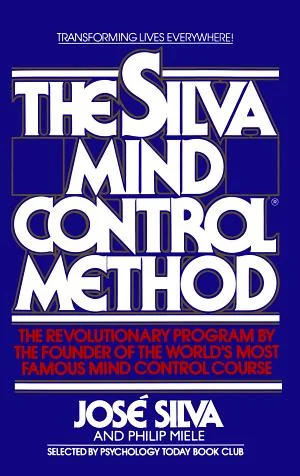
The Silva Mind Control Method
 79
79

The Silva Mind Control Method
José Silva’s 1991 text, co-authored with Philip Miele, offers a structured, almost pedagogical approach to mental self-mastery that feels less like esoteric dogma and more like a practical toolkit. The strength lies in its systematic progression; Silva doesn't just present concepts but provides step-by-step exercises. For instance, the detailed instructions for entering the alpha state via the '50-to-1 Relaxing Technique' are clear and repeatable. However, the book occasionally leans into an almost overly optimistic, deterministic view of mental control, particularly when discussing applications like influencing external events or achieving perfect recall, which may strain credulity for some readers. The insistence on a singular 'correct' way to achieve these states also feels limiting. Still, the sheer volume of exercises and the accessible language make it a significant historical document in the self-help and mind-power movements.
Silva provides a compelling, if sometimes oversimplified, path to self-directed mental change.
📝 Description
79
Published in 1991, The Silva Mind Control Method details a system for accessing the mind's potential through altered states.
José Silva and Philip Miele's 1991 book, The Silva Mind Control Method, outlines a systematic approach to mental self-mastery. It teaches techniques to reach the 'alpha level,' a state of heightened awareness Silva believed allows access to deeper mental faculties. The book progresses from basic relaxation exercises to applications in problem-solving, healing, and even telepathy. It aims to provide practical methods for individuals interested in enhancing their mental abilities, personal growth, stress reduction, and creativity. The approach is structured and emphasizes actionable techniques for influencing well-being and circumstances, intended for both the curious and the skeptical. Silva's method presents a secularized framework for mental self-mastery, distinct from more overtly spiritual traditions, and relies on principles that appear scientific in nature.
The core of the Silva Method is the achievement and use of the alpha state of brainwave activity. Silva viewed this state as a connection between conscious and subconscious awareness, a space conducive to learning, healing, and intuition. The book describes specific techniques designed to facilitate this state and leverage it. These methods aim to make mental self-improvement accessible through structured practice.
The Silva Method emerged in 1991 amidst a growing interest in the mind-body connection and New Age thought. José Silva's work drew on earlier research into altered states of consciousness, with influences from figures like Dr. Joseph Banks Rhine and his parapsychology studies at Duke University. Silva's approach distinguished itself by offering a secularized, scientifically framed system for mental self-mastery, diverging from more traditional spiritual practices. This made concepts of enhanced mental abilities and psychic phenomena seem attainable through practical, repeatable exercises, though it was met with varied reception from the scientific community.
💡 Why Read This Book?
• You will learn the specific '50-to-1 Relaxing Technique' to enter the alpha state, a foundational skill for accessing deeper mental processing as detailed in the book's early chapters. • You will discover concrete visualization exercises, such as the 'Three Fingers Technique,' enabling you to recall information more effectively and solve problems using methods outlined by José Silva. • You will gain an understanding of how to apply mind control principles for personal betterment, moving beyond mere relaxation to practical applications for healing and goal achievement, as presented in the book's later sections.
⭐ Reader Reviews
Honest opinions from readers who have explored this book.
❓ Frequently Asked Questions
What is the core concept behind the Silva Mind Control Method?
The core concept is achieving and utilizing the 'alpha state' of brainwave activity. José Silva believed this state of relaxed awareness allows access to subconscious capabilities for enhanced learning, problem-solving, and healing.
When was The Silva Mind Control Method first published?
The Silva Mind Control Method was first published on January 15, 1991, by José Silva and Philip Miele.
What are some practical techniques taught in the book?
Practical techniques include the '50-to-1 Relaxing Technique' for entering the alpha state, the 'Three Fingers Technique' for memory recall, and various visualization exercises for problem-solving and goal setting.
Is the Silva Method considered scientific?
While the method uses terms like 'alpha state' associated with brainwaves, its broader claims about telepathy and influencing external events are not widely accepted by mainstream science. It's often categorized as pseudoscience or parapsychology.
Who was José Silva?
José Silva was an American self-taught parapsychologist and the founder of the Silva Method, a system of mind development and mind control techniques he developed over several decades.
Does the book offer techniques for healing?
Yes, the book details 'hands-on' and 'hands-off' healing techniques that Silva claimed could be performed by practitioners using their mind and intention from a distance, often while in the alpha state.
🔮 Key Themes & Symbolism
Alpha State Attainment
The central tenet of the Silva Method is the systematic attainment of the alpha brainwave state, typically associated with relaxed wakefulness. Silva and Miele provide detailed, repeatable exercises, such as the '50-to-1 Relaxing Technique,' to guide the reader into this mental space. The work posits that alpha is not merely for relaxation but is a gateway to accessing subconscious resources, enhancing learning capacity, intuition, and problem-solving abilities far beyond ordinary conscious processing.
Mental Programming and Visualization
A significant portion of the book is dedicated to practical techniques for 'programming' the mind. This involves using focused intention and vivid visualization to achieve desired outcomes. Concepts like the 'Three Fingers Technique' for memory retrieval and the use of mental laboratories are explained. The authors emphasize that consistent practice of these mental exercises can reprogram subconscious beliefs and patterns, leading to tangible changes in behavior and reality.
Mind-Body Connection and Healing
The Silva Method explores the profound connection between mental states and physical well-being. It introduces techniques that Silva claimed could be used for self-healing and even for helping others heal. These methods often involve projecting positive energy, visualizing healing processes, and utilizing the alpha state to facilitate the body's natural restorative functions. The book suggests that mental discipline is a key component in maintaining health and recovering from illness.
Intuition and Extrasensory Perception
Silva believed that by mastering the alpha state and practicing specific mental exercises, individuals could significantly enhance their intuitive faculties and develop extrasensory perception (ESP). The book discusses techniques for developing 'inner-mind' communication, perceiving information beyond the normal senses, and using these abilities for practical guidance and problem-solving. This aspect positions the Silva Method within broader discussions of parapsychology and consciousness studies.
💬 Memorable Quotes
Direct passages from the work, attributed to the author.
“The alpha level is the level of mind where you can do your best thinking.”
— This statement expresses Silva's core thesis: that the relaxed, focused state of alpha brainwaves is optimal for cognitive functions like learning, creativity, and problem-solving, surpassing ordinary beta-wave consciousness.
“To solve a problem, you need to be able to remember it.”
— This highlights the practical application of mental techniques, specifically memory enhancement, as a prerequisite for effective problem-solving within the Silva system. The 'Three Fingers Technique' is a direct method for this.
“The mind can heal the body.”
— This succinctly expresses the book's perspective on the mind-body connection, suggesting that mental focus and intention, particularly within the alpha state, can actively influence physical health and healing.
“You are the master of your own mind.”
— This is an overarching principle of the Silva Method, encouraging self-empowerment and the belief that individuals possess the inherent capability to control and direct their mental processes for personal improvement.
💡 Key Ideas
Editorial paraphrase of the work's core concepts — not direct quotes.
When you are in the alpha state, you can learn faster and remember more.
This paraphrased concept emphasizes the enhanced learning and memory retention attributed to the alpha state, a key benefit promoted by the Silva Method's training.
🌙 Esoteric Significance
Tradition
While not strictly adhering to any single esoteric lineage, the Silva Method draws from various traditions that explore consciousness and mental discipline. It shares common ground with Hermetic principles of 'As Above, So Below' by linking internal mental states to external reality and with Gnostic ideas of inner knowledge. Its emphasis on direct mental experience and self-realization also echoes elements of Western esotericism and even some aspects of mindfulness practices found in Eastern traditions, albeit secularized and framed within a quasi-scientific model.
Symbolism
The primary 'symbol' within the Silva Method is the concept of the 'alpha state' itself – representing a liminal space between the conscious and subconscious, a gateway to deeper awareness. Brainwave patterns, often depicted visually, serve as a symbolic representation of mental states. Another motif is the 'mental laboratory,' a symbolic inner space where users construct and test ideas, visualize outcomes, and practice mental skills, akin to an alchemist's laboratory for the mind.
Modern Relevance
The Silva Method's legacy continues to influence contemporary practices in neuro-linguistic programming (NLP), mindfulness-based stress reduction (MBSR), and various forms of cognitive behavioral therapy (CBT). Thinkers and practitioners in fields focused on mental resilience, peak performance, and accelerated learning often reference Silva's foundational work on accessing altered states and utilizing visualization. Its emphasis on self-efficacy and the mind's role in well-being remains highly relevant in today's wellness and personal development industries.
👥 Who Should Read This Book
• Individuals seeking structured, practical techniques for mental self-improvement, including stress reduction and enhanced focus, will find the step-by-step exercises valuable. • Aspiring practitioners of consciousness exploration and altered states will benefit from the clear methodology for achieving the alpha level. • Those interested in the history of self-help and mind-power movements will gain insight into a foundational system that influenced subsequent popular psychology and wellness trends.
📜 Historical Context
The Silva Mind Control Method emerged in 1991, a period characterized by widespread interest in human potential, New Age thought, and the burgeoning field of cognitive psychology. José Silva, a self-taught researcher from Texas, had been developing his system since the 1950s, influenced by early parapsychological research like that of J.B. Rhine and principles of mental conditioning. His work offered a secular, systematic approach to achieving altered states, differentiating it from more spiritually-oriented traditions like Theosophy or Transcendental Meditation. While contemporaries like Deepak Chopra were popularizing mind-body medicine, Silva focused on practical, repeatable techniques accessible through structured training. The method's claims regarding telepathy and mind-over-matter were often met with skepticism by the scientific establishment, yet its accessibility and focus on tangible self-improvement garnered a significant following globally, making it a notable phenomenon in the self-help and personal development landscape.
📔 Journal Prompts
The 'alpha state' as described by Silva and Miele: how does it differ from ordinary relaxation?
Reflecting on the 'Three Fingers Technique': how might consistent practice improve your recall?
The concept of a 'mental laboratory': what would be the first experiment you'd conduct within it?
Applying Silva's problem-solving visualizations: what challenge would you tackle first?
The mind's role in healing: what personal belief about this connection shifts after reading?
🗂️ Glossary
Alpha State
A brainwave frequency range (typically 8-12 Hz) associated with relaxed wakefulness, creativity, and heightened subconscious awareness, which José Silva believed was key to unlocking mental potential.
Beta State
The normal waking state of consciousness characterized by active thinking, alertness, and concentration, typically associated with brainwave frequencies above 12 Hz.
50-to-1 Relaxing Technique
A specific counting-down method detailed in the book, designed to guide the user from a beta state into the alpha state by associating each number with increasing relaxation.
Three Fingers Technique
A memory recall technique where touching specific fingers together is used as a mental trigger to access stored information or enter a specific mental state quickly.
Mental Laboratory
A visualization exercise where the user creates an imagined space to practice mental skills, solve problems, or conduct experiments in a controlled, internal environment.
Centering
A technique for achieving a state of calm focus and balance, often used as a preparatory step before engaging in more complex mental exercises or problem-solving.
Subjective Effect
An effect or experience that is perceived and interpreted internally by the individual, often used in the context of psychic phenomena or subjective mental states.
This book appears in 1 collection
🔮 Readers Also Liked
Browse all →








From the “Meditation” Collection
View all →




![Paul Foster Case The Tarot ( A Key To The Wisdom Of The Ages)[ebook Pdf]](/img/thumb/paul-foster-case-the-tarot-a-key-to-the-wisdom-of-the-ages-ebook-pdf.webp)


More Free Occult Philosophy Books
View all →