The Importance Of Ceremonial Magic
 61
61

The Importance Of Ceremonial Magic

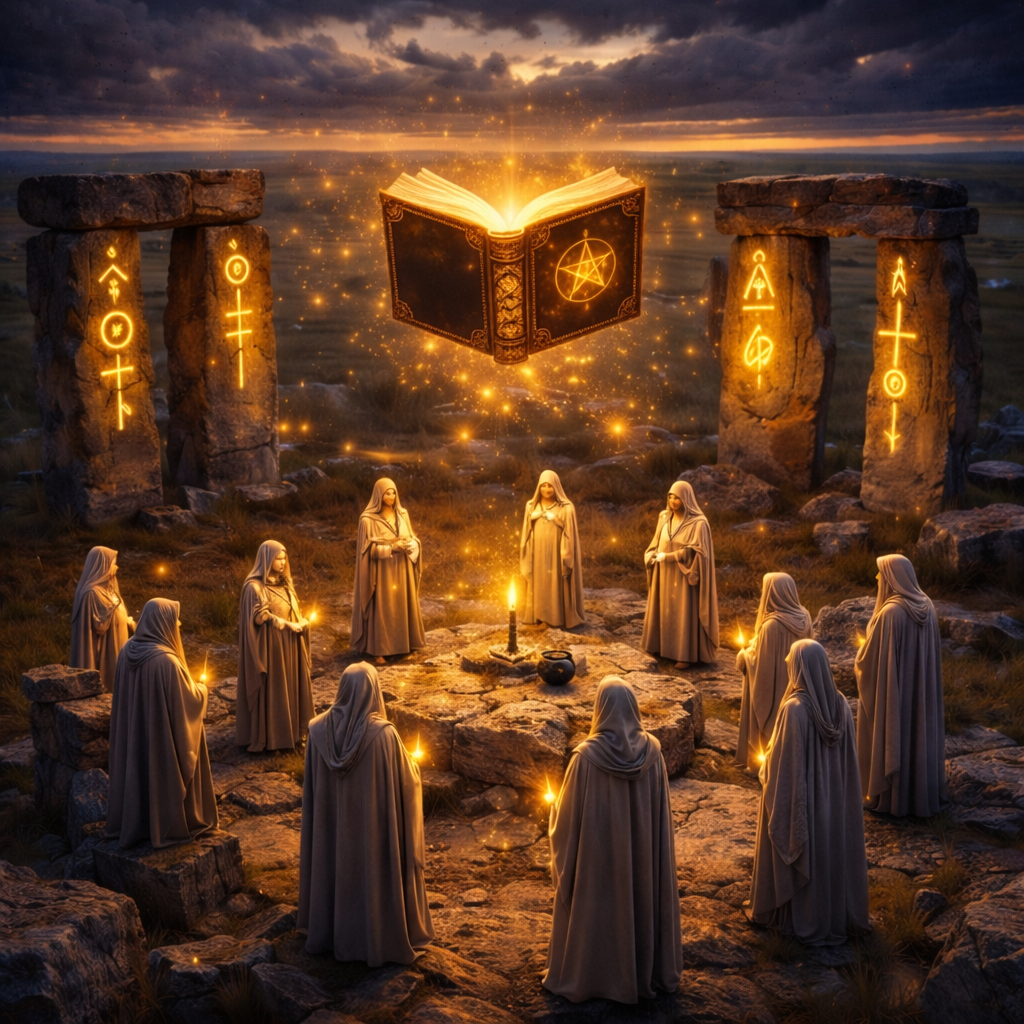

Celeste Moreau (Divination & Symbolism Reviewer) — Arthur Edward Waite's 'The Importance of Ceremonial Magic' stands as a cornerstone text for serious students of the occult. Waite's erudition is palpable as he dissects the intricate mechanisms and philosophical underpinnings of ceremonial magic with unparalleled clarity. He deftly navigates the symbolic landscapes, revealing how ritual acts not merely as performance but as a potent tool for psychological transformation and spiritual ascent. This work is not for the casual dabbler but for the dedicated practitioner and the scholar seeking a profound understanding of magic's historical and esoteric significance. Its strengths lie in its comprehensive scope and Waite's authoritative, yet accessible, prose.
📝 Description
61
Arthur Edward Waite published 'The Importance of Ceremonial Magic' in 1911.
Arthur Edward Waite's 1911 book examines ceremonial magic not just as a set of rituals, but as a system integral to spiritual development. He details how these practices aim to achieve hidden knowledge and personal transformation. Waite, himself a significant figure in occult studies, interprets the symbolic language and psychological aspects of magic. He discusses its power to connect earthly existence with higher planes. The work approaches its subject with a serious tone, suitable for those interested in the deeper aspects of esoteric philosophy.
This volume serves as a guide to understanding the philosophical basis and practical uses of what is often termed the Great Work. Waite suggests that ceremonial magic offers a way to understand consciousness itself and the processes by which spiritual ascent might occur. It is written for serious students of the occult, practitioners of ritual, and academics interested in the historical and theoretical underpinnings of magical traditions.
Published in 1911, 'The Importance of Ceremonial Magic' sits within the Western esoteric tradition that flourished in the late 19th and early 20th centuries. This period saw a surge of interest in occultism, Hermeticism, Kabbalah, and various forms of ritualistic practice. Waite, a prolific writer and scholar of these subjects, sought to categorize and explain the underlying principles of magic. His work reflects a scholarly effort to give structure and philosophical weight to practices that were often shrouded in secrecy or misunderstood. It engages with traditions like Rosicrucianism and the Golden Dawn, where Waite was a prominent member.
💡 Why Read This Book?
Uncover the foundational principles of ritualistic magic, understand its deep symbolic language, and explore its transformative potential for spiritual growth. Ideal for serious seekers, occult scholars, and practitioners aiming to deepen their understanding of the esoteric arts. This book offers a profound perspective on accessing hidden knowledge and achieving profound personal evolution through structured magical practice.
⭐ Reader Reviews
Honest opinions from readers who have explored this book.
❓ Frequently Asked Questions
What is ceremonial magic according to Waite?
Waite defines ceremonial magic as a structured and symbolic system of ritualistic practices designed to effect spiritual transformation, achieve communion with higher powers, and manifest desired outcomes through the disciplined application of will and esoteric knowledge.
Is this book suitable for beginners?
While comprehensive, the book assumes a certain level of intellectual engagement. Beginners are encouraged to approach it with an open mind and a willingness to delve into complex symbolism and philosophical concepts, perhaps alongside introductory materials.
What is the role of symbolism in ceremonial magic?
Symbolism is paramount. Waite illustrates how symbols in ceremonial magic act as conduits for spiritual energy, cognitive anchors, and keys to unlocking deeper layers of consciousness, facilitating communication with the divine and the subconscious.
Does Waite advocate for a specific magical tradition?
Waite's work often draws from various Western esoteric traditions, including Hermeticism, Kabbalah, and Rosicrucianism, presenting a synthesis of their ceremonial aspects rather than strictly adhering to a single lineage.
What is the 'Great Work' mentioned in relation to ceremonial magic?
The 'Great Work' (Magnum Opus) refers to the ultimate goal of spiritual alchemy and magic: the purification and perfection of the self, leading to enlightenment, union with the divine, and the attainment of higher consciousness.
🔮 Key Themes & Symbolism
The Architecture of Ritual
Waite meticulously deconstructs the fundamental components of ceremonial magic, examining the precise arrangement of elements, the potent force of intention, and the intricate interplay of correspondences that form the very architecture of effective ritual. He emphasizes that ritual is not mere theatre but a sophisticated science of spiritual engineering, designed to harmonize the microcosm with the macrocosm and to facilitate the conscious manipulation of subtle energies for profound transformative effects.
Symbolism as the Language of the Soul
Central to Waite's thesis is the indispensable role of symbolism. He elucidates how sacred symbols, sigils, and allegorical imagery serve as the universal language of the soul and the divine, acting as keys to unlock hidden truths and communicate with the deeper strata of consciousness. Understanding and correctly employing these symbols is presented as crucial for working through the esoteric landscape and achieving meaningful spiritual progress.
The Alchemical Ascent of Consciousness
Waite frames ceremonial magic as an integral part of the Great Work, an alchemical process of spiritual purification and self-transformation. He details how ritualistic practices serve to dissolve the base elements of the ego, refine the spiritual essence, and ultimately transmute the practitioner into a higher, more enlightened state of being, mirroring the alchemical transformation of base metals into gold.
💬 Memorable Quotes
Direct passages from the work, attributed to the author.
“The symbols of the ritual are the stepping stones across the abyss.”
— This evokes the idea that the symbolic elements within ceremonial magic are not mere decorations but essential tools for bridging the gap between the mundane and the spiritual, guiding the practitioner safely through challenging inner landscapes.
“True magic is a path of knowledge and self-discovery.”
— Waite emphasizes that the ultimate purpose of magic lies not in external manipulation but in profound internal growth, leading to a deeper understanding of oneself and the universe.
“The universe is a magical entity, and we are part of its unfolding.”
— This suggests a pantheistic or panentheistic view, where magic is an inherent quality of existence, and human consciousness plays a role in its continuous creation and evolution.
“The ritual is the crucible wherein the soul is tested and refined.”
— This metaphor powerfully illustrates how ceremonial magic acts as a transformative process, challenging and purifying the practitioner's spiritual essence through dedicated practice.
💡 Key Ideas
Editorial paraphrase of the work's core concepts — not direct quotes.
Magic is the science and art of causing change to occur in conformity with Will.
This quote captures Waite's definition of magic as a deliberate and skillful application of conscious intent to manifest desired transformations, highlighting the active and volitional nature of magical practice.
🌙 Esoteric Significance
Tradition
Waite's work is deeply rooted in the Western Esoteric Tradition, drawing heavily from Hermeticism, Kabbalah, ceremonial magic lineages such as those influenced by the Golden Dawn, and alchemical symbolism. He synthesizes these diverse streams, presenting ceremonial magic as a sophisticated discipline for spiritual evolution and the attainment of gnosis, distinct from mere superstition or folk magic.
Symbolism
The book is a profound exploration of esoteric symbolism, treating symbols not as arbitrary signs but as potent energetic forms that communicate directly with the subconscious and facilitate spiritual ascent. Waite dissects the layered meanings of divine names, planetary correspondences, geometric forms, and divine archetypes, revealing their function as keys to unlocking hidden knowledge and aligning the practitioner with cosmic forces.
Modern Relevance
In an age often characterized by rapid technological advancement and superficial connections, Waite's work offers a vital counterpoint, emphasizing the enduring power of inner exploration, focused intention, and symbolic engagement. It remains relevant for those seeking to cultivate discipline, deepen their spiritual practice, and understand the profound psychological and metaphysical dimensions of ritual in a contemporary context.
👥 Who Should Read This Book
This key work is essential for serious students of the occult, spiritual seekers, and practitioners of magic who wish to move beyond superficial understanding. Scholars of comparative religion, Western esotericism, and the history of ideas will find Waite's meticulous research and insightful analysis invaluable. Beginners are encouraged to approach with a prepared mind, perhaps in conjunction with introductory texts, to fully grasp the depth of Waite's teachings. Ultimately, anyone drawn to the profound mysteries of ritual and the potential for transformation through disciplined spiritual practice will find this book a richly rewarding guide.
📜 Historical Context
Written in the early 20th century, a period of burgeoning interest in spiritualism, occultism, and esoteric philosophies, Arthur Edward Waite's 'The Importance of Ceremonial Magic' emerged from a rich intellectual milieu. This era saw a revival of interest in ancient mysteries, Hermeticism, Kabbalah, and Rosicrucianism, fueled by scholars and mystics seeking deeper truths beyond the materialist worldview. Waite himself was a prolific author and prominent figure in occult societies like the Hermetic Order of the Golden Dawn and the Fellowship of the Rosicrucian Order. His work reflects a scholarly yet deeply committed engagement with these traditions, aiming to provide a rational and systematic understanding of ceremonial magic at a time when it was often misunderstood or sensationalized. The book stands as a proof of the intellectual currents of esoteric thought that sought to synthesize ancient wisdom with modern inquiry.
📔 Journal Prompts
Reflect on a personal experience where symbolism played an important role in understanding a situation or emotion.
Consider the 'Will' as described by Waite. How can this concept be practically applied to a current goal or challenge in your life?
Explore the concept of 'alchemical transformation' within your own life. What aspects of yourself do you wish to purify or refine?
Imagine designing a simple ritual for a specific intention. What symbolic elements would you incorporate and why?
How does the idea of bridging the terrestrial and celestial realms resonate with your personal spiritual beliefs or aspirations?
🗂️ Glossary
Gnosis
Esoteric knowledge, often of a spiritual or mystical nature, attained through direct experience or intuition rather than through empirical reasoning or faith.
Great Work (Major work)
The ultimate goal of spiritual alchemy and magic, involving the purification, perfection, and spiritual enlightenment of the individual, often symbolized by the creation of the Philosopher's Stone.
Microcosm
The individual human being, seen as a miniature reflection or representation of the greater universe (the Macrocosm).
Macrocosm
The universe as a whole, considered as a vast, ordered system, often in parallel with the Microcosm.
Correspondences
The relationships and affinities between different elements, forces, or phenomena within the universe, as understood in esoteric traditions (e.g., planetary correspondences, elemental associations).
This book appears in 3 collections
🔮 Readers Also Liked
Browse all →





More by Arthur Edward Waite
All books →
From the “Ritual Magic” Collection
View all →






More Free Magic & Ritual Books
View all →



![Faust: a Tragedy [part 1], Translated from the German of Goethe](/img/thumb/faust-a-tragedy-part-1-translated-from-the-german-of-goethe-goethe-johann-wolfgang-von.webp)