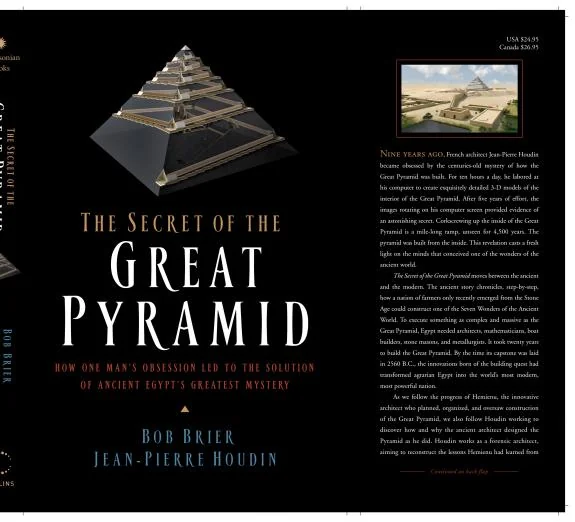
The Secret of the Great Pyramid
 81
81

The Secret of the Great Pyramid
Bob Brier and Jean-Pierre Houdin’s "The Secret of the Great Pyramid" offers a fascinating, if occasionally speculative, re-evaluation of how Khufu’s monument might have been erected. The core thesis—an internal ramp system—is presented with architectural rigor by Houdin, whose insights into structural mechanics are the book's strongest asset. He effectively visualizes the challenges and proposes a plausible, if unproven, solution. Brier provides the historical context and narrative flair, making the intellectual adventure accessible. However, the book sometimes leans heavily on the internal ramp theory as the *only* viable explanation, occasionally downplaying other potential contributing factors or existing scholarly debates. The claim that this theory represents the 'most exciting discovery in Egyptology in decades' feels like hyperbole; while intriguing, it remains a hypothesis awaiting definitive proof. The inclusion of an 8-page black and white photo insert aids visualization but lacks the detail needed to fully convince skeptics. Ultimately, the work succeeds as an engaging thought experiment and a testament to persistent inquiry into ancient engineering, even if it doesn't definitively unlock the pyramid's secrets.
📝 Description
81
Jean-Pierre Houdin and Bob Brier propose a radical pyramid construction theory in 2008.
In 'The Secret of the Great Pyramid,' Bob Brier and Jean-Pierre Houdin propose an inside-out construction method for the Great Pyramid. This theory suggests an internal ramp system, a significant departure from the widely accepted external scaffolding models. Houdin, an architect, applies his understanding of structures to analyze the pyramid's form and potential building techniques. The authors examine architectural evidence and logical deductions to support their hypothesis, aiming to reconstruct the practicalities and decisions of the pyramid's builders. Their work moves beyond simple description to actively recreate a plausible construction process. This book is for those interested in ancient engineering puzzles and alternative historical viewpoints. It will appeal to readers who enjoy meticulous research and theories that question established accounts of history. Those fascinated by the logistical challenges of monumental construction and the potential for reinterpreting historical evidence will find it particularly interesting. The book also speaks to individuals who appreciate the application of scientific reasoning to historical mysteries. Houdin's architect's eye and Brier's Egyptological background combine to offer a fresh look at this ancient marvel. The work considers how the builders might have overcome the immense practical difficulties of raising such a structure.
This book fits within a tradition of alternative Egyptology that seeks explanations beyond official archaeological consensus. It questions established timelines and methods, proposing a more complex, perhaps even ingenious, internal logic to ancient construction. Unlike purely historical accounts that focus on recorded facts, this work engages with the 'how' of monumental building, implying a level of knowledge and planning that might be considered esoteric by its focus on hidden or unconventional understanding of the past. It taps into a fascination with uncovering the 'secrets' of ancient civilizations, suggesting a deeper, less obvious truth about their capabilities.
💡 Why Read This Book?
• Understand the "internal ramp" construction theory, a specific alternative to external scaffolding for building the Great Pyramid, as detailed by architect Jean-Pierre Houdin. • Gain insight into the logistical challenges faced by Fourth Dynasty Egyptians, such as moving 2.5-ton blocks, by examining the practicalities presented in the book. • Re-evaluate established Egyptological narratives by exploring the evidence and reasoning presented for building the Great Pyramid from the inside out, a departure from conventional theories.
⭐ Reader Reviews
Honest opinions from readers who have explored this book.
❓ Frequently Asked Questions
What is the main theory proposed in "The Secret of the Great Pyramid"?
The book's central thesis, developed by Jean-Pierre Houdin, suggests the Great Pyramid of Giza was constructed using an internal ramp system, allowing blocks to be raised from within the pyramid's structure.
Who are the authors and what are their backgrounds?
Bob Brier is a renowned Egyptologist and historian, known for his work on ancient Egypt. Jean-Pierre Houdin is a French architect with a long-standing interest in pyramid construction.
When was the Great Pyramid of Giza built?
The Great Pyramid, also known as the Pyramid of Khufu, was constructed during the Fourth Dynasty of Egypt, approximately between 2580 and 2560 BC.
Does this book offer definitive proof of the internal ramp theory?
While the book presents a detailed hypothesis supported by architectural analysis and evidence interpretation, it is presented as a theory rather than definitive, universally accepted proof.
What evidence supports the internal ramp theory?
The authors point to evidence such as the apparent lack of sufficient external ramp material, internal anomalies detected by surveys, and the logical feasibility of an internal spiral ramp for construction.
Is this book suitable for beginners in Egyptology?
Yes, the book is written in an accessible style, blending historical context with architectural theory, making it suitable for those new to Egyptology and interested in construction mysteries.
🔮 Key Themes & Symbolism
Internal Ramp Hypothesis
The book's central argument posits that the Great Pyramid was built using an ingenious internal ramp system. This concept, developed by architect Jean-Pierre Houdin, challenges the long-held belief in massive external ramps. The authors detail how a spiral ramp, contained within the pyramid's structure, could have facilitated the efficient upward movement of stone blocks, significantly reducing the visible external construction footprint and logistical challenges associated with immense scaffolding or solely external ramps. This theory re-frames the builders' ingenuity.
Ancient Engineering and Logistics
Beyond the ramp theory, the work meticulously examines the practicalities of pyramid construction. It addresses the immense scale of labor, the quarrying and transportation of stone, and the precision required. The authors explore how the builders might have overcome obstacles like lifting multi-ton granite beams, organizing thousands of workers, and maintaining the project's momentum over decades. The focus is on a realistic, step-by-step approach to ancient construction.
Reinterpretation of Evidence
Brier and Houdin engage with existing archaeological findings and historical accounts related to the Giza plateau. They propose new interpretations for anomalies detected within the pyramid and re-examine the feasibility of conventional construction methods. This theme emphasizes the dynamic nature of historical research, where new perspectives, like Houdin's architectural analysis, can lead to a revision of established understanding based on careful observation and logical deduction.
The Builders' Perspective
This theme centers on understanding the mindset and capabilities of the ancient Egyptian workforce and their overseers. By proposing a plausible construction method, the authors attempt to reconstruct the decision-making processes and the technological knowledge available during the Fourth Dynasty. It humanizes the monumental task, shifting focus from the sheer scale to the intelligent application of resources and techniques by the individuals involved in building the pyramid.
💬 Memorable Quotes
Direct passages from the work, attributed to the author.
“The pyramid was built from the inside out.”
— This concise statement expresses the core, radical hypothesis of the book, challenging conventional Egyptological understanding and suggesting a sophisticated internal construction method.
“Houdin's architectural analysis.”
— This refers to the specific, detailed examination of the Great Pyramid's structure and potential construction methods undertaken by co-author Jean-Pierre Houdin, an architect by profession.
“The logistical challenges of moving multi-ton stone blocks.”
— This highlights a key problem addressed by the book: the practical difficulties and ingenious solutions required by the ancient Egyptians to transport and place the massive stones used in pyramid construction.
“A re-evaluation of conventional Egyptology.”
— This phrase signifies the book's intent to question and offer an alternative to widely accepted theories regarding the construction techniques employed for the Great Pyramid.
“The Fourth Dynasty construction methods.”
— This points to the specific historical period and technological context within which the authors believe the Great Pyramid was built, focusing on the engineering capabilities of that era.
🌙 Esoteric Significance
Tradition
While not strictly aligned with a single esoteric lineage like Hermeticism or Theosophy, the work taps into a broader esoteric tradition of seeking hidden knowledge and challenging orthodox interpretations of ancient mysteries. It appeals to a desire to uncover the 'true' methods and perhaps the 'higher purpose' behind monumental ancient constructions, a common thread in occult and mystical studies seeking lost wisdom.
Symbolism
The Great Pyramid itself is a potent symbol in esoteric thought, often representing cosmic order, divine geometry, or a repository of ancient knowledge. The book's focus on its construction can be interpreted esoterically as exploring the manifestation of divine will or cosmic principles through material construction, with the 'inner workings' symbolizing hidden spiritual truths or levels of consciousness.
Modern Relevance
This work influences contemporary discussions on archaeoastronomy, sacred geometry, and alternative history, particularly within communities interested in consciousness studies and ancient civilizations. Thinkers exploring theories of advanced ancient technology or non-human influence on historical sites may draw upon Houdin's architectural analysis as a potential piece of a larger, often esoteric, puzzle.
👥 Who Should Read This Book
• Aspiring Egyptologists and amateur historians interested in challenging established theories about ancient monument construction. • Readers fascinated by engineering puzzles and architectural problem-solving, particularly those applied to historical contexts. • Enthusiasts of alternative history and ancient mysteries seeking well-reasoned, though not universally accepted, hypotheses about the construction of the Great Pyramid.
📜 Historical Context
Published in 2008, "The Secret of the Great Pyramid" emerged during a period of renewed interest in archaeological reinterpretation and popular science communication. While mainstream Egyptology, largely adhering to theories involving external ramps and immense labor forces as discussed by scholars like Mark Lehner, continued its established research, alternative hypotheses gained traction in public discourse. Jean-Pierre Houdin's theory, building on his father's earlier work, presented a specific, architecturally grounded challenge to these orthodox views. The book’s reception highlighted a division between academic consensus and public fascination with 'hidden' or unconventional explanations for ancient wonders. Unlike purely speculative works, Houdin's approach was rooted in architectural principles, adding a layer of technical detail to the ongoing debate surrounding pyramid construction methods.
📔 Journal Prompts
The internal ramp theory proposed by Jean-Pierre Houdin.
The logistics of moving multi-ton blocks during the Fourth Dynasty.
Reinterpreting the evidence for the Great Pyramid's construction.
The builders' perspective on monumental construction.
Comparing the internal ramp theory to conventional Egyptology.
🗂️ Glossary
Internal Ramp Theory
The hypothesis that the Great Pyramid was constructed using a ramp system built inside the pyramid's own structure, spiraling upwards.
Fourth Dynasty
The period in ancient Egyptian history (circa 2613–2494 BC) during which the most famous pyramids, including the Great Pyramid of Giza, were constructed.
Khufu
The ancient Egyptian pharaoh for whom the Great Pyramid of Giza was built, reigning during the Fourth Dynasty.
Egyptology
The academic field devoted to the study of ancient Egypt, encompassing its history, language, literature, religion, architecture, and art.
External Ramp Theory
The conventional hypothesis suggesting that pyramids were built using large ramps constructed externally around the pyramid structure.
Giza Plateau
The arid plateau on the outskirts of Cairo, Egypt, where the Great Pyramid, the Pyramid of Khafre, the Pyramid of Menkaure, and the Great Sphinx are located.
Houdin's Hypothesis
Refers specifically to the theory developed by architect Jean-Pierre Houdin regarding the internal construction of the Great Pyramid.
This book appears in 1 collection
🔮 Readers Also Liked
Browse all →









From the “Pyramids” Collection
View all →






More Free Occult Philosophy Books
View all →