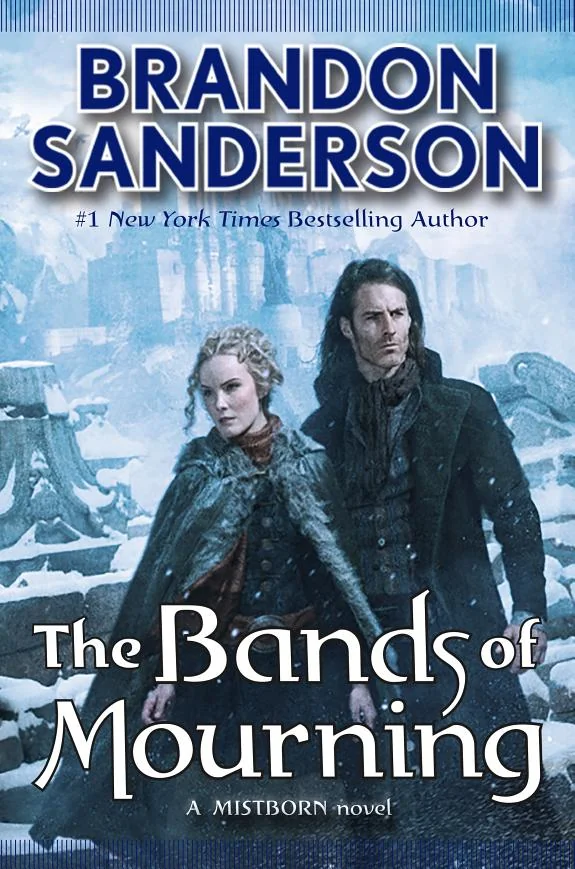
The Bands of Mourning
 71
71

The Bands of Mourning
Brandon Sanderson’s "The Bands of Mourning" arrives as the third installment in his Wax and Wayne era of the Mistborn universe, and it largely delivers on the promise of its predecessors. The novel excels in its pacing, a significant improvement over the sometimes-ponderous middle sections of "Shadows of Self." The introduction of the Bands themselves, a powerful artifact tied to the Lord Ruler, injects a compelling urgency into the plot, pushing Waxillium Ladrian and his companions toward a confrontation that feels earned. However, the romantic subplot between Wax and Steris, while intended to add depth, occasionally feels overwrought, sometimes detracting from the more intriguing political and mystical machinations at play. A standout moment involves the intricate unraveling of the mystery surrounding the Bands and their connection to past figures, showcasing Sanderson's meticulous planning. Ultimately, "The Bands of Mourning" is a solid, engaging entry that reaffirms the strength of this unique post-industrial fantasy setting.
📝 Description
71
Brandon Sanderson's 2016 novel, The Bands of Mourning, continues the Mistborn saga in the Wax and Wayne era.
The Bands of Mourning returns readers to the era of Wax and Wayne, a time that evokes the late 19th century but is shaped by Allomancy and Feruchemy. This installment, published in 2016, builds upon the world-building and character arcs established in "The Alloy of Law" and "Shadows of Self." The narrative weaves together intricate plots with an examination of societal progress juxtaposed against enduring magical forces. It is a story for readers who value detailed world construction and character development within a fantasy setting.
Sanderson uses the late 19th century as a thematic parallel, a period of industrialization and changing social structures. This backdrop allows him to explore how magic, specifically Allomancy and Feruchemy, interacts with emerging technologies such as firearms and early trains. The novel examines the inherent conflicts that arise when traditional practices meet new advancements, reflecting historical tensions. Readers interested in how magic systems integrate with technological and social evolution will find this a unique blend of historical atmosphere and fantastical elements.
This novel operates within a fantasy tradition that grounds its magical systems in consistent, observable rules, akin to a natural philosophy. The magic of Allomancy and Feruchemy functions as an internal cosmology, governing the abilities of individuals and shaping their society. Its exploration of how these internal, supernatural forces interact with external, technological advancement echoes philosophical inquiries into the nature of power and change, both personal and societal, often found in speculative fiction that considers the consequences of unique belief systems.
💡 Why Read This Book?
• Gain insight into the interplay between advanced technology and ingrained magical abilities, as seen in the specific challenges faced by Waxillium Ladrian in the year 2016 (publication year) as he balances firearm use with his Allomantic powers. • Experience the intricate unfolding of a central mystery surrounding a powerful artifact, the Bands of Mourning, and understand its historical significance within the lore established by Sanderson. • Explore nuanced character development where personal desires and professional duties collide, particularly through the evolving relationship dynamics and Steris’s pragmatic approach to partnership.
⭐ Reader Reviews
Honest opinions from readers who have explored this book.
❓ Frequently Asked Questions
What is the primary magic system in "The Bands of Mourning"?
The novel prominently features Allomancy, where individuals ingest and burn metals for specific powers, and Feruchemy, allowing the storage of personal attributes in metalminds. These systems are integral to the plot and character abilities.
What historical period does "The Bands of Mourning" emulate?
The book's setting is inspired by the late 19th century, a period of industrialization and societal change, allowing Sanderson to explore how magic interacts with developing technologies like trains and firearms.
Who are the main protagonists in "The Bands of Mourning"?
The central figures are Waxillium Ladrian, a former lawman with Allomantic and Feruchemical abilities, and his companions Wayne and Marasi Colms, as they investigate a dangerous conspiracy.
What is the significance of the Bands of Mourning?
The Bands of Mourning are a powerful artifact with deep historical ties to the Lord Ruler, possessing abilities that make them a central object of conflict and mystery within the narrative.
Is "The Bands of Mourning" a standalone novel?
No, it is part of a series. It follows "The Alloy of Law" and "Shadows of Self" and is the third book in the Wax and Wayne era of the Mistborn saga.
When was "The Bands of Mourning" originally published?
The book was first published on January 26, 2016, continuing the narrative established in the preceding Mistborn novels.
🔮 Key Themes & Symbolism
Magic Meets Industry
The narrative meticulously explores the friction and synergy between innate magical abilities like Allomancy and Feruchemy and the burgeoning technologies of a world resembling the late 19th century. This juxtaposition is not merely aesthetic; it drives plot and character conflict. For instance, Waxillium Ladrian's skills as a Lawman are constantly tested as he confronts threats that utilize both advanced weaponry and magical means, forcing a re-evaluation of how power operates in this evolving society. This theme offers a unique lens on progress and tradition.
The Weight of the Past
"The Bands of Mourning" grapples with legacy and the enduring influence of historical figures and events. The titular artifact is a direct link to the tyrannical Lord Ruler, whose actions continue to shape the present. Characters are often burdened by their lineage or the history of their institutions, such as the Scadrian aristocracy and law enforcement. This theme examines how past decisions and power structures can manifest in contemporary conflicts, questioning whether true change is possible or if history inevitably repeats itself.
Law, Order, and Justice
As a continuation of the Wax and Wayne storyline, the concepts of law and justice remain central. Waxillium's transition from federal Lawman to noble presents a stark contrast between idealism and the realities of political maneuvering. The narrative probes the effectiveness of the established legal system in dealing with complex threats, including those involving powerful magic users and clandestine organizations. It questions the nature of justice when faced with overwhelming power and societal corruption, particularly in the context of the city of Elendel.
Artifacts of Power
The book places significant emphasis on powerful magical artifacts, most notably the Bands of Mourning themselves. These objects are not mere plot devices but are imbued with history, mystery, and immense potential for both creation and destruction. Their discovery and the race to control them form the crux of the narrative, forcing characters to confront their own desires for power and the ethical implications of wielding such influence. This focus on potent relics adds a layer of ancient mystique to the otherwise industrialized setting.
💬 Memorable Quotes
Direct passages from the work, attributed to the author.
“The Bands of Mourning are more than just metal. They are history.”
— This highlights the central theme of legacy and the tangible power of historical artifacts. It implies that the Bands carry not just magical potential but the weight of past events and intentions.
“Sometimes the best way to solve a problem is to make it someone else's.”
— This cynical, yet pragmatic, statement reflects the complexities of power and responsibility. It touches upon themes of delegation, avoidance, and the often-unseen consequences of shifting burdens.
“Justice is a tool. And like any tool, it can be used or misused.”
— This interpretation emphasizes the malleable nature of justice within the narrative's world. It suggests that the concept itself is neutral, its application dependent on the intentions and methods of those who wield it.
💡 Key Ideas
Editorial paraphrase of the work's core concepts — not direct quotes.
A good person has to be willing to do what's necessary.
This quote speaks to the moral compromises often required of those in positions of authority or those pursuing difficult goals. It suggests that true goodness isn't passive but demands active, sometimes unpleasant, choices.
People don't like being told they're wrong.
A simple observation on human nature, this quote underscores the difficulty of enacting change or enforcing unpopular truths, especially within established social or political structures.
🌙 Esoteric Significance
Tradition
While not explicitly tied to a single historical esoteric tradition like Hermeticism or Gnosticism, Sanderson's magic systems, particularly Allomancy and Feruchemy, draw upon principles that resonate with Western esoteric thought. The concept of manipulating internal energies (metals as catalysts, storing attributes) can be seen as a fantastical analogue to alchemical transmutation or the manipulation of vital forces described in various occult philosophies. The meticulous cataloging and systematic application of powers echo the ordered, almost scientific approach found in some branches of ceremonial magic, seeking to understand and control unseen forces.
Symbolism
The metals used in Allomancy serve as potent symbols. For example, Steel (Pushing) can represent outward force, assertion, and direction, while Iron (Pulling) might symbolize attraction, connection, or drawing things inward. Feruchemy's metalminds, storing aspects of the self, evoke ideas of self-mastery, the preservation of essence, or even a form of arcane archiving. The Bands of Mourning themselves, as an artifact, symbolize ultimate authority, historical burden, and the potential for god-like power, representing the lingering influence of past regimes and the dangerous allure of absolute control.
Modern Relevance
Contemporary fantasy authors and game designers often look to Sanderson's work for innovative magic system construction. The idea of a 'hard magic system' – one with clearly defined rules and limitations that can be explored and exploited – is particularly influential. Thinkers and creators interested in building believable, internally consistent magical worlds that interact meaningfully with societal structures find valuable blueprints in Sanderson's approach, influencing everything from tabletop role-playing games to other novels seeking to blend genre conventions.
👥 Who Should Read This Book
• Fans of Brandon Sanderson's previous Mistborn novels, particularly "The Alloy of Law" and "Shadows of Self," seeking the continuation of the Wax and Wayne storyline and its combination of magic and technology. • Readers interested in intricate world-building and meticulously crafted magic systems that operate with internal consistency and explore the societal implications of supernatural abilities. • Those who enjoy fantasy narratives set in periods reminiscent of historical eras, such as the late 19th century, offering a departure from traditional medieval settings and exploring the intersection of magic with industrialization.
📜 Historical Context
Published in 2016, "The Bands of Mourning" emerged during a period where epic fantasy continued its mainstream dominance, with authors like George R.R. Martin and Patrick Rothfuss commanding significant attention. Sanderson’s Mistborn series, particularly this Wax and Wayne arc, distinguished itself by transplanting fantasy elements into a setting that consciously echoes late 19th-century America. This was a deliberate move away from traditional medieval-inspired fantasy, aligning with a broader trend in speculative fiction to explore diverse historical analogues. The era itself, marked by rapid industrialization, technological innovation, and social upheaval, provided a fertile ground for exploring themes of progress versus tradition, mirroring real-world historical tensions. While Sanderson’s intricate magic systems and detailed world-building were lauded, the integration of these elements into a quasi-Victorian/Edwardian technological landscape was a particular point of interest for critics comparing his work to other fantasy authors of the time, such as Scott Lynch, who also played with anachronistic elements.
📔 Journal Prompts
Waxillium Ladrian's internal conflict between his noble duties and his Lawman instincts.
The societal impact of Allomancy and Feruchemy in a world embracing industrial advancements.
The symbolic meaning and historical weight carried by the Bands of Mourning.
Wayne's unique brand of humor and its function within the narrative's darker themes.
Marasi Colms's journey from observer to active participant in the unfolding events.
🗂️ Glossary
Allomancy
The magical ability to ingest and burn specific metals to gain superhuman powers. Different metals grant different abilities, such as enhanced senses, physical augmentation, or emotional manipulation.
Feruchemy
A magic system that allows users, Feruchemists, to store aspects of themselves, such as strength or speed, into metalminds and later tap into that stored power.
Metalmind
An object, typically made of metal, used by Feruchemists to store attributes or memories. These can be tapped later to access the stored power or information.
Scadrial
The name of the planet on which the Mistborn novels take place. The current era is set centuries after the original trilogy.
Lawman
In the Wax and Wayne era, a figure tasked with upholding the law, often possessing Allomantic or Feruchemical abilities, operating in territories outside the main city.
The Bands of Mourning
A powerful artifact central to the plot, possessing immense Allomantic potential and deeply connected to the history of the Lord Ruler.
The Set
A clandestine organization operating within the city of Elendel, seeking power and involved in criminal activities, posing a significant threat.
This book appears in 1 collection
🔮 Readers Also Liked
Browse all →








From the “Secret Societies” Collection
View all →






More Free Occult Philosophy Books
View all →