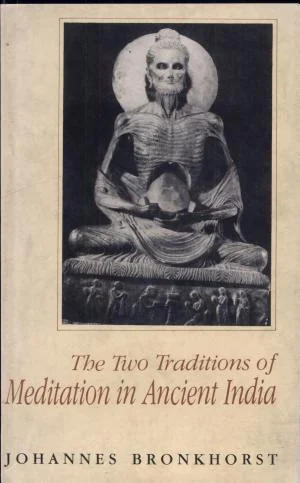
The Two Traditions of Meditation in Ancient India
 71
71

The Two Traditions of Meditation in Ancient India
Johannes Bronkhorst's "The Two Traditions of Meditation in Ancient India" offers a meticulous, if at times dry, dissection of early Buddhist textual history. Bronkhorst's strength lies in his rigorous textual analysis, demonstrating with compelling examples how certain meditative practices, accepted in one Buddhist context, are explicitly disavowed in another. He argues persuasively that these accepted-then-rejected techniques often represent non-Buddhist traditions absorbed into the Buddhist canon, a significant point for understanding the religion's development. The limitation, however, is the dense academic prose, which can make the arguments feel less accessible to a general reader. The detailed examination of specific suttas and their variant readings, while crucial for scholarly accuracy, requires considerable concentration. Nonetheless, Bronkhorst's exploration of the interplay between Buddhist and "proto-Yogic" elements provides a vital corrective to overly simplified views of meditation's early history. It is an essential, albeit challenging, resource for serious scholars of Buddhism.
📝 Description
71
Johannes Bronkhorst's 1993 book identifies two distinct meditation traditions in ancient India.
Johannes Bronkhorst's scholarly work examines the development of meditative practices within ancient Indian spiritual traditions, with a particular focus on early Buddhist texts. He meticulously analyzes how Buddhist canonical literature sometimes accepts and at other times rejects specific meditative techniques. Bronkhorst proposes that instances of rejection often signal the incorporation of non-Buddhist practices that found their way into Buddhist scriptures.
This study is intended for serious students of Buddhist philosophy, comparative religion, and the history of spiritual practices in South Asia. It will appeal to scholars, researchers, and practitioners interested in the textual evolution of meditation and the complex relationship between early Buddhism and its contemporary spiritual milieu. A background in Indology or religious studies is beneficial for a full appreciation of the arguments presented.
This book engages with the historical development of Buddhist thought and practice, a key area within the broader study of esoteric traditions in South Asia. It situates itself within Indology, focusing on the re-evaluation of Sanskrit and Pali canonical texts. Bronkhorst's research addresses the authenticity and evolution of early Buddhist doctrines, particularly concerning the practice and theory of meditation as a path to liberation.
💡 Why Read This Book?
• Gain a nuanced understanding of meditation's historical roots by examining Bronkhorst's distinction between indigenous Buddhist practices and those adopted from non-Buddhist traditions, as detailed in his analysis of canonical texts. • Appreciate the critical methodology used to decipher the evolution of spiritual practices, learning how textual variations from circa the early centuries CE reveal internal debates and external influences. • Understand the concept of *moksha* or liberation as it relates to meditative states, exploring how different traditions within ancient India conceptualized the path to ultimate release.
⭐ Reader Reviews
Honest opinions from readers who have explored this book.
❓ Frequently Asked Questions
What is the main argument of "The Two Traditions of Meditation in Ancient India"?
The book's primary thesis is that early Buddhist texts reveal two distinct traditions of meditation: one originating within Buddhism and another adopted from non-Buddhist ascetic and yogic practices, which were sometimes integrated and sometimes rejected by Buddhist authors.
Who is Johannes Bronkhorst and what is his expertise?
Johannes Bronkhorst is a distinguished scholar of Indology and religious studies, known for his extensive work on the history of Indian religions, particularly early Buddhism and its philosophical developments.
When was "The Two Traditions of Meditation in Ancient India" first published?
The book was first published in 1993, marking a significant contribution to the scholarly understanding of meditation in ancient India during that period.
What kind of evidence does Bronkhorst use to support his claims?
Bronkhorst relies heavily on comparative textual analysis of early Buddhist canonical scriptures (like the Pali Canon and early Sanskrit texts), examining variations and apparent contradictions in the description of meditative practices.
Does this book discuss modern meditation techniques?
No, the book focuses exclusively on the historical and textual evidence of meditative traditions in ancient India, primarily from the early Buddhist period, rather than contemporary practices.
What does the book suggest about the relationship between Buddhism and other Indian ascetic traditions?
It suggests a complex and dynamic relationship, indicating that Buddhism was not an isolated phenomenon but actively engaged with, borrowed from, and sometimes reacted against other contemporary spiritual and yogic schools.
🔮 Key Themes & Symbolism
Textual Layers of Meditation
The work meticulously dissects Buddhist canonical texts, revealing how layers of authorship and editorial intervention distinguish between core Buddhist meditative practices and those absorbed from external traditions. Bronkhorst highlights inconsistencies where a practice is accepted in one scripture but rejected in another, suggesting these latter instances often point to non-Buddhist origins that infiltrated the Buddhist corpus.
Buddhism and Ascetic Rivals
A central theme is the historical interaction between early Buddhism and contemporaneous ascetic and yogic movements in ancient India. Bronkhorst argues that many meditative techniques found in Buddhist texts were not original to the Buddha's teachings but were adopted from these rival schools, such as those focused on achieving liberation through intense physical or mental discipline.
The Path to Liberation
The book consistently examines the role of meditation within the broader framework of achieving liberation (moksha or nirvana) in ancient Indian thought. It explores how different traditions, including Buddhism, conceptualized the meditative path as a means to transcend suffering and attain ultimate freedom, often differentiating between paths that were considered efficacious and those that were not.
Evolution of Doctrine
Bronkhorst's analysis underscores the dynamic evolution of Buddhist doctrine and practice. By identifying borrowed meditative techniques, he sheds light on how Buddhism adapted and responded to its religious environment, demonstrating that its canonical texts are not static but reflect historical processes of integration and differentiation from other spiritual lineages.
💬 Memorable Quotes
Direct passages from the work, attributed to the author.
“In a number of cases, the Buddhist canonical texts reject practices which they accept elsewhere.”
— This observation is key to Bronkhorst's argument, suggesting that the acceptance and rejection of meditative techniques within Buddhist scriptures are not arbitrary but indicate historical layers and the influence of external traditions.
“The author proposes that the acceptance of certain yogic practices within Buddhist texts reflects their adoption from non-Buddhist sources.”
— This interpretation focuses on the proposed outcome of Bronkhorst's textual analysis—the idea that Buddhist acceptance of specific yogic methods indicates their borrowing from contemporary Indian spiritual movements.
“Bronkhorst's work suggests a critical re-evaluation of early Buddhist meditative canons.”
— This interpretation emphasizes the scholarly impact of the book, suggesting it prompts readers to question the assumed purity of Buddhist meditative traditions and consider external influences.
“The distinction between indigenous and adopted meditative traditions is central to understanding Buddhist history.”
— This interpretation frames the core academic contribution of the book, positioning the 'two traditions' as a crucial lens through which to view the historical development and textual composition of early Buddhism.
💡 Key Ideas
Editorial paraphrase of the work's core concepts — not direct quotes.
When these practices—sometimes rejected, sometimes accepted—correspond to what is known about non-Buddhist practices, the conclusion is then proposed that they are non-Buddhist practices which have somehow found their way into the Buddhist texts.
This paraphrased concept highlights Bronkhorst's methodology: identifying shared practices between Buddhist and non-Buddhist sources as evidence for the latter's integration into Buddhist literature.
🌙 Esoteric Significance
Tradition
While not directly aligning with Western esoteric lineages like Hermeticism or Kabbalah, Bronkhorst's work is crucial for understanding the historical roots of meditative practices that later informed various esoteric traditions globally. It provides a scholarly framework for the study of contemplative disciplines that are foundational to many mystical paths, including those that eventually influenced or were influenced by Buddhism.
Symbolism
The primary 'symbolism' explored here is not visual but conceptual: the symbolic representation of the 'path' to liberation through meditation. Different meditative states and techniques function as symbolic markers of spiritual progress or deviation. The text implicitly deals with the symbolism of purity and impurity in spiritual practice, where adopted non-Buddhist techniques might be viewed as impure by some Buddhist adherents.
Modern Relevance
Contemporary scholars of comparative religion and Buddhist philosophy continue to draw upon Bronkhorst's meticulous textual analysis. His work is relevant to modern mindfulness practitioners seeking deeper historical context, as well as to researchers investigating the cross-pollination of spiritual ideas across ancient Indian traditions. Thinkers exploring the evolution of consciousness studies also find value in his historical distinctions.
👥 Who Should Read This Book
• Students of early Buddhism seeking to understand the historical formation of its meditative practices beyond simplistic narratives. • Comparative religion scholars interested in the complex interplay between different spiritual traditions in ancient India and how texts reflect these interactions. • Advanced practitioners of meditation who wish to explore the scholarly debates surrounding the origins and evolution of contemplative techniques.
📜 Historical Context
Published in 1993, Johannes Bronkhorst's "The Two Traditions of Meditation in Ancient India" arrived during a vibrant period of scholarship in Buddhist studies. The late 20th century saw a concerted effort to move beyond devotional interpretations and engage rigorously with the historical and philological evidence of early Buddhism. Bronkhorst's work contributed to ongoing debates about the formation of the Buddhist canon and the influence of Brahmanical and other ascetic traditions. Key contemporaries like Richard Gombrich were also examining the historical Buddha and the socio-religious milieu of his time. Bronkhorst's specific focus on textual discrepancies regarding meditation practices offered a novel angle, challenging the notion of a monolithic early Buddhist doctrine and highlighting its dynamic interaction with the diverse spiritual range of ancient India, including proto-Yogic schools.
📔 Journal Prompts
The contrast between accepted and rejected meditation practices within Buddhist texts.
Bronkhorst's methodology for identifying non-Buddhist influences on Buddhist scriptures.
The concept of 'two traditions' of meditation in ancient Indian spiritual history.
The role of meditation in achieving liberation across different early Indian schools.
Textual analysis as a tool for understanding religious evolution.
🗂️ Glossary
Canonical texts
The collection of scriptures officially recognized as authentic and authoritative by a religious tradition, such as the Pali Canon for Theravada Buddhism.
Ascetic practices
Self-denying practices, often involving severe physical or mental discipline, undertaken for religious or spiritual goals, common in ancient Indian traditions.
Liberation (Moksha/Nirvana)
The ultimate goal in many Indian religions, referring to freedom from the cycle of birth, death, and rebirth, and from suffering.
Textual criticism
The academic study of the textual evidence for a work, aiming to establish its original form and identify variations or interpolations.
Yogic practices
Techniques, often involving physical postures, breath control, and meditation, aimed at achieving spiritual or mental development, associated with Yoga traditions.
Indology
The academic study of the history, languages, literature, and cultures of India.
Sutta/Sutra
A discourse or sermon, particularly attributed to the Buddha or his disciples in Buddhist traditions, often forming part of a canon.
This book appears in 1 collection
🔮 Readers Also Liked
Browse all →









From the “Meditation” Collection
View all →







More Free Occult Philosophy Books
View all →