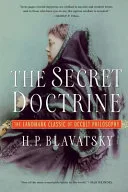
The Secret Doctrine
 81
81

The Secret Doctrine
Helena Petrovna Blavatsky's The Secret Doctrine is an ambitious, sprawling attempt to construct a universal esoteric cosmology. Its strength lies in its sheer scope and its intellectual audacity in attempting to synthesize Eastern and Western esoteric thought with nascent scientific theories of the late 19th century. The work's detailed exposition of cosmic evolution, particularly its concepts of 'Root Races' and 'Rounds,' offers a unique perspective on human development that differs radically from conventional historical accounts. However, the book's considerable length and often dense, repetitive prose can be a significant barrier to entry. A specific limitation is the occasional reliance on obscure terminology without consistent, clear definition, which can obscure the core ideas. The passage describing the descent of spiritual beings into physical form, detailing the stages of manifestation, exemplifies both the book's intricate conceptual architecture and its demanding nature. Ultimately, The Secret Doctrine remains a foundational text for Theosophy, but its accessibility for the general reader is considerably challenging.
📝 Description
81
Helena Petrovna Blavatsky published The Secret Doctrine in 1888, proposing a grand cosmological system.
The Secret Doctrine presents a comprehensive cosmology aimed at harmonizing ancient religious philosophies with contemporary scientific thought. Blavatsky posits a singular, absolute principle as the unmanifest source of all existence, from which cosmic evolution unfolds through cycles of manifestation and dissolution. The work meticulously details hierarchical spiritual beings, planetary chains, and the evolution of consciousness across seven root races. It seeks to offer a coherent explanation for the universe and humanity's place within it, drawing upon a vast array of global mythologies and esoteric traditions.
This text is intended for serious students of comparative religion, esoteric philosophy, and ancient cosmologies. It appeals to those seeking to understand the underlying unity of spiritual traditions and who are prepared to engage with complex philosophical arguments. Readers will find it requires strong intellectual curiosity and an interest in archaic wisdom, occult science, and the history of human consciousness as framed by spiritual doctrines. It is a scholarly examination of metaphysical principles rather than a casual read.
Published in 1888, The Secret Doctrine emerged during a period of significant interest in spiritualism and Eastern religions. Blavatsky's work aimed to counter prevailing materialistic scientific views by offering a spiritual interpretation of the cosmos. It synthesized comparative mythology and ancient texts to propose a universal, archaic wisdom tradition. The book's reception was polarizing, contributing to the Theosophical Society's growing influence.
💡 Why Read This Book?
• Understand the Theosophical view of cosmic evolution, including concepts like 'Root Races' and 'Rounds,' to gain a non-materialistic perspective on universal and human history. • Explore Blavatsky's synthesis of Eastern philosophies (like Vedanta and Buddhism) and Western esotericism, as presented in her foundational work published in 1888. • Examine the intricate cosmology and the roles of spiritual hierarchies, such as the 'Dhyan Chohans,' to grasp a detailed esoteric framework for the universe's organization.
⭐ Reader Reviews
Honest opinions from readers who have explored this book.
❓ Frequently Asked Questions
What is the primary goal of Helena Blavatsky's The Secret Doctrine?
The Secret Doctrine aims to present a universal esoteric cosmology, reconciling ancient religious traditions and modern scientific ideas. It seeks to reveal an archaic wisdom underlying all religions and philosophies, explaining the evolution of the cosmos and humanity.
When was The Secret Doctrine first published?
Helena Blavatsky's seminal work, The Secret Doctrine, was first published in two volumes in 1888.
What are some key concepts explored in The Secret Doctrine?
Key concepts include the Absolute (Sat), cyclical evolution through 'Rounds' and 'Root Races,' planes of existence, and the role of spiritual beings like the 'Dhyan Chohans' in cosmic creation.
Is The Secret Doctrine considered part of Theosophy?
Yes, The Secret Doctrine is considered a foundational text of Theosophy, outlining its core cosmological and anthropological doctrines as established by Helena Blavatsky and the Theosophical Society.
What kind of reader would benefit most from studying The Secret Doctrine?
Students of comparative religion, esoteric philosophy, ancient wisdom traditions, and those interested in the history of occult thought would find this work particularly beneficial.
Does The Secret Doctrine address scientific theories of its time?
Indeed, Blavatsky attempts to integrate or reinterpret contemporary scientific theories, such as Darwinism and cosmology, through an esoteric lens, seeking to show their underlying spiritual truths.
🔮 Key Themes & Symbolism
Cosmic Evolution Cycles
The work details a grand cyclical process of cosmic and human evolution, structured into 'Rounds' and 'Root Races.' It posits that the universe undergoes periodic cycles of manifestation and dissolution, with humanity evolving through seven distinct Root Races across seven planetary chains. This concept challenges linear notions of time and progress, offering a view of existence as an ongoing, rhythmic unfolding from and return to the Absolute, guided by spiritual intelligences known as Dhyan Chohans.
The Absolute and Manifestation
Fundamentally, The Secret Doctrine posits 'Sat,' the Absolute, Unconditioned Reality, as the ultimate source of all existence. This unknowable 'Be-ness' is the ground of all being, from which the manifested universe, with its myriad forms and phenomena, gradually unfolds. The process of manifestation is a descent from the subtlest spiritual planes to the densest material ones, driven by an inherent evolutionary impulse originating from the Absolute itself.
Spiritual Hierarchies
The text describes intricate hierarchies of spiritual beings, collectively referred to as 'Dhyan Chohans' or 'Builders,' who are responsible for shaping and guiding cosmic evolution. These beings operate on various planes of existence, from the highest spiritual realms down to the physical. They are portrayed not as anthropomorphic deities but as cosmic forces and intelligences orchestrating the laws of nature and the development of consciousness across all kingdoms of life.
Unity of Religions
A central tenet is that all world religions and philosophical systems stem from a single, ancient source of wisdom. Blavatsky seeks to demonstrate this underlying unity by drawing parallels between diverse mythologies, scriptures, and esoteric traditions. The Secret Doctrine is presented as a key to unlocking this universal wisdom, showing how apparent contradictions are reconcilable when viewed through the lens of an archaic, shared spiritual heritage.
💬 Memorable Quotes
Direct passages from the work, attributed to the author.
““From the Absolute and Infinite, the first differentiation, the Logos, is projected.””
— This captures the initial step in the cosmic creative process described in the doctrine. It signifies the emergence of a manifested divine principle, or 'Logos,' from the unmanifest Absolute, initiating the chain of causation that leads to the formation of the universe and its subsequent evolution.
““Evolution is the orderly unfolding of latent capacities.””
— This statement expresses the book's view of evolution, emphasizing that it is not a random process but a systematic, purposeful development of inherent potentials. This applies to both cosmic and human evolution, suggesting an inherent intelligence guiding the process.
““Man is the microcosm of the macrocosm.””
— This well-known esoteric principle, central to many traditions, is explored extensively. It means that the same fundamental laws and principles governing the vast universe (macrocosm) are mirrored within the individual human being (microcosm).
““The universe is the same cycle of creation, preservation, and dissolution, which is the law of all things.””
— This interpretation emphasizes the cyclical nature of existence presented in the book, contrasting with linear progress. It suggests that all phenomena, from stars to individual lives, undergo periods of birth, sustenance, and eventual cessation, only to be reborn in a continuous cosmic rhythm.
💡 Key Ideas
Editorial paraphrase of the work's core concepts — not direct quotes.
“The first article in the Credo of Reason is: ‘I believe in one, unseen, unknown, absolute existence, the one reality.’
This paraphrased concept highlights the work's fundamental assertion of a singular, ultimate reality that transcends all description and comprehension. It serves as the unmanifest source from which all phenomena and consciousness eventually arise, setting the stage for the book's complex cosmological narrative.
🌙 Esoteric Significance
Tradition
The Secret Doctrine is a foundational text of the Theosophical tradition, which Blavatsky co-founded. While drawing heavily on Hermeticism, Neoplatonism, Gnosticism, Kabbalah, and Eastern philosophies (especially Hinduism and Buddhism), Theosophy aimed to synthesize these into a coherent, universal 'Archaic Wisdom Religion.' It sought to present an esoteric interpretation of the universe and humanity's place within it that was distinct from, yet inclusive of, these diverse streams of ancient thought.
Symbolism
The work is rich with symbolism, interpreting recurring motifs across global mythologies. Key symbols include the 'Circle and Dot' (representing the Absolute and its manifestation, or the divine unity and the manifested cosmos), the 'Serpent' (symbolizing cyclicality, wisdom, and cosmic energy), and the 'Lotus' (representing creation, spiritual unfolding, and the connection between the material and spiritual realms). These symbols are presented as universal keys to understanding cosmic laws and spiritual truths.
Modern Relevance
The Secret Doctrine continues to influence contemporary esoteric thinkers, New Age movements, and students of comparative religion. Its concepts of cyclical evolution, interconnectedness, and the underlying unity of spiritual traditions are echoed in modern ecological philosophies and holistic worldviews. Thinkers and practitioners in fields ranging from depth psychology to consciousness studies often reference Blavatsky's work for its ambitious scope and its attempt to bridge science and spirituality.
👥 Who Should Read This Book
• Students of Theosophy and comparative religion seeking to understand the foundational texts of the movement and explore Blavatsky's synthesis of global esoteric traditions. • Researchers interested in the history of occultism and spiritual movements in the late 19th and early 20th centuries, particularly the intellectual milieu surrounding the Theosophical Society. • Individuals seeking a comprehensive, albeit challenging, esoteric cosmology that attempts to explain the universe's origins, evolution, and humanity's place within it from a non-materialistic perspective.
📜 Historical Context
The Secret Doctrine, published in 1888, emerged during a period of intense intellectual and spiritual curiosity in the late Victorian era. This time saw a growing interest in Eastern religions, comparative mythology, and the burgeoning field of psychology, alongside a reaction against rigid materialism. Helena Blavatsky's work aimed to provide a comprehensive esoteric framework that could reconcile ancient wisdom with contemporary scientific and philosophical thought. It attempted to establish a universal, archaic religion or philosophy underlying all traditions. The book's reception was polarized; it garnered a devoted following within the Theosophical movement but faced considerable skepticism and criticism from academics and religious authorities. Contemporary figures like Annie Besant championed the work, while critics like the Society for Psychical Research cast doubt on its origins and Blavatsky's claims. The book's influence was significant in shaping Theosophy and inspiring later esoteric movements.
📔 Journal Prompts
The concept of 'Root Races' across cosmic 'Rounds': how does this cyclical view challenge linear historical progression?
Reflection on the 'Dhyan Chohans': what might these cosmic intelligences represent in terms of natural law or consciousness?
The Absolute 'Be-ness' versus 'Being': explore the philosophical implications of this distinction.
Compare the 'microcosm/macrocosm' principle in The Secret Doctrine with its usage in other esoteric traditions.
Consider the 'Unity of Religions' theme: how does Blavatsky's approach attempt to reconcile disparate spiritual narratives?
🗂️ Glossary
Sat
The Absolute, Unconditioned Reality; the ultimate, unknowable source of all existence. It is described as 'Be-ness' rather than 'Being,' transcending all form and concept.
Logos
The first differentiated manifestation or divine creative principle projected from the Absolute. It acts as the intermediary between the unmanifest source and the manifested universe.
Round
A major cycle of cosmic evolution, referring to the progression of life and consciousness through seven planetary 'globes' or stages within a larger planetary chain.
Root Race
A stage in the evolution of humanity on Earth, with each Root Race possessing distinct physical, mental, and spiritual characteristics. Seven Root Races are described in total, evolving sequentially.
Dhyan Chohans
Celestial beings or cosmic intelligences that guide and direct the process of universal evolution. They are often referred to as 'Builders' or 'Architects' of the cosmos.
Akasha
The primordial, subtle substance or ether pervading the universe, considered the medium for all forces and phenomena. It is often described as the 'Soul of the World'.
Anupadaka
Literally 'parentless,' referring to spiritual beings or principles that are uncreated or self-existent, originating directly from the Absolute.