Sacred Geometry in Ancient Goddess Cultures
 76
76

Sacred Geometry in Ancient Goddess Cultures
Richard Heath’s "Sacred Geometry in Ancient Goddess Cultures" presents a compelling, if sometimes speculative, thesis on the astronomical and geometric sophistication of prehistoric matriarchal societies. The author’s meticulous examination of sites like Malta and Göbekli Tepe, detailing their alignments and geometric layouts, is a clear strength. He effectively argues that these structures reveal a shared cosmic science, predating much of what is conventionally taught about early civilization. A particularly intriguing section discusses how early Christians in Cappadocia may have inadvertently preserved elements of this ancient knowledge within their rock-cut churches, a fascinating hypothesis. However, the book occasionally leans heavily on interpretation, particularly when reconstructing the belief systems of cultures with limited written records. The connection drawn between Greek myths and the matriarchy-to-patriarchy transition, while insightful, could benefit from more direct textual analysis rather than broad symbolic readings. Heath’s work is most powerful when it grounds its arguments in the physical evidence of megalithic architecture and astronomical observation. It is a significant contribution to understanding the potential depth of pre-patriarchal knowledge systems, though readers should approach its more interpretive leaps with a critical eye. The work ultimately stands as an important, if challenging, re-examination of ancient history.
📝 Description
76
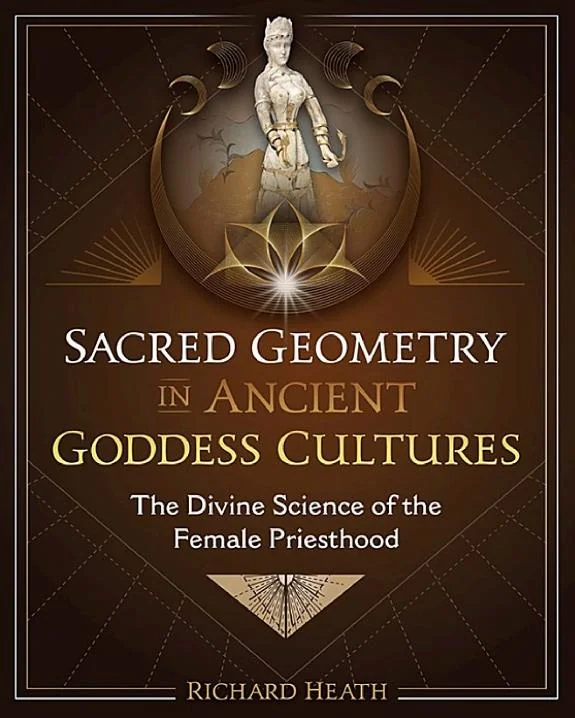
Richard Heath's 2007 book links geometry and astronomy to early matriarchal societies.
Richard Heath's "Sacred Geometry in Ancient Goddess Cultures" proposes that advanced civilizations predating patriarchal structures employed a "cosmic science." This science, rooted in female astronomical observation, was physically encoded into monumental architecture and calendars. Heath examines key sites like Malta, Göbekli Tepe, and Minoan Crete, presenting evidence that these ancient peoples understood celestial mechanics and geometric principles. These understandings formed the basis of their spiritual and societal frameworks, reflecting a deep reverence for the feminine principle.
The author analyzes megalithic structures, temples, and observatories as deliberate manifestations of sophisticated knowledge. He details how ancient peoples tracked celestial cycles and aligned their constructions with astronomical events, connecting this knowledge to goddess veneration. Heath traces the legacy of this science into later traditions, suggesting its echoes appear even in early Christian communities in Cappadocia.
This work sits within esoteric traditions that seek to uncover suppressed or forgotten histories of ancient wisdom. It connects to archaeoastronomy and the study of ancient cosmologies, suggesting a continuity of knowledge linked to feminine principles. Heath's approach aligns with interpretations that view monumental sites not merely as historical artifacts but as repositories of sophisticated cosmological understanding, often overlooked by mainstream archaeology.
💡 Why Read This Book?
• Learn how megalithic astronomers in Malta, Gobekli Tepe, and Minoan Crete utilized specific geometric principles and celestial observations to construct their temples and calendars, revealing a shared "cosmic science." • Understand the author's argument for how early Christians in Cappadocia, Turkey, may have encoded ancient goddess culture knowledge into their rock-cut churches, offering a unique perspective on religious syncretism. • Gain insight into how Greek myths are interpreted as evidence of the societal transition from matriarchy to patriarchy, linking this shift to the potential loss or transformation of ancient astronomical wisdom.
⭐ Reader Reviews
Honest opinions from readers who have explored this book.
❓ Frequently Asked Questions
What is 'sacred geometry' as presented in Richard Heath's book?
Sacred geometry, in Heath's context, refers to the use of specific geometric forms and proportions believed to reflect cosmic order and divine principles, particularly as understood and applied by ancient matriarchal cultures in their architecture and astronomy.
Which ancient cultures are central to the study of "Sacred Geometry in Ancient Goddess Cultures"?
The book primarily focuses on the matrilineal cultures of Malta, Göbekli Tepe, and the Minoans of Crete, examining their megalithic monuments and astronomical practices.
How does the book connect early Christianity to ancient goddess cultures?
Heath proposes that early Christian communities in Cappadocia, Turkey, preserved elements of ancient astronomical and geometric science by encoding them into the design and orientation of their rock-cut churches.
What does the author suggest about the transition from matriarchy to patriarchy?
The book interprets Greek myths as revealing this societal shift, suggesting that the transition involved a transformation or suppression of the ancient cosmic science previously associated with goddess veneration.
What is the significance of 'female megalithic astronomers' mentioned in the book?
It highlights the author's theory that women were the primary observers and practitioners of astronomy and geometry in these ancient goddess cultures, viewing celestial cycles through a feminine lens.
When was Richard Heath's "Sacred Geometry in Ancient Goddess Cultures" first published?
The book was first published on March 26, 2024, making it a recent exploration of these ancient themes.
🔮 Key Themes & Symbolism
Megalithic Astronomy
The work meticulously details how megalithic sites like those in Malta and Göbekli Tepe were aligned with celestial events, serving as sophisticated astronomical observatories. Heath argues that these structures reveal a shared "cosmic science" developed by early matriarchal societies, demonstrating an advanced understanding of geometry and the cosmos long before conventional historical timelines. This theme emphasizes the practical application of geometric principles for tracking solstices, equinoxes, and other significant astronomical phenomena, linking earthly structures to celestial movements.
Goddess Culture and Feminine Principle
A central tenet is the idea that ancient goddess cultures were the custodians of this sacred geometry and astronomical knowledge. Heath posits that the feminine principle was intrinsically linked to the understanding of cosmic cycles and creation. The book explores how this reverence for the divine feminine shaped their worldview, architecture, and societal structures, suggesting a profound connection between female astronomical observation and the development of early science and spirituality.
Preservation of Ancient Science
Heath investigates how elements of this ancient science were preserved, even after societal shifts towards patriarchy. He highlights the rock-cut churches of Cappadocia as potential repositories, where early Christian builders may have unknowingly encoded geometric patterns and astronomical alignments from older traditions. This theme explores the resilience of knowledge and its subtle transmission through cultural and religious transitions, offering a unique perspective on historical continuity.
Myth as Historical Record
The book reinterprets Greek myths, suggesting they offer clues to the transition from matriarchal societies to patriarchal ones. By analyzing these narratives through the lens of lost astronomical science and the decline of goddess veneration, Heath proposes that myths function as a form of historical record, revealing deep cultural shifts and the transformation of spiritual paradigms.
💬 Memorable Quotes
Direct passages from the work, attributed to the author.
“The megalithic monuments, temples, and secret calendars of the matrilineal cultures of Malta, Gobekli Tepe, and the Minoans of Crete shared sacred geometry and astronomy knowledge.”
— This statement captures the book's core argument: that disparate ancient cultures, linked by matriarchal structures, possessed a unified scientific understanding based on geometry and celestial observation, manifested in their architectural and calendrical systems.
“Early Christians helped preserve ancient science by encoding it in the rock-cut churches of the Cappadocia region of Turkey.”
— This highlights Heath's theory that later religious groups, perhaps inadvertently, acted as custodians of older knowledge. The geometric and astronomical features within Cappadocia's churches are presented as elements of a forgotten, pre-Christian wisdom.
“Greek myths reveal the transition from matriarchy to patriarchy.”
— This suggests that the narratives of ancient Greece are not merely fantastical tales but contain historical and sociological information about a fundamental shift in societal organization and power structures, linked to spiritual changes.
“The ancient cosmic science of the female megalithic astronomers.”
— This phrase emphasizes the author's belief that women were the primary architects of early scientific understanding, particularly in astronomy and geometry, within the context of goddess-centric cultures.
“Minoan civilization's temples and secret calendars.”
— This points to specific cultural artifacts and practices of the Minoans that are analyzed in the book to demonstrate their sophisticated understanding and application of sacred geometry and astronomical tracking.
🌙 Esoteric Significance
Tradition
This work fits within the broader tradition of ancient wisdom studies, particularly those that explore pre-Abrahamic spiritualities and the concept of a forgotten cosmic science. It appeals to perennial philosophy's search for universal truths across cultures and time, but specifically grounds these in the material evidence of megalithic sites and astronomical alignments. While not strictly Hermetic or Gnostic, it shares their interest in hidden knowledge and a cyclical view of history, emphasizing a feminine divine principle often downplayed in patriarchal esoteric lineages.
Symbolism
The primary symbols explored are geometric forms – circles, squares, triangles – as they relate to celestial bodies and cosmic order. The book likely explores the symbolism of the Great Goddess, representing the generative and cyclical forces of the universe, and how this was expressed through architectural proportions and astronomical calendars. Symbols related to specific constellations or astronomical events, as observed and revered by these ancient cultures, would also be central.
Modern Relevance
Contemporary interest in sacred geometry, earth mysteries, archaeoastronomy, and Goddess spirituality draws directly on the kind of research Heath presents. Thinkers and practitioners exploring ley lines, ancient site alignments, and non-patriarchal spiritual paths often look to these prehistoric cultures for inspiration and validation. The book's re-evaluation of early science through a feminine lens offers a relevant counter-narrative to dominant historical and scientific paradigms, appealing to those seeking alternative understandings of human history and consciousness.
👥 Who Should Read This Book
• Researchers of archaeoastronomy and ancient architecture: Those interested in the scientific and astronomical capabilities of prehistoric cultures will find detailed analyses of megalithic sites and their celestial alignments. • Students of comparative religion and mythology: Individuals exploring the evolution of spiritual beliefs, particularly the shift from goddess veneration to patriarchal structures, will benefit from the interpretation of myths and religious sites. • Practitioners of esoteric traditions and Goddess spirituality: Those seeking to connect with ancient feminine wisdom and understand the foundational role of sacred geometry in early spiritual systems will find significant inspiration.
📜 Historical Context
Published in 2024, Richard Heath's "Sacred Geometry in Ancient Goddess Cultures" enters a contemporary academic landscape increasingly open to re-examining pre-Indo-European civilizations and the role of women in early societies. Its focus on megalithic astronomy and matriarchal structures aligns with burgeoning fields like archaeoastronomy and feminist archaeology, which challenge traditional patriarchal narratives. The work implicitly critiques established historical timelines and interpretations that often marginalize or dismiss the achievements of prehistoric goddess cultures. While not explicitly engaging with specific contemporary scholars by name within the blurb, its thesis would likely be discussed in relation to figures like Marija Gimbutas, whose work on Neolithic Europe and goddess figurines has been influential, though also debated. The book's exploration of encoded knowledge in Cappadocia could also be seen as a counterpoint to purely theological interpretations of early Christian architecture, suggesting a deeper, older layer of meaning. The primary intellectual current it challenges is the standard Greco-Roman-centric view of Western civilization's origins.
📔 Journal Prompts
The sacred geometry embedded in Malta's megalithic temples and its connection to female astronomers.
Göbekli Tepe's astronomical alignments and the concept of a shared cosmic science.
The Minoan civilization's secret calendars and their geometric underpinnings.
Cappadocia's rock-cut churches as potential repositories of ancient goddess culture knowledge.
Interpreting Greek myths as evidence of the matriarchy-to-patriarchy transition.
🗂️ Glossary
Sacred Geometry
The study of geometric shapes, proportions, and patterns believed to hold symbolic or sacred meaning, reflecting cosmic order and divine principles, as applied by ancient cultures.
Megalithic Astronomers
Individuals or groups in prehistoric times who constructed large stone monuments (megaliths) with deliberate alignments to celestial bodies and events, demonstrating advanced astronomical knowledge.
Matrilineal Cultures
Societies in which descent, inheritance, and social status are traced through the female line, often associated with a prominent role for the divine feminine.
Cosmic Science
A holistic understanding of the universe that integrates scientific observation (especially of astronomy and geometry) with spiritual and philosophical principles, as practiced by ancient civilizations.
Minoan Civilization
A Bronze Age civilization centered on the island of Crete, known for its sophisticated palaces, art, and maritime trade, believed by the author to have preserved ancient astronomical knowledge.
Rock-cut Churches
Churches carved directly into the rock formations, particularly notable in the Cappadocia region of Turkey, which the book suggests may contain encoded ancient wisdom.
Matriarchy to Patriarchy Transition
The hypothesized societal shift from a system where women held primary power and lineage was traced through them, to one where men dominate public life and lineage is traced through them.
This book appears in 1 collection
🔮 Readers Also Liked
Browse all →









From the “Sacred Geometry” Collection
View all →








More Free Occult Philosophy Books
View all →