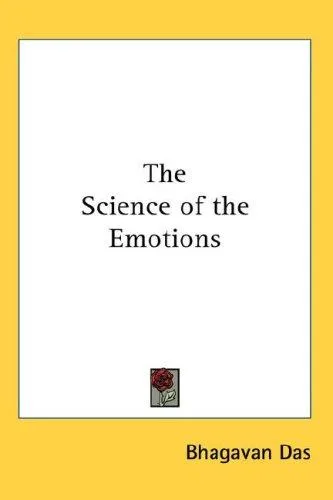
The science of the emotions
 75
75

The science of the emotions
Bhagavan Das’s *The Science of the Emotions* offers a fascinating, if dense, exploration of the psyche from an early 20th-century esoteric perspective. Its strength lies in its systematic attempt to codify emotional energies, presenting them as forces subject to discoverable laws. The author’s detailed classifications of emotional states and their corresponding energetic expressions are particularly compelling, moving beyond simple descriptive psychology. However, the prose can be challenging, often steeped in the specific terminology of Indian philosophy and yogic traditions, which may present a barrier to readers unfamiliar with these concepts. A particularly striking passage discusses the 'will-force' as a specific type of energy that can be cultivated to manage more volatile emotional currents. While the book provides a robust theoretical framework, its practical application requires significant dedication and prior knowledge. It stands as a significant, albeit demanding, contribution to the literature on consciousness and emotional mastery.
📝 Description
75
Bhagavan Das published The Science of the Emotions in 1924, arguing emotions are tangible energies with discernible laws.
This 1924 text by Bhagavan Das proposes that emotions are not just subjective feelings but are instead tangible energies governed by specific laws. Das aims to explain emotional states as phenomena that can be understood and managed through conscious awareness and particular practices. The book is written for those deeply interested in esoteric philosophy, psychology, and comparative religion. It is for readers who wish to understand their inner lives more scientifically, moving beyond standard psychological views. Those who study the links between Eastern spiritual practices and Western esoteric thought, especially yogic philosophy and consciousness, will find much here.
Das breaks down emotions into categories, exploring their sources and how they appear. He discusses the 'emotional body' and how 'prana', or life force, influences emotional conditions. The work highlights the significance of 'manas', the mind, and its function in shaping emotional experience. The author's goal is to provide a systematic framework for analyzing emotional life, suggesting that through this understanding, individuals can achieve greater self-mastery.
Bhagavan Das's The Science of the Emotions appeared in 1924, a time of significant interest in esoteric thought and the blending of Eastern and Western ideas. The Theosophical Society, with figures like Helena Blavatsky, had already paved the way for such cross-cultural philosophical inquiry. Das's work fits within this milieu, seeking to connect ancient yogic principles with a modern, analytical understanding of the mind. This period also saw thinkers like Carl Jung exploring the psyche's deeper dimensions, though Das's approach is rooted in a different tradition.
💡 Why Read This Book?
• Understand emotional energies as tangible forces, moving beyond subjective feeling, by studying Bhagavan Das’s classification of emotional states as detailed in the 1924 publication. • Learn about the energetic underpinnings of the psyche, specifically how concepts like 'prana' and the 'emotional body' influence your inner experience, as explored in the text. • Discover methods for achieving emotional equilibrium through conscious awareness of psychic forces, drawing parallels to yogic principles discussed within the book.
⭐ Reader Reviews
Honest opinions from readers who have explored this book.
❓ Frequently Asked Questions
What is the primary focus of Bhagavan Das's 'The Science of the Emotions'?
The book focuses on understanding emotions not just as subjective feelings, but as tangible energies governed by specific laws. It explores how these energies manifest and can be managed through conscious awareness, drawing heavily on yogic philosophy.
When was 'The Science of the Emotions' first published?
'The Science of the Emotions' by Bhagavan Das was first published in 1924, placing it within the early 20th-century wave of esoteric and philosophical inquiry.
What esoteric traditions influence Bhagavan Das's work?
The work is deeply influenced by Indian yogic philosophy and Vedanta, integrating concepts such as prana, chakras, and manas into its analysis of the human emotional and psychic apparatus.
Is 'The Science of the Emotions' suitable for beginners in psychology?
While insightful, the book uses specialized terminology from Indian philosophy and esoteric traditions. Beginners might find it more accessible after gaining some familiarity with these underlying concepts or with guidance.
What are the practical applications of the concepts in this book?
The book aims to provide readers with a framework for self-mastery, enabling them to understand, analyze, and consciously direct their emotional energies towards greater equilibrium and spiritual development.
How does this book relate to modern psychology?
It offers an alternative perspective to conventional Western psychology by treating emotions as energetic phenomena with spiritual implications, a viewpoint that resonates with some transpersonal and esoteric psychology approaches.
🔮 Key Themes & Symbolism
Emotional Energy Dynamics
This work posits emotions not as passive states but as active energies that flow through the individual. Bhagavan Das elaborates on how these energies are generated, directed, and can be transmuted. He introduces concepts like the 'emotional body' to describe the energetic substratum of feelings, suggesting that understanding these dynamics is key to self-mastery and spiritual progression. The book details how specific emotional states correlate with distinct energetic patterns, offering a framework for recognizing and working with one's inner emotional landscape.
The Role of Manas (Mind)
Central to Bhagavan Das's thesis is the function of 'manas,' the mind, in relation to emotional experience. The book explores how the mind acts as both the generator and potential regulator of emotional currents. It distinguishes between the reactive mind, which is easily swayed by emotional impulses, and a higher, discerning intellect capable of observing and directing these forces. This perspective emphasizes conscious awareness and focused volition as tools for reading through the often turbulent waters of emotional life.
Yogic Principles and Chakras
Bhagavan Das integrates core yogic concepts, including the vital life force 'prana' and the energy centers known as 'chakras.' The book elucidates how emotional experiences are intrinsically linked to the state and activity of these chakras. It suggests that imbalances or blockages in the chakra system can manifest as specific emotional disturbances, while balanced energy flow promotes psychological well-being. This framework offers a physiological and energetic basis for understanding emotional states.
Consciousness and Emotional Mastery
Ultimately, 'The Science of the Emotions' guides the reader toward achieving a state of conscious mastery over their emotional responses. By understanding emotions as energetic phenomena and the mind's role in their manifestation, individuals can cultivate detachment and equanimity. The book presents a path towards spiritual evolution, where emotional stability is not merely a goal for comfort but a prerequisite for higher states of consciousness and self-realization.
💬 Memorable Quotes
Direct passages from the work, attributed to the author.
“Emotions are not simply feelings; they are energies that can be understood and directed.”
— This statement captures the book's core premise: emotions possess a tangible, energetic quality akin to physical forces, which, if properly understood, can be consciously managed rather than passively experienced.
“The mind, or manas, is the seat where emotional energies are generated and processed.”
— This highlights the critical role of the mental faculty in the formation and experience of emotions, suggesting that mental discipline is paramount for emotional regulation.
“The flow of prana is intimately connected with the state of our emotional being.”
— This points to the yogic concept of life force (prana) as a fundamental element influencing emotional states, implying that practices affecting prana can impact emotional well-being.
“Chakras act as focal points for emotional and psychic energies within the subtle body.”
— This interpretation links the ancient Indian concept of energy centers (chakras) to the manifestation and experience of emotions, providing an energetic map for psychological phenomena.
“True emotional equilibrium is achieved through conscious awareness and disciplined volition.”
— This emphasizes that emotional stability is an active achievement requiring sustained mental attention and the exercise of willpower, rather than a passive state.
🌙 Esoteric Significance
Tradition
The work firmly resides within the tradition of Indian yogic philosophy and Vedanta, integrating concepts like prana, manas, and chakras. It adapts these ancient principles into a structured analysis of emotional phenomena, presenting them with a rational, almost scientific, methodology that appealed to a Western audience seeking a systematic understanding of the psyche beyond dogma.
Symbolism
Key symbols include 'prana,' representing the universal life force that animates all beings and is directly tied to emotional states; the 'chakras,' visualized as energetic wheels within the subtle body that govern different psychological and emotional functions; and 'manas' (mind), symbolizing the interface between consciousness and emotional energy, capable of both generating and controlling these forces.
Modern Relevance
Contemporary practitioners of yoga, meditation, and mindfulness often engage with the concepts of prana and chakras, finding Das's work a valuable theoretical companion. His systematic approach to emotional energies also appeals to modern transpersonal psychology and certain somatic experiencing therapies that explore the body's role in emotional regulation and trauma.
👥 Who Should Read This Book
• Students of yogic philosophy and Vedanta seeking a detailed, analytical framework for understanding emotional dynamics through traditional Indian concepts. • Individuals interested in comparative psychology and the esoteric study of consciousness who want to explore non-Western models of the psyche. • Practitioners of meditation and mindfulness seeking a deeper theoretical basis for the energetic and mental aspects of emotional self-regulation and spiritual development.
📜 Historical Context
Bhagavan Das's *The Science of the Emotions*, released in 1924, emerged during a period of intense global interest in esoteric philosophies and the human mind. This era saw the Theosophical Society, founded by Helena Blavatsky, popularizing Eastern spiritual concepts in the West, creating fertile ground for works like Das's. Simultaneously, Western psychology was evolving, with figures like Carl Jung exploring archetypes and the collective unconscious, albeit through a different lens. Das's work can be seen as contributing to a broader discourse seeking to reconcile ancient spiritual wisdom with modern scientific inquiry. It offered a detailed, systematic approach to emotional energies informed by yogic philosophy, contrasting with the more purely psychoanalytic or empirical methods developing elsewhere. The book's reception was likely within specialized circles interested in comparative religion and occult sciences, rather than mainstream academia.
📔 Journal Prompts
The flow of prana and its connection to specific emotional states.
Manas as the generator and director of emotional energies.
The energetic manifestation of emotions through the chakras.
Cultivating disciplined volition to manage emotional responses.
The 'emotional body' as a distinct energetic entity.
🗂️ Glossary
Prana
The vital life force or energy that pervades the universe and animates all living beings. In the context of emotions, its flow and balance are considered crucial for psychological well-being.
Manas
The Sanskrit term for mind or consciousness, often referring to the lower mind or intellect that processes sensory information and is directly involved in emotional experiences and volitional acts.
Chakras
Literally 'wheels,' these are psycho-energetic centers within the subtle body, often depicted along the spine, believed to regulate physiological and psychological functions, including emotional states.
Emotional Body
A concept referring to the energetic or subtle body component associated with emotions, distinct from the physical body, through which emotional energies are experienced and expressed.
Will-force (or Volition)
The faculty of conscious decision-making and directed action; in this context, it is presented as a specific type of energy that can be cultivated to control and manage emotional impulses.
Vedanta
A school of Hindu philosophy that aims to understand the nature of ultimate reality (Brahman) and the self (Atman), often emphasizing meditation and self-knowledge.
Yogic Philosophy
A broad category of Indian philosophies focused on achieving spiritual liberation and self-realization through practices such as meditation, ethical discipline, and control of the body and mind.
🔮 Readers Also Liked
Browse all →







More by Bhagavan Das
All books →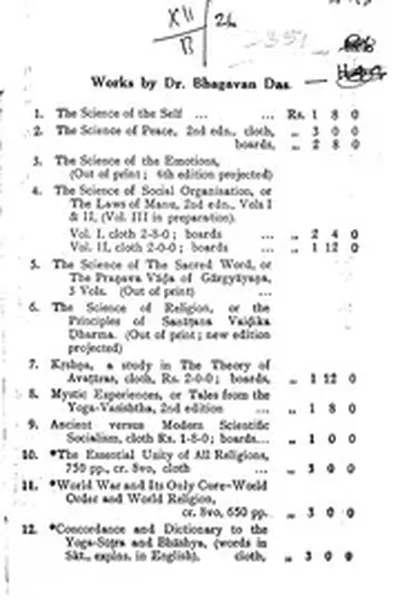

More Free Theosophy & Anthroposophy Books
View all →