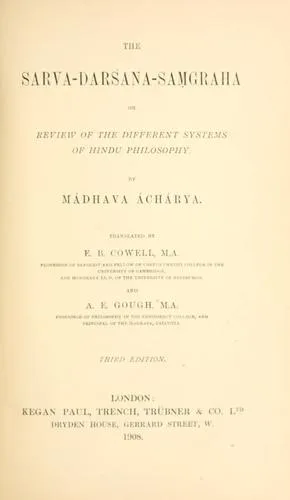
The Sarva-darsana-samgraha
 71
71

The Sarva-darsana-samgraha
Madhava's Sarva-darsana-samgraha, as rendered by Gough and Cowell, offers a starkly efficient survey of Indian philosophical thought. Its strength lies in its systematic presentation; Madhava’s ability to distill sixteen distinct schools into digestible summaries is remarkable. The text avoids polemic, instead focusing on exposition. A particularly illustrative section is the treatment of the Sankhya school, where the dualistic interplay of Purusha and Prakriti is laid bare. However, the sheer density of information can be daunting for the uninitiated. The historical context provided by the translators, while useful, does not fully bridge the gap for a reader entirely unfamiliar with Indian philosophical terminology. The 1924 translation, while a scholarly achievement, occasionally feels dated in its prose. Despite these limitations, the Sarva-darsana-samgraha remains an essential, if demanding, roadmap for navigating the labyrinthine landscape of Indian philosophy.
📝 Description
71
Madhava compiled the Sarva-darsana-samgraha, a Sanskrit text, around the 14th century.
The Sarva-darsana-samgraha, meaning 'Compendium of All Philosophical Systems,' systematically surveys and summarizes sixteen principal schools of Indian philosophy. Madhava, a 14th-century scholar, presents their core tenets and arguments with conciseness. The work offers an encyclopedic overview of the diverse intellectual landscape of ancient and medieval India, covering heterodox traditions like Buddhism and Jainism alongside orthodox Brahmanical schools. This text is a valuable resource for understanding the scope of Indian metaphysical thought.
This compendium is useful for students of comparative philosophy, religious studies, and Indian intellectual history. Scholars examining the arguments and distinctions between various Indian darsanas will find its structured approach beneficial. It also suits readers interested in the historical development of philosophical inquiry, especially how different schools engaged with concepts of reality, consciousness, karma, and liberation. The text demands focused attention, appealing to those who appreciate rigorous intellectual exposition.
Compiled around the 14th century in India, the Sarva-darsana-samgraha emerged during a period of significant philosophical synthesis. Madhava’s work organizes the multitude of philosophical systems that had evolved over centuries. It appeared when intellectual debates were vibrant, with established schools like Vedanta and Nyaya interacting with critiques from traditions such as Buddhism.
As a compendium of diverse Indian philosophical systems, the Sarva-darsana-samgraha touches upon traditions that are often considered esoteric due to their complex metaphysical frameworks and their exploration of consciousness, liberation, and the nature of reality. While not a single esoteric doctrine itself, its systematic presentation of schools like Vedanta, Samkhya, and Yoga, alongside heterodox views, provides a map to the varied paths of spiritual and intellectual inquiry that developed within the Indian subcontinent. Understanding these distinct darsanas is a prerequisite for grasping the deeper currents of Indian thought that have influenced esoteric practices and philosophies for centuries.
💡 Why Read This Book?
• Gain a structured overview of sixteen major Indian philosophical systems, understanding their core differences and similarities as presented by Madhava, thereby clarifying complex schools like Advaita Vedanta. • Grasp the historical intellectual currents of medieval India through Madhava's 14th-century compilation, offering a unique lens on the development of Brahmanical and heterodox thought. • Learn about foundational concepts like karma, moksha, and the nature of reality as interpreted by diverse darsanas, providing a comparative framework beyond Western philosophical traditions.
⭐ Reader Reviews
Honest opinions from readers who have explored this book.
❓ Frequently Asked Questions
What is the primary purpose of the Sarva-darsana-samgraha?
Its primary purpose is to systematically survey and summarize the core doctrines of sixteen major Indian philosophical schools, providing a comprehensive overview of the diverse intellectual landscape of ancient and medieval India.
Who was Madhava, the author?
Madhava was a 14th-century Indian scholar who compiled this comprehensive compendium of Indian philosophical systems. He aimed to present a clear exposition of each darsana's tenets.
When was the English translation first published?
The English translation of the Sarva-darsana-samgraha by Archibald Edward Gough and Edward B. Cowell was first published in 1924, making the text accessible to a Western audience.
Does the book cover only Hindu philosophies?
No, the Sarva-darsana-samgraha is notable for including heterodox traditions such as Buddhism and Jainism alongside orthodox Brahmanical schools like Vedanta, Samkhya, and Nyaya.
What is a 'darsana' in the context of this book?
A 'darsana' refers to a philosophical system or school of thought in Indian philosophy. The book examines sixteen such darsanas, presenting their distinct views on reality and existence.
Is this book suitable for beginners in philosophy?
While comprehensive, the book's dense and systematic approach might be challenging for absolute beginners. It is best suited for those with some existing interest in or background knowledge of Indian philosophy.
🔮 Key Themes & Symbolism
Systematic Philosophical Exposition
The Sarva-darsana-samgraha excels in its systematic presentation of sixteen distinct Indian philosophical schools. Madhava meticulously outlines the foundational principles, epistemological methods (pramana), and soteriological goals (moksha) of each darsana. This structured approach allows readers to compare and contrast the divergent views on reality, consciousness, and the path to liberation, moving beyond anecdotal knowledge to a coherent understanding of the Indian philosophical landscape.
Diversity of Indian Thought
This work is crucial for appreciating the sheer breadth of Indian intellectual traditions. It moves beyond a singular narrative, presenting orthodox Brahmanical systems like Vedanta and Nyaya alongside heterodox schools such as Buddhism, Jainism, and the materialist Carvaka. By dedicating sections to each, Madhava highlights the extensive philosophical dialogue and debate that characterized Indian thought for centuries, revealing a rich spectrum of metaphysical and ethical viewpoints.
Concepts of Liberation (Moksha)
A central theme across many darsanas surveyed is the concept of liberation or release (moksha) from the cycle of suffering and rebirth. The Sarva-darsana-samgraha illustrates how different schools conceptualize this ultimate goal and the diverse paths prescribed for its attainment. Whether through knowledge (jnana), devotion (bhakti), or disciplined practice, the text maps out the varied spiritual aspirations and methodologies prevalent in Indian traditions.
Epistemology and Metaphysics
The compendium looks at the fundamental questions of how we know what we know (epistemology) and the nature of reality itself (metaphysics). Each darsana's unique approach to valid sources of knowledge (pramana) and its metaphysical framework—whether monistic, dualistic, or pluralistic—are clearly delineated. This focus provides a critical framework for understanding the grounds upon which each philosophical system builds its worldview.
💬 Memorable Quotes
Direct passages from the work, attributed to the author.
“The Cārvāka system holds that consciousness is a product of the material elements.”
— This statement expresses the radical materialism of the Carvaka school, positing that all phenomena, including consciousness, arise solely from the combination of physical matter, rejecting any spiritual or immaterial substance.
“The doctrine of the Sankhya school posits two ultimate realities: Purusha and Prakriti.”
— This highlights the core dualism of Sankhya philosophy, where Purusha (consciousness) is seen as a passive, unchanging observer, while Prakriti (primordial matter) is the active principle responsible for the manifest world.
“Advaita Vedanta asserts the identity of the individual soul (Atman) with the ultimate reality (Brahman).”
— This succinctly explains the non-dualistic stance of Advaita, asserting that the apparent separation between the self and the absolute is an illusion, and true reality is a single, undifferentiated consciousness.
“The Jaina perspective emphasizes non-violence (ahimsa) and the multiplicity of souls (jiva).”
— This points to two central tenets of Jainism: the ethical imperative of causing no harm and the metaphysical view that reality is composed of an infinite number of individual, eternal souls.
“Buddhism denies the existence of a permanent, independent self (anatman).”
— This captures the Buddhist doctrine of 'no-self,' which refutes the notion of a fixed, unchanging soul or ego, viewing the individual as a temporary aggregation of physical and mental processes.
🌙 Esoteric Significance
Tradition
While not strictly an 'esoteric' text in the Western sense of Hermeticism or Kabbalah, the Sarva-darsana-samgraha is foundational to understanding the esoteric dimensions within Indian traditions. It maps the philosophical underpinnings for practices like Yoga (often linked to Samkhya) and various meditative paths central to Vedanta and Buddhism, which aim for profound inner transformation and liberation.
Symbolism
The text implicitly deals with symbols related to the cyclical nature of time (kalpas, yugas) and the cosmic order. Concepts like Brahman and Atman, while philosophical, carry deep symbolic weight representing unity and ultimate consciousness. The contrasting views on reality, such as the interplay of Purusha and Prakriti in Sankhya, function as symbolic frameworks for understanding existence and the human condition.
Modern Relevance
Contemporary thinkers and practitioners in fields ranging from comparative religion to consciousness studies draw upon the systematic distinctions Madhava provides. Modern interpretations of Yoga and Vedanta often reference the historical philosophical debates clarified by the Sarva-darsana-samgraha. Its value lies in offering a clear map for understanding the diverse roots of contemplative and philosophical practices popular today.
👥 Who Should Read This Book
['• Scholars of comparative philosophy: To gain a foundational understanding of the distinctions and relationships between major Indian darsanas, crucial for cross-cultural philosophical analysis.', '• Students of religious studies: To explore the diverse metaphysical and ethical frameworks that underpin various Indian religious traditions, including Hinduism, Buddhism, and Jainism.', '• Practitioners seeking deeper context: For those engaged in Yoga or meditation who wish to understand the philosophical underpinnings of these practices as presented in their historical schools.']
📜 Historical Context
Compiled in the 14th century, Madhava's Sarva-darsana-samgraha emerged during a vibrant period of Indian intellectual history, long after the foundational texts of many philosophical schools were established. It provided a much-needed synthesis in an era where commentaries and debates flourished. The work implicitly engaged with the long-standing philosophical traditions, including the influential Advaita Vedanta of Shankara and the realist Nyaya school. Its significance was recognized by Western scholars in the late 19th and early 20th centuries; Edward B. Cowell, who collaborated on the 1924 translation with Archibald Edward Gough, was a prominent Indologist. The translation itself was a product of the burgeoning field of South Asian studies within British academia, aiming to make these complex Indian philosophical systems accessible to European scholars and students, bridging a gap in comparative philosophy.
📔 Journal Prompts
The Carvaka materialism versus the Advaita Brahman realization: What are the implications of each perspective for understanding the self?
The Sankhya concept of Purusha and Prakriti: How does this dualistic framework explain the world's phenomena?
The Buddhist doctrine of anatman: Reflect on the challenges and liberation offered by a philosophy without a permanent self.
The Jaina emphasis on ahimsa: Consider the practical and ethical ramifications of this principle in daily life.
Comparing the paths to moksha across different darsanas: Which approach seems most compelling and why?
🗂️ Glossary
Darsana
A Sanskrit term meaning 'view,' 'perspective,' or 'philosophy.' It refers to one of the orthodox or heterodox schools of Indian philosophy.
Brahman
In Vedanta philosophy, the ultimate, unchanging reality or absolute ground of all being. It is considered the source and substance of the universe.
Atman
The individual self or soul. In Advaita Vedanta, Atman is ultimately identical with Brahman; in other schools, it may be distinct.
Moksha
Liberation or release from the cycle of birth, death, and rebirth (samsara). It is the ultimate goal in most Indian philosophical and religious systems.
Pramana
A means of valid knowledge or cognition in Indian philosophy. Different schools recognize different pramāṇas, such as perception, inference, and testimony.
Prakriti
In Sankhya and Yoga philosophy, the primordial, unmanifest matter or nature from which the material world evolves. It is considered the feminine principle.
Purusha
In Sankhya and Yoga philosophy, the principle of pure consciousness, the self, or spirit. It is considered the masculine principle, passive and unchanging.
🔮 Readers Also Liked
Browse all →









More by Madhava, Archibald Edward Gough, Edward B. Cowell
All books →
More Free Occult Philosophy Books
View all →