The Sarva-darsana-samgraha
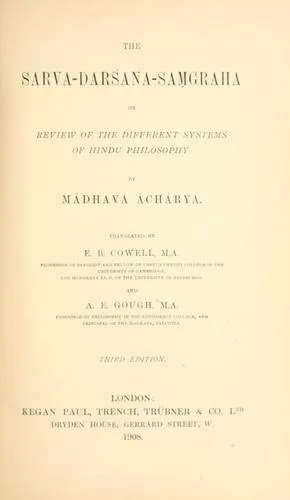
 73
73

The Sarva-darsana-samgraha
Madhava's 'Sarva-darsana-samgraha' offers an invaluable cartography of Indian philosophical thought, a necessary undertaking given the period's intellectual ferment. Its strength lies in its systematic approach, presenting sixteen distinct schools with remarkable clarity and concision. The translation by Gough and Cowell, first published in 1924, remains a vital conduit for Western understanding. However, the sheer density of material, while comprehensive, can be daunting for the uninitiated. A specific passage detailing the Carvaka's radical materialism, which denies any form of afterlife or soul, is particularly striking for its stark contrast to other systems. While the analytical rigor is commendable, the work sometimes presents the schools' arguments without fully capturing the lived devotional or experiential dimensions that often underpin them. Nonetheless, it remains an indispensable reference for serious students of Indic traditions.
📝 Description
73
Authored in the 14th century, Madhava's Sarva-darsana-samgraha surveys sixteen Indian philosophical schools.
The Sarva-darsana-samgraha, translating to 'Compendium of All Philosophical Systems,' presents a systematic survey of sixteen major Indian philosophical traditions. Madhava Acharya compiled this work in the 14th century, detailing the core arguments and refutations of each school. Its scope offers a broad overview of Indian thought, covering both orthodox and heterodox systems.
This text is valuable for students of Indian philosophy, comparative religion, and intellectual history. It provides direct access to the foundational ideas shaping South Asian spiritual and philosophical traditions. Readers will find structured explanations of systems like Vedanta, Samkhya, Yoga, Nyaya, and the heterodox Carvaka. It also helps practitioners understand their own paths within the larger context of Indic thought. The work originated during a period of intense philosophical discussion in the Vijayanagara Empire. Its English translation, by Archibald Edward Gough and Edward B. Cowell, made these complex systems accessible to a Western audience around 1924.
While not strictly esoteric in the Western sense, the Sarva-darsana-samgraha catalogues traditions that delve into profound questions about reality, consciousness, and liberation. It maps the intellectual terrain where spiritual goals (moksha) intersect with complex philosophical frameworks. The text contrasts systems positing ultimate realities or divine creators with those that do not, revealing the diverse approaches to understanding existence and achieving release within the Indic sphere.
💡 Why Read This Book?
• Gain a structured understanding of the sixteen major Indian philosophical systems, from the dualism of Samkhya to the monism of Advaita Vedanta, as presented by Madhava Acharya in the 14th century. • Explore the contrasting epistemological frameworks (pramana) used by diverse schools, such as the Nyaya's emphasis on logical inference versus the Yoga's focus on meditative perception. • Appreciate the historical context of Indian philosophical discourse, understanding how Madhava synthesized these varied traditions before their English translation made them widely available in 1924.
⭐ Reader Reviews
Honest opinions from readers who have explored this book.
❓ Frequently Asked Questions
What is the primary purpose of the Sarva-darsana-samgraha?
The primary purpose is to provide a comprehensive overview and systematic summary of sixteen distinct philosophical systems of ancient India, detailing their core tenets and arguments.
Who was Madhava Acharya, the compiler of this work?
Madhava Acharya was a scholar and commentator from the 14th century, associated with the Vijayanagara Empire, known for his extensive writings on Indian philosophy and theology.
What does the term 'Sarva-darsana-samgraha' mean?
'Sarva-darsana-samgraha' translates from Sanskrit to 'Compendium of All Philosophical Systems,' accurately reflecting its content.
When was the English translation by Gough and Cowell first published?
The English translation by Archibald Edward Gough and Edward B. Cowell was first published in 1924, making the work accessible to a broader audience.
Does this book cover heterodox Indian philosophical schools?
Yes, the Sarva-darsana-samgraha includes heterodox schools such as the Carvaka (Lokayata), alongside orthodox Brahmanical traditions like Vedanta and Yoga.
What is the historical significance of this text?
It offers a crucial 14th-century perspective on the diverse philosophical landscape of India, preserving summaries of systems that might otherwise be less understood.
🔮 Key Themes & Symbolism
Epistemological Frameworks (Pramana)
The text systematically dissects the methods of acquiring knowledge (pramana) employed by different Indian philosophical schools. It contrasts the Nyaya's reliance on logical inference (anumana) and perception (pratyaksa) with the Vedanta's emphasis on scripture (shruti) and the Yoga's focus on meditative insight. Understanding these varied epistemologies is crucial for appreciating how each system establishes its claims about reality, the self, and the divine, offering a comparative study of rational and intuitive pathways to truth within the Indian tradition.
Metaphysical Realities
Central to the compendium is the exploration of differing metaphysical views on the nature of existence. This includes the debate between monistic systems, like Advaita Vedanta's concept of Brahman as the sole reality, and dualistic schools such as Samkhya, which posits distinct principles of Purusha (consciousness) and Prakriti (matter). The work also addresses materialistic viewpoints, like those of the Carvaka, which deny any reality beyond the physical. These discussions illuminate the profound ontological questions that have occupied Indian thinkers for centuries.
Soteriological Goals (Moksha)
The ultimate aim of liberation (moksha) is a recurring theme, explored through the lens of diverse traditions. The Sarva-darsana-samgraha outlines the paths to liberation as envisioned by each school, whether through knowledge (jnana), action (karma), devotion (bhakti), or meditative discipline (samadhi). It highlights the varied conceptions of the liberated state itself – from union with the divine to the cessation of suffering and the realization of the true nature of the self. This comparative approach reveals the complex understanding of spiritual emancipation within Indian thought.
Theistic vs. Heterodox Views
A significant aspect of the compendium is its juxtaposition of theistic philosophies with heterodox and even atheistic systems. It presents schools that center on a creator deity or supreme being alongside those, like the Carvaka, that fundamentally reject such concepts, often focusing solely on empirical reality and sensory experience. This contrast is vital for understanding the intellectual breadth of ancient India, showcasing a spectrum of belief and disbelief that challenged conventional notions of spirituality and cosmology.
💬 Memorable Quotes
Direct passages from the work, attributed to the author.
“The Pāśupata system regards Śiva as the supreme Lord, the creator, preserver, and destroyer.”
— This interpretation points to the theistic foundation of the Pasupata school, identifying Śiva as the ultimate divine principle responsible for the cosmic functions of creation, sustenance, and dissolution.
“The Yoga system is based on the Yoga Sutras of Patañjali.”
— This reflects the textual lineage of the Yoga school as presented in the compendium, emphasizing its foundational reliance on Patañjali's key work for its philosophical and practical framework.
“The Nyāya system emphasizes logic and debate as paths to knowledge.”
— This highlights the epistemological focus of the Nyaya school, as detailed in the compendium, underscoring its commitment to rigorous argumentation and rational inquiry for discerning truth.
💡 Key Ideas
Editorial paraphrase of the work's core concepts — not direct quotes.
The Cārvāka system is materialistic, and teaches that consciousness is a product of the elements.
This paraphrased concept highlights the radical empiricism of the Carvaka school, which posits that consciousness arises solely from the combination of physical elements, denying any separate soul or spiritual dimension.
Advaita Vedanta posits that the individual self (ātman) is identical with the ultimate reality (Brahman).
This summarizes the core tenet of Advaita Vedanta discussed in the text: the non-dualistic assertion that the apparent distinction between the personal self and the universal consciousness is an illusion.
🌙 Esoteric Significance
Tradition
While not strictly an esoteric text in the Western sense (like Hermeticism or Kabbalah), the Sarva-darsana-samgraha is crucial for understanding the philosophical underpinnings of many Indian esoteric and yogic traditions. It provides the intellectual framework for practices found within Yoga, Tantra, and various Vedanta lineages. By detailing concepts like subtle energies, cosmic cycles, and the nature of consciousness beyond the empirical, it connects philosophical discourse to the experiential goals of spiritual liberation, which are central to many Indic spiritual paths.
Symbolism
The text frequently discusses the concept of 'Om' (Aum) as a sacred syllable representing the ultimate reality (Brahman) in traditions like Vedanta and Yoga. It also touches upon the symbolism of the cosmic dance of Shiva (Nataraja) within Shaivite traditions, representing the cyclical nature of creation and destruction. The very structure of the book, presenting diverse 'darsanas' (views or visions), can be seen symbolically as mapping the varied paths or visions of reality available to the seeker.
Modern Relevance
Contemporary practitioners of Yoga and Vedanta often refer to the Sarva-darsana-samgraha to contextualize their practices within a rich historical and philosophical lineage. Thinkers and movements focused on comparative philosophy and non-dual traditions frequently cite Madhava's work as a primary source for understanding the diversity of Indian thought. Its structured presentation aids modern scholars and spiritual seekers in reading through the complex intellectual heritage of South Asia, bridging ancient philosophical debates with contemporary spiritual inquiry.
👥 Who Should Read This Book
• Students of comparative philosophy: Gain a foundational overview of sixteen distinct Indian philosophical schools, understanding their core arguments and interrelationships. • Practitioners of Yoga and Vedanta: Deepen your understanding of the philosophical roots and diverse interpretations of concepts central to your practice, as laid out by Madhava. • Researchers in religious studies: Access a key historical text that synthesizes and categorizes major Indian philosophical traditions from a 14th-century perspective.
📜 Historical Context
The Sarva-darsana-samgraha emerged in 14th-century India, a period characterized by vibrant intellectual exchange and the consolidation of various philosophical traditions within and beyond the burgeoning Vijayanagara Empire. Madhava Acharya, likely a minister or scholar associated with this empire, compiled this work to provide a comprehensive survey of sixteen distinct philosophical schools. This era saw continued engagement with ancient Vedic traditions alongside the development of sophisticated critiques and alternative viewpoints. The text's compilation occurred centuries after the initial flourishing of many of these schools, serving as a valuable synoptic overview. Its later translation into English by Archibald Edward Gough and Edward B. Cowell, with contributions from Edward B. Cowell, culminating in its first full publication around 1924, was central. This made the complex range of Indian philosophy accessible to Western scholars, contributing to the global study of comparative religion and philosophy, and placing it in dialogue with contemporary European philosophical trends.
📔 Journal Prompts
The Carvaka rejection of the soul and afterlife: How does this materialistic view contrast with other presented systems?
Patañjali's Yoga system: What specific practices are implied by its philosophical underpinnings?
The Advaita Vedanta concept of Brahman: Reflect on the implications of 'Atman is Brahman'.
The Nyaya school's emphasis on logic: How does this approach to knowledge differ from intuitive methods?
Madhava's synthesis: What is the significance of compiling these varied darsanas in the 14th century?
🗂️ Glossary
Darsana
A Sanskrit term meaning 'view,' 'vision,' or 'philosophy.' In the context of the Sarva-darsana-samgraha, it refers to one of the distinct philosophical systems or schools of thought within Indian tradition.
Pramana
A Sanskrit term referring to the means of acquiring valid knowledge or cognition. Different philosophical schools in India accept varying numbers and types of pramanas (e.g., perception, inference, testimony).
Brahman
In Advaita Vedanta and other Hindu philosophies, Brahman is the ultimate, unchanging reality, the supreme cosmic spirit, and the ground of all existence. It is often described as pure consciousness.
Atman
The Sanskrit word for the 'self' or 'soul.' In many Indian philosophies, particularly Vedanta, Atman refers to the true, eternal essence of an individual, which is ultimately identical with Brahman in Advaita.
Moksha
The Sanskrit term for liberation, emancipation, or release from the cycle of birth, death, and rebirth (samsara). It is considered the ultimate goal in many Indian spiritual traditions.
Carvaka (Lokayata)
A heterodox school of Indian philosophy characterized by materialism and empiricism. It is notable for its rejection of the Vedas, the concept of an afterlife, and the existence of a soul independent of the body.
Advaita Vedanta
A prominent school of Hindu philosophy that emphasizes the oneness (Advaita means 'non-duality') of the individual soul (Atman) and the ultimate reality (Brahman), positing that the perceived world is illusory.
🔮 Readers Also Liked
Browse all →









More by Madhava, Archibald Edward Gough, Edward B. Cowell
All books →
More Free Occult Philosophy Books
View all →