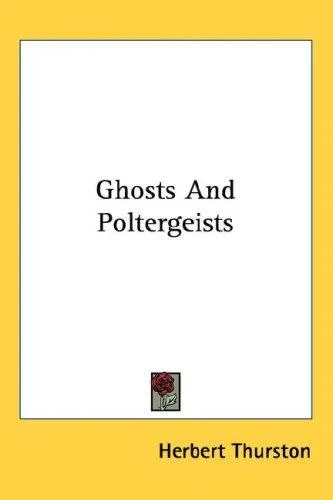
Ghosts and poltergeists
 80
80

Ghosts and poltergeists
Herbert Thurston's "Ghosts and Poltergeists" is a monumental undertaking, presenting a vast compendium of alleged hauntings and spectral visitations with an uncommon degree of academic rigor for its time. Thurston, a Jesuit, doesn't dismiss the phenomena outright but meticulously sifts through accounts, seeking rational explanations or, where none suffice, a genuine anomaly. The strength lies in its sheer breadth of documented cases, spanning centuries and continents, offering a historical panorama of human encounters with the uncanny. A notable limitation, however, is the inherent subjectivity in evaluating anecdotal evidence; even Thurston's careful dissection can't entirely overcome the unreliability of memory and testimony. The chapter detailing the Enfield Poltergeist case, while presented with caution, highlights the difficulty in definitively proving paranormal agency over complex psychological and environmental factors. Ultimately, Thurston’s work remains a vital, if occasionally dated, resource for understanding the historical cataloging of spectral events.
📝 Description
80
Herbert Thurston's 1953 book, 'Ghosts and Poltergeists,' analyzes supernatural accounts with a critical, scholarly eye.
Published in 1953, Herbert Thurston's 'Ghosts and Poltergeists' offers a detailed examination of reported hauntings and spectral events. Thurston, a Jesuit priest, approached such accounts with scholarly rigor, distinguishing between genuine paranormal activity, natural explanations, and fabrication. He compiled numerous historical and contemporary testimonies, subjecting them to careful analysis. This work serves as a significant resource for understanding the historical discussion of spectral phenomena, framed by skepticism yet openness.
The book is valuable for those studying parapsychology, religious history, and the sociology of belief. It will appeal to readers interested in the historical records of ghost stories and poltergeist incidents, particularly those from the late 19th and early 20th centuries. Skeptics examining believers' evidence and believers engaging with a historically grounded analysis will find it useful. It is also relevant for students of the connections between faith, folklore, and unexplained occurrences.
Thurston's work emerged during a time of heightened interest in spiritualism and psychical research, following the founding of the Society for Psychical Research in 1882. While spiritualist and theosophical movements popularized beliefs in the unseen, Thurston's Catholic background informed his approach. He navigated an intellectual climate where science challenged tradition, yet paranormal studies gained traction. His method reflected a Catholic scholarly tradition seeking to reconcile faith with empirical observation, engaging with debates on miracles and divine intervention.
💡 Why Read This Book?
• Understand the historical methodology applied to paranormal claims, particularly Thurston's critical analysis of witness testimony from the late 19th and early 20th centuries, which informs modern parapsychological research. • Gain insight into the distinction between 'residual hauntings' and 'intelligent hauntings,' concepts Thurston explores through numerous case studies, offering a framework for classifying different types of alleged spectral activity. • Appreciate the intellectual context of the 1950s when faith and science grappled with the supernatural, as evidenced by Thurston's approach within his Catholic tradition to phenomena documented in the book.
⭐ Reader Reviews
Honest opinions from readers who have explored this book.
❓ Frequently Asked Questions
What is the primary focus of Herbert Thurston's "Ghosts and Poltergeists"?
The book primarily focuses on a scholarly and critical examination of numerous historical and contemporary accounts of alleged ghost sightings and poltergeist disturbances, seeking to analyze them for evidence of genuine paranormal activity.
When was "Ghosts and Poltergeists" first published and by whom?
The book was first published in 1953. Herbert Thurston, a Jesuit priest, authored it.
Does Thurston offer definitive proof of ghosts in his book?
No, Thurston does not claim definitive proof. Instead, he presents documented cases and critically analyzes them, often suggesting natural or psychological explanations while acknowledging phenomena that remain unexplained.
What is the difference between ghosts and poltergeists according to Thurston?
Thurston distinguishes between 'ghosts' (apparitions, often visual or auditory phenomena linked to a specific location or person) and 'poltergeists' (physical disturbances, such as moving objects or unexplained noises, often associated with a living agent).
What kind of evidence does Thurston rely on?
Thurston relies on witness testimony, historical records, and accounts collected by various investigators and societies interested in psychical research. He emphasizes the importance of corroboration and critical evaluation of these sources.
Is "Ghosts and Poltergeists" suitable for skeptics?
Yes, the book is valuable for skeptics as it approaches the subject matter with a critical, analytical perspective, offering reasoned arguments and examining potential non-supernatural explanations for reported events.
🔮 Key Themes & Symbolism
The Evidential Value of Testimony
Thurston dedicates significant attention to the reliability and interpretation of witness accounts concerning apparitions and poltergeist activity. He grapples with the challenges posed by memory distortion, suggestibility, and the potential for deliberate deception. The work examines how testimonies were collected and corroborated, reflecting a 1950s approach to evidential standards in psychical research. This theme is crucial for understanding the foundation upon which many spectral case studies are built, highlighting both the strengths and inherent weaknesses of relying on human observation.
Categorization of Supernatural Manifestations
A core aspect of Thurston's methodology is the systematic classification of reported phenomena. He differentiates between visual or auditory apparitions, often termed 'ghosts,' and physical disturbances, labelled 'poltergeists.' The book explores whether these represent distinct types of phenomena or variations of a single underlying cause. This analytical approach, distinguishing between 'intelligent hauntings' and 'residual phenomena,' provides a structured way to engage with the diverse reports documented, moving beyond simple categorization to deeper analysis of characteristics and potential origins.
Rational Explanation vs. Paranormal Agency
Throughout "Ghosts and Poltergeists," Thurston consistently seeks naturalistic explanations for reported supernatural events. This involves exploring psychological factors like hallucination, delusion, and mass suggestion, as well as environmental causes such as structural noises or atmospheric conditions. However, he also acknowledges cases where conventional explanations appear insufficient, leaving open the possibility of genuine paranormal agency. This constant tension between skepticism and open-minded inquiry is central to the book's enduring appeal for researchers of the unexplained.
Historical Documentation of Hauntings
The book serves as an extensive historical archive of ghost stories and poltergeist cases spanning several centuries. Thurston meticulously compiles accounts from various periods, offering readers a chronological and geographical overview of reported encounters with the spectral realm. This collection is useful for tracing the evolution of beliefs about ghosts and understanding how different eras perceived and documented such phenomena, providing a rich source for comparative study.
💬 Memorable Quotes
Direct passages from the work, attributed to the author.
“The sheer number of well-attested stories of apparitions is very considerable.”
— This statement captures Thurston's initial assessment of the evidence, acknowledging the volume of reports he encountered. It sets the stage for his detailed investigation, indicating that the phenomena are widespread enough to warrant serious scholarly attention.
“It is not sufficient to dismiss such stories on the ground that they are incredible.”
— Here, Thurston advocates for a critical but open-minded approach. He argues against immediate dismissal of supernatural claims simply because they challenge conventional understanding, emphasizing the need for careful examination of each case.
“The evidence for the survival of human personality after death is far from conclusive.”
— Reflecting his critical stance, this interpretation conveys Thurston's cautious conclusion regarding claims of life after death based on spectral evidence. He finds the data insufficient for definitive proof, underscoring the need for rigorous standards of evidence.
💡 Key Ideas
Editorial paraphrase of the work's core concepts — not direct quotes.
Poltergeists are almost always associated with a particular person.
This paraphrase highlights a key observation about poltergeist phenomena. Thurston notes the tendency for these disturbances to be linked to specific individuals, often adolescents, suggesting a potential human agent or focus for the activity.
Many phenomena attributed to ghosts may be explained by natural causes.
This paraphrase points to Thurston's consistent effort to find rational explanations. It underscores his methodical approach, where he systematically explores mundane causes before considering supernatural ones for reported spectral events.
🌙 Esoteric Significance
Tradition
While not strictly an esoteric text in the vein of Hermeticism or Kabbalah, Thurston's work engages with phenomena often considered within occult and metaphysical traditions. His Catholic background informs his approach, seeking to reconcile supernatural reports with a theological worldview rather than purely occult doctrine. The book can be seen as bridging the gap between religious demonology/hagiography and modern parapsychology, offering a scholarly critique of the boundaries between the physical and spiritual realms recognized in many esoteric systems.
Symbolism
The primary 'symbol' explored is the apparition itself – the spectral figure. In many esoteric traditions, ghosts can symbolize unresolved issues, psychic residue, or even spiritual entities. Thurston's analysis, however, tends to explain these, framing them as potential elements of past events or psychological projections, rather than necessarily symbolic manifestations of spiritual truths or divine messages as might be found in esoteric symbolism.
Modern Relevance
Thurston's work remains relevant for contemporary researchers in parapsychology and the psychology of belief. It provides a foundational historical dataset for studying hauntings and spectral phenomena. Modern paranormal investigation teams and scholars of religion and folklore still reference his meticulous case collection and analytical methods when examining alleged hauntings, drawing on his distinctions and critical approach to evidence.
👥 Who Should Read This Book
• Students of parapsychology and psychical research seeking a historical overview of documented hauntings and spectral phenomena from the early to mid-20th century. • Researchers of religious history and folklore interested in how supernatural beliefs have been recorded and analyzed within a specific historical and cultural context. • Skeptics and critical thinkers who wish to engage with a rigorously documented, yet balanced, examination of alleged paranormal events, exploring both potential explanations and unexplained anomalies.
📜 Historical Context
Herbert Thurston's "Ghosts and Poltergeists" emerged in 1953, a period marked by a persistent public fascination with the paranormal, fueled by post-war anxieties and the ongoing influence of spiritualism. While scientific rationalism was ascendant, societies like the Society for Psychical Research (founded 1882) continued to investigate unexplained phenomena. Thurston, a Jesuit priest, operated within the Catholic intellectual tradition, which possessed its own frameworks for understanding miracles and divine intervention, distinct from the more secular or occult-focused psychical research of contemporaries like Harry Price. Price, a prominent investigator of poltergeists, notably conducted his own investigations during the interwar period. Thurston's work was received as a scholarly, though cautious, contribution to the discourse on apparitions and hauntings, often cited for its comprehensive cataloging of cases and its balanced assessment, distinguishing it from more sensationalist accounts.
📔 Journal Prompts
The distinction between residual hauntings and intelligent hauntings in Thurston's analysis.
Witness testimony reliability concerning the Enfield Poltergeist case.
Investigating the psychological factors Thurston suggests for spectral phenomena.
Comparing Thurston's 1953 approach to modern paranormal investigation techniques.
The role of Catholic tradition in Thurston's critical evaluation of ghost stories.
🗂️ Glossary
Apparition
A ghost or ghostlike image of a person, typically seen after their death. Thurston uses this term broadly for visual or auditory spectral manifestations.
Poltergeist
A type of ghost or spirit, or other entity, that is responsible for physical disturbances such as loud noises and objects being moved or destroyed. Thurston often links these to a living agent.
Psychical Research
The study of alleged psychic phenomena and other paranormal claims, including extrasensory perception (ESP) and psychokinesis, often with the aim of explaining these phenomena in terms of known science.
Residual Haunting
A type of haunting where paranormal activity is thought to be the repetition of a past event, like an echo, rather than an interactive spirit. Thurston discusses this concept in relation to certain spectral reports.
Intelligent Haunting
A type of haunting where the phenomena are believed to be caused by a conscious spirit or entity that can interact with its environment and observers. Thurston examines cases fitting this description.
Suggestibility
The quality or state of being easily influenced or affected by external factors. Thurston frequently considers suggestibility as a potential explanation for witness accounts of paranormal events.
Corroboration
Evidence that confirms or supports a statement, theory, or finding. Thurston stresses the importance of corroborating testimony when evaluating ghost and poltergeist accounts.
🔮 Readers Also Liked
Browse all →








More by Herbert Thurston
All books →
More Free Occult Philosophy Books
View all →