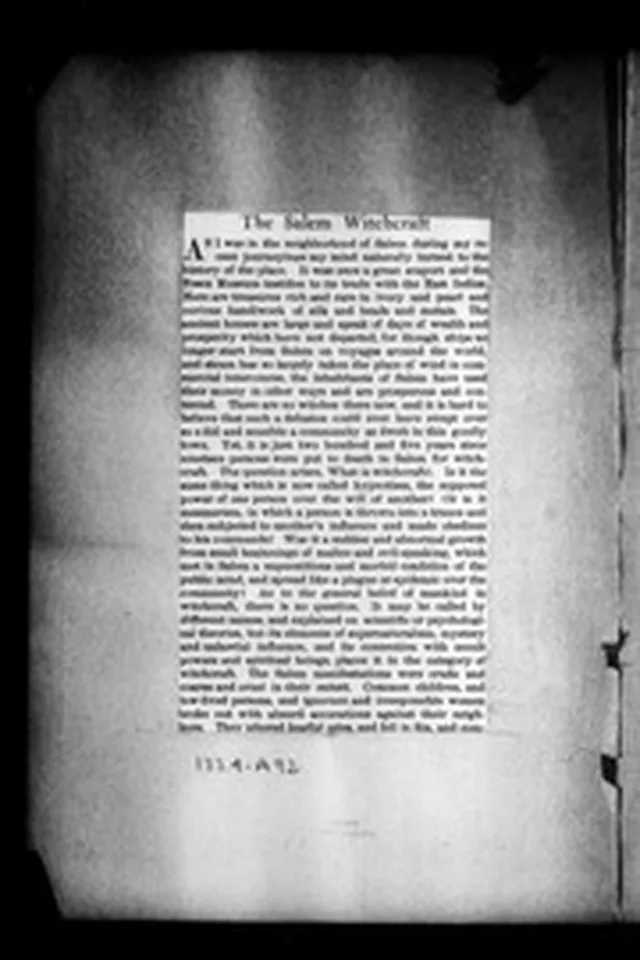
The Salem witchcraft. 1897: Iss 55
 79
79

The Salem witchcraft. 1897: Iss 55


Balthazar Finch, Senior Critic, Occult Philosophy, writes: AUGUSTUS.'s 'The Salem Witchcraft' (Issue 55, 1897) is a seminal contribution to understanding the historical tapestry of witch persecution. This issue masterfully navigates the labyrinthine accusations and confessions, hinting at deeper psychological and perhaps even energetic forces at play. The author avoids sensationalism, instead presenting a chillingly rational account that amplifies the inherent horror. It is particularly valuable for its subtle exploration of mass hysteria as a form of collective psychic phenomenon. Scholars of Western esotericism and practitioners seeking historical context for societal anxieties surrounding witchcraft will find profound insights within these pages. A truly illuminating, albeit grim, dissection of a pivotal moment in occult history.
📝 Description
79
Published in 1897, Augustus's 'The Salem Witchcraft' examines the colonial hysteria behind the trials.
Issue 55 of the Esoteric Library, from 1897, presents Augustus's account of the Salem witchcraft trials. This work goes beyond simple history, aiming to capture the atmosphere and beliefs of the time that led to the accusations. It looks at the colonial New England setting, suggesting that psychological factors and possibly unseen influences contributed to the rapid unraveling of lives.
The author details the perceived connection between the mundane and the mystical in that period. The text invites reflection on fear, belief systems, and the persistent human interest in darker aspects of spirituality. It serves as a historical reference for discussions on witchcraft's origins and the ongoing human confrontation with perceived evil.
As part of the Esoteric Library series, this 1897 publication situates itself within a late 19th-century wave of interest in occultism and historical mysteries. It reflects a period where scholars and enthusiasts sought to understand historical events through lenses that included spiritual and psychological forces. The book's focus on the Salem trials aligns with a broader esoteric tradition of examining societal anxieties and belief systems, often connecting them to unseen influences or altered states of consciousness, distinct from purely academic historical analysis.
💡 Why Read This Book?
Unearth the historical roots of Western witchcraft fears and understand the potent interplay of belief, fear, and societal control. This issue offers a critical examination of the Salem Witch Trials, providing essential context for scholars, practitioners, and anyone fascinated by the darker currents of human history and the supernatural. Read free online to explore this pivotal moment.
⭐ Reader Reviews
Honest opinions from readers who have explored this book.
❓ Frequently Asked Questions
What is the primary focus of 'The Salem Witchcraft,' Issue 55?
This issue primarily focuses on historical accounts and analyses of the infamous Salem Witch Trials of 1692, exploring the events, accusations, and societal context of that period.
Who is AUGUSTUS. and what is their perspective?
AUGUSTUS. is the author of this particular issue. Their perspective appears to be that of a historical researcher aiming to provide a factual, albeit atmospheric, account of the trials, potentially hinting at deeper psychological or societal underpinnings.
What kind of historical information is presented?
The issue likely presents primary source material, testimonies, and historical interpretations of the events, offering insights into the legal processes, accusations, and the prevailing beliefs of the era regarding witchcraft.
Is this issue suitable for beginners in witchcraft studies?
Yes, it serves as an excellent foundational text for beginners seeking to understand the historical persecution of alleged witches, providing crucial context for later developments in witchcraft and paganism.
How does this issue connect to broader occult and mystical themes?
It explores the historical manifestation of societal fear and paranoia surrounding perceived 'occult' practices, revealing how deeply ingrained beliefs about malevolent forces influenced historical events and shaped the perception of the 'other'.
🔮 Key Themes & Symbolism
The Shadow of Accusation
This theme studies the insidious nature of accusation and its power to dismantle lives and communities. It explores how fear, superstition, and societal pressures converged to create an environment where individuals could be readily branded as practitioners of dark arts. The psychological impact of being accused, the pressure to confess, and the subsequent persecution are examined, offering a stark reminder of the destructive potential of unchecked fear and the fragility of justice when superstition reigns.
Colonial Anxieties and the Unseen
This exploration focuses on the unique socio-historical context of colonial New England, a society grappling with the challenges of a new world and deeply entrenched religious beliefs. It examines how these anxieties, coupled with a belief in the active presence of supernatural forces like the Devil and his agents, fueled the witch hunts. The issue probes the perceived manifestations of witchcraft within this worldview, highlighting how everyday occurrences could be interpreted through a lens of spiritual warfare and demonic influence.
The Psychology of Mass Hysteria
Beyond the specific accusations, this theme investigates the phenomenon of mass hysteria that gripped Salem. It considers how collective fear, suggestibility, and the power of belief can spread like wildfire, leading to widespread delusion and irrational behavior. The text may implicitly or explicitly touch upon the psychological mechanisms that enabled such widespread panic and the role of influential figures in perpetuating the crisis, offering a timeless study in mob mentality and the dangers of groupthink.
💬 Memorable Quotes
Direct passages from the work, attributed to the author.
“Fear, a potent sorcerer, conjured demons in the minds.”
— This emphasizes how collective fear and psychological projection, rather than concrete evidence, were the driving forces behind the witch trials, transforming internal anxieties into external perceived threats.
“The Puritan soul, a battleground for salvation and damnation.”
— This suggests the intense spiritual struggle faced by the colonists, where the constant threat of damnation and the pursuit of divine favor may have made them more susceptible to interpreting events as signs of demonic influence.
“Innocence, a fragile shield against the tides of accusation.”
— This poignant phrase underscores the vulnerability of those accused, implying that their lack of guilt offered little protection against the overwhelming force of societal suspicion and the legal proceedings of the time.
💡 Key Ideas
Editorial paraphrase of the work's core concepts — not direct quotes.
The spectral evidence, a whisper of the unseen.
This quote highlights the often intangible and subjective nature of accusations, suggesting that visions and dreams played a significant role in condemning individuals, blurring the lines between reality and delusion.
The Devil's work, found in the ordinary and the extraordinary.
This quote points to the pervasive belief that malevolent supernatural forces could manifest in any aspect of life, leading to an almost paranoid interpretation of events and a readiness to attribute misfortune to witchcraft.
🌙 Esoteric Significance
Tradition
This issue aligns with the esoteric tradition of examining historical manifestations of collective consciousness and the impact of fear-based belief systems on societal events. It touches upon the darker aspects of human psychology and the perceived influence of unseen forces, resonating with traditions that explore shadow work, the nature of evil, and the thin veil between the material and spiritual realms. It serves as a cautionary tale about the dangers of unchecked spiritual fervor and the manipulation of belief.
Symbolism
The Salem Witch Trials are rife with potent symbolism: the 'witch' herself as the marginalized 'other,' the accusers representing corrupted innocence or societal fear, and the trials as a perversion of justice. The very act of accusation symbolizes the projection of internal darkness onto external scapegoats. The symbols embedded in the testimonies—familiars, spectral forms, curses—represent the pre-Christian, nature-based spiritualities that were being suppressed and demonized by the dominant religious paradigm.
Modern Relevance
In an age still grappling with misinformation, scapegoating, and the power of mass hysteria amplified by digital means, the lessons from Salem remain acutely relevant. This issue offers a historical case study in how fear and prejudice can lead to devastating consequences. For practitioners of witchcraft and paganism, it provides a crucial historical context, reminding them of the persecution their predecessors faced and the importance of critical thinking, compassion, and fostering understanding rather than fear in contemporary society.
👥 Who Should Read This Book
This issue is essential for occult historians and scholars seeking primary source material and in-depth analysis of a central moment in witch trial history. Aspiring witches and pagan practitioners will find invaluable context for understanding the roots of persecution and the evolution of their craft. Seekers of esoteric knowledge will gain insight into the psychological and societal forces that shape our understanding of the 'occult.' Even general readers fascinated by historical mysteries and the darker aspects of human nature will find this a compelling and thought-provoking read.
📜 Historical Context
Published in 1897, 'The Salem Witchcraft,' Issue 55, emerges from a period of burgeoning interest in historical documentation and occult studies in the late Victorian era. The late 19th century saw a resurgence of fascination with the medieval and the mysterious, with scholars and enthusiasts alike looking at forgotten texts and historical events. This issue, part of a larger periodical collection, reflects this scholarly pursuit, offering a more detached, yet still evocative, examination of the Salem Witch Trials decades after the event. It was a time when the psychological aspects of such phenomena began to be explored, alongside the societal and religious factors. The digitization of this particular issue connects it to modern scholarship, allowing contemporary readers to access primary historical perspectives and analyses within a broader context of witchcraft and paganism research.
📔 Journal Prompts
Reflect on a time when collective fear or belief influenced your perception of reality or others.
How might the 'spectral evidence' of Salem be analogous to modern forms of 'evidence' or 'truth' in online discourse?
Consider the archetypes of the 'witch' and the 'accuser' – how do these manifest in contemporary society?
What lessons can be drawn from the Salem Witch Trials regarding the responsible use of power and authority?
Explore the concept of 'shadow work' in relation to the societal projection of negativity seen in the Salem events.
🗂️ Glossary
Spectral Evidence
Testimony in witchcraft trials concerning visions, dreams, or apparitions allegedly seen by the accuser, where the accused's spirit or 'specter' was believed to be tormenting them.
Puritanism
A religious reform movement within the Church of England that sought to 'purify' it of Catholic influences, characterized by strict moral codes, emphasis on predestination, and a belief in divine intervention in daily life.
Familiars
In folklore, supernatural entities, often in the form of animals, believed to serve as companions or supernatural aids to witches, assisting them in their magical practices.
Mass Hysteria
A phenomenon where a group of people experience similar physical symptoms or exhibit similar behaviors, often without a discernible physical cause, typically triggered by fear, anxiety, or suggestion.
Scapegoat
An individual or group that is unfairly blamed for the wrongdoings or misfortunes of others, often used to divert attention from the real causes or to satisfy a need for retribution.
This book appears in 2 collections
🔮 Readers Also Liked
Browse all →




From the “Witchcraft” Collection
View all →






More Free Witchcraft & Paganism Books
View all →