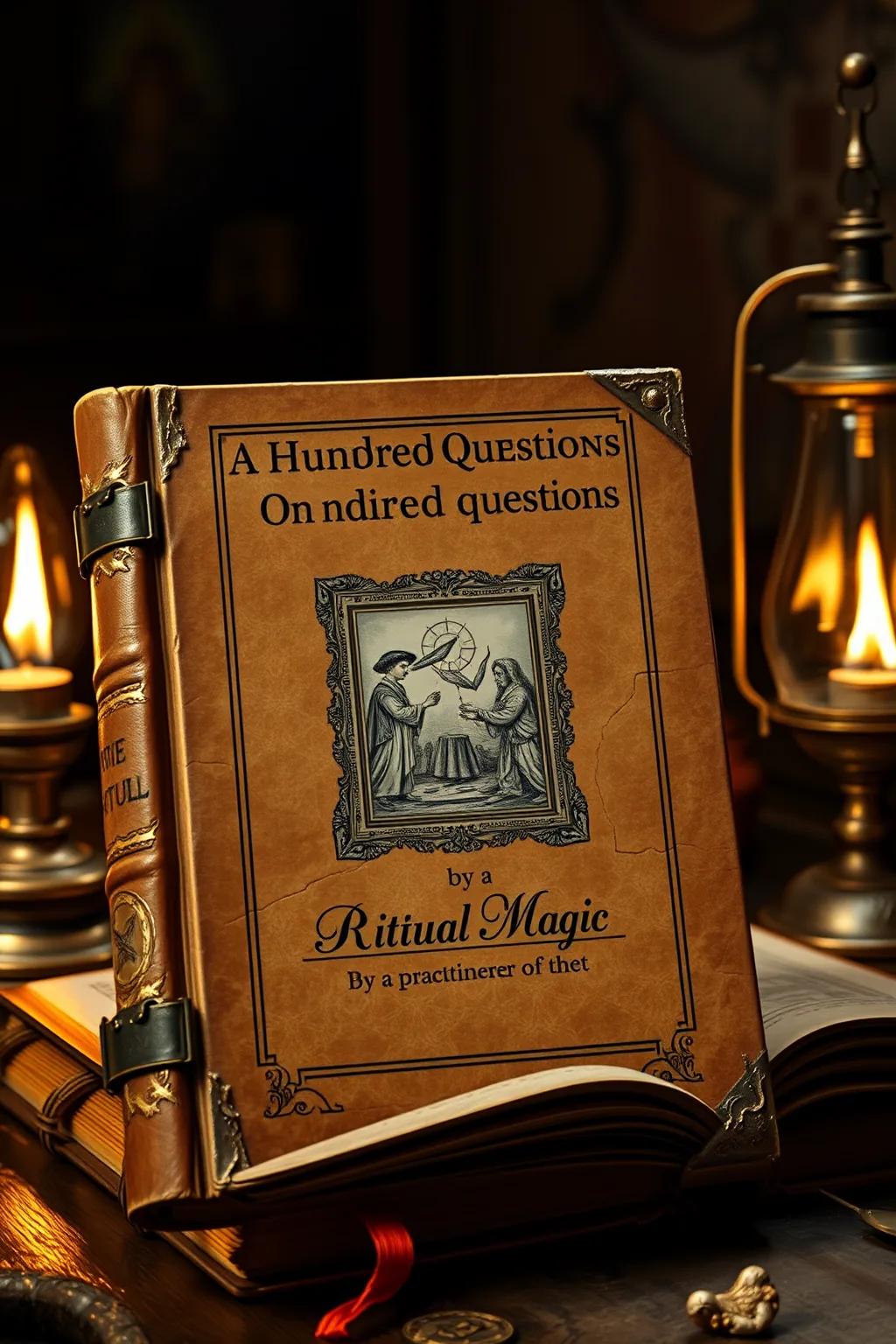
A Hundred questions on ritual magic answered by a practitioner of the art
 61
61

A Hundred questions on ritual magic answered by a practitioner of the art


By Alaric Kestrel (Metaphysical Studies Reviewer) — This anonymous work is a masterclass in practical occultism, offering clarity and depth where many texts falter. The practitioner's voice is authoritative yet accessible, guiding the reader through a hundred essential queries with unwavering insight. It excels in translating arcane principles into actionable steps, making complex magical theory tangible. Its strength lies in its directness and its commitment to revealing the underlying spiritual and psychological dynamics of ritual. Ideal for serious students of magic seeking to move beyond superficial understanding, this book provides a solid foundation for personal practice and deeper esoteric exploration.
📝 Description
61
Published anonymously, 'A Hundred Questions on Ritual Magic Answered by a Practitioner of the Art' directly addresses magical practice.
This book presents a series of questions and answers concerning ritual magic, written by an individual who identifies as a practitioner. It aims to clarify common inquiries about occult practices, moving beyond theory to offer practical insights.
The text covers not only the mechanics of spells and rituals but also the philosophical ideas that support magical work. It seeks to provide clear guidance for those interested in understanding and engaging with these subjects. The anonymous author's approach suggests a desire to demystify the art for a serious audience.
The work functions as a guide for individuals drawn to the esoteric, wanting to grasp the symbolic aspects of the universe and apply them through disciplined magical practice. It intends to connect theoretical interest with practical experience, encouraging a deeper engagement with the subject.
This work belongs to the tradition of grimoires and practical occult manuals that emerged prominently from the late medieval period through the Renaissance and beyond. Such texts often present themselves as direct transmissions of knowledge from experienced practitioners, aiming to instruct neophytes in the art. Unlike purely theoretical treatises, these books focus on the 'how-to' of magical operations, often framed within a specific cosmology or worldview. The anonymous nature of the author is common in such traditions, sometimes suggesting a desire to emphasize the knowledge itself over the individual transmitting it.
💡 Why Read This Book?
This book is essential for anyone seeking to demystify ritual magic. It offers direct, practitioner-led answers to a hundred crucial questions, fostering a deeper understanding of occult principles and practices. Ideal for novice practitioners and seasoned occultists alike, it provides a clear path to integrating esoteric knowledge into tangible magical work, revealing the hidden logic behind ritual.
⭐ Reader Reviews
Honest opinions from readers who have explored this book.
❓ Frequently Asked Questions
What is the fundamental purpose of ritual magic?
The fundamental purpose of ritual magic is to effect change, both within the practitioner and in the external world, by consciously directing Will and energy through symbolic actions and focused intent, aligning oneself with universal forces.
How does one prepare for a magical ritual?
Preparation involves purifying oneself physically and mentally, gathering appropriate tools and symbols, establishing a sacred space, and meticulously planning the ritual's intent and execution to ensure clarity and potency.
What role do symbols play in ritual magic?
Symbols are the language of the subconscious and the divine. In ritual, they act as potent focal points, bridging the gap between the practitioner's intent and the manifestation of desired outcomes, by tapping into archetypal energies.
Can anyone practice ritual magic effectively?
While the potential exists within all, effective practice requires discipline, study, focused Will, consistent effort, and a genuine understanding of the underlying principles. It is a path of continuous learning and refinement.
What are the ethical considerations in ritual magic?
Ethical considerations are paramount. Practitioners must strive to act with integrity, respect the free Will of others, and understand the karmic consequences of their actions, ensuring their magic serves a higher, constructive purpose.
🔮 Key Themes & Symbolism
The Art of Focused Intent
This theme explores the crucial role of concentrated Will and clear intention in the practice of ritual magic. It explores how to cultivate and direct mental energy with precision, transforming abstract desires into potent forces capable of shaping reality. The text emphasizes that intention is not mere wishing, but a directed, active engagement with the fabric of existence, underscoring the practitioner's responsibility in wielding this powerful tool with wisdom and ethical consideration.
Symbolism as the Language of the Soul
The book illuminates the profound significance of symbols as the universal language that bridges the conscious and subconscious mind, and connects us to deeper spiritual currents. It dissects how various symbols, from ancient sigils to elemental representations, act as keys to unlock hidden potentials and communicate directly with the subtle realms. Understanding and employing these symbolic archetypes is presented as fundamental to the effectiveness and depth of any magical working, allowing for a more direct and potent communion with the forces invoked.
The Practitioner's Path to Mastery
This core theme addresses the journey of the aspiring magician, outlining the necessary steps for developing skill, discipline, and discernment. It emphasizes that true mastery is not achieved through rote memorization or superficial performance, but through dedicated practice, self-reflection, and a continuous process of learning and refinement. The text advocates for a holistic approach, integrating spiritual growth, ethical awareness, and practical application to foster a mature and responsible engagement with the magical arts.
💬 Memorable Quotes
Direct passages from the work, attributed to the author.
“The veil is thin where the Will is strong.”
— This potent aphorism highlights the direct correlation between the focused power of intention and the ability to perceive and interact with subtle realities, suggesting that mental discipline is the key to unlocking magical perception.
“Every symbol is a doorway waiting for a name.”
— This metaphor emphasizes the active nature of symbolic language. A symbol holds potential power, but it is the conscious invocation, understanding, and focused intent of the practitioner that truly activates and opens the 'doorway' it represents.
“Know thyself, for the microcosm reflects the macrocosm.”
— This ancient Hermetic principle underscores the interconnectedness of the individual and the universe. Self-knowledge is paramount, as understanding one's inner world provides the blueprint and the tools to comprehend and influence the greater cosmos.
“Ritual is not a performance, but a communion.”
— This statement reframes ritual from a mere act to a profound connection. It emphasizes that the essence of magical ceremony lies in the genuine, heartfelt interaction and exchange of energy between the practitioner and the forces being invoked or worked with.
💡 Key Ideas
Editorial paraphrase of the work's core concepts — not direct quotes.
The greatest magic is often the most silent.
This quote suggests that true magical power does not require outward ostentation or dramatic displays. Profound transformations can occur through subtle, internal work and quiet, focused application of Will, often with unseen but significant results.
🌙 Esoteric Significance
Tradition
This work is deeply rooted in the Western Esoteric Tradition, particularly drawing from Hermeticism, Ceremonial Magic, and potentially aspects of Kabbalah and Western Alchemy. It emphasizes the practical application of principles found in these lineages, focusing on the directed manipulation of subtle energies, the power of Will, and the symbolic language of the universe for personal transformation and external manifestation.
Symbolism
The text heavily relies on the understanding and application of symbolic systems. Key symbols likely explored include those associated with the elements (Fire, Water, Air, Earth), the planets, the zodiac, divine names, geometric forms (like the pentagram and hexagram), and archetypal imagery. These symbols are presented not as mere decorations, but as potent keys that unlock specific energetic resonances and facilitate communication with higher or subtler planes of existence.
Modern Relevance
In an age often characterized by materialism and disconnection, this book offers a vital bridge to the unseen dimensions of reality. Its emphasis on focused Will, personal responsibility, and the power of intention resonates strongly with contemporary seekers interested in consciousness, manifestation, and personal empowerment. The principles discussed remain timeless, providing a practical framework for reading through the complexities of modern life through the disciplined application of ancient magical wisdom.
👥 Who Should Read This Book
This indispensable volume is a must-read for anyone starting or deepening their journey into ritual magic. **Beginners** will find a clear, foundational guide that explains complex concepts and provides actionable steps. **Serious students and practitioners** will appreciate the depth of insight and the practitioner's direct approach, offering solutions to common challenges and enriching their existing practices. **Occult scholars and researchers** will find value in its unvarnished perspective on practical application within a historical context. Ultimately, any **seeker** who feels a pull towards understanding and working with the hidden forces of the universe will discover profound wisdom and guidance within these pages.
📜 Historical Context
Emerging likely from the late 19th or early 20th century, a period of intense occult revival and intellectual curiosity in esoteric traditions, 'A Hundred Questions on Ritual Magic' reflects a growing desire among practitioners to codify and share practical knowledge. This era saw the proliferation of magical orders and the publication of influential texts that sought to systematize ceremonial magic, often drawing from Hermeticism, Kabbalah, and Neoplatonism. The anonymous nature of the author suggests a potential desire to emphasize the teaching over the teacher, or perhaps a need for discretion within certain circles. The book's direct, question-and-answer format hints at a pedagogical approach, possibly stemming from personal tutelage or correspondence within a magical lineage, aiming to provide accessible answers to common obstacles faced by students of the occult.
📔 Journal Prompts
Reflect on a time you felt a strong, focused intention lead to a desired outcome, even outside of formal ritual. What were the key elements?
Choose a symbol that speaks to you. Meditate on its meaning and write down your intuitive understanding of its energetic properties and potential applications.
What personal beliefs or mental blocks might hinder the effectiveness of your Will in magical practice? How can you address these?
Consider a specific goal you wish to achieve. How can you translate this goal into a clear, potent magical intention, and what symbols might aid this process?
Describe your ideal sacred space for ritual work. What elements are essential for its energetic potency and your personal connection to it?
🗂️ Glossary
Will
In magical context, 'Will' refers to directed, focused intention and the energetic force consciously applied by the practitioner to achieve a specific magical outcome, distinct from mere desire or passive wishing.
Sacred Space
An area ritually consecrated and purified to serve as a focused environment for magical work, designed to enhance concentration, invoke specific energies, and protect the practitioner from unwanted influences.
Sigil
A symbolic representation, often a unique glyph or design, created to embody a specific magical intent or idea. Sigils are charged and activated to influence the subconscious and subtle realms.
Invocation
The act of calling upon or inviting spiritual entities, forces, or energies to manifest or be present within a ritual context, often for assistance or communion, as opposed to evocation which commands.
Microcosm
The principle that the human being (or any individual entity) is a miniature reflection of the universe (the Macrocosm), implying that understanding oneself is key to understanding the greater reality.
This book appears in 2 collections
🔮 Readers Also Liked
Browse all →


From the “Ritual Magic” Collection
View all →






More Free Magic & Ritual Books
View all →