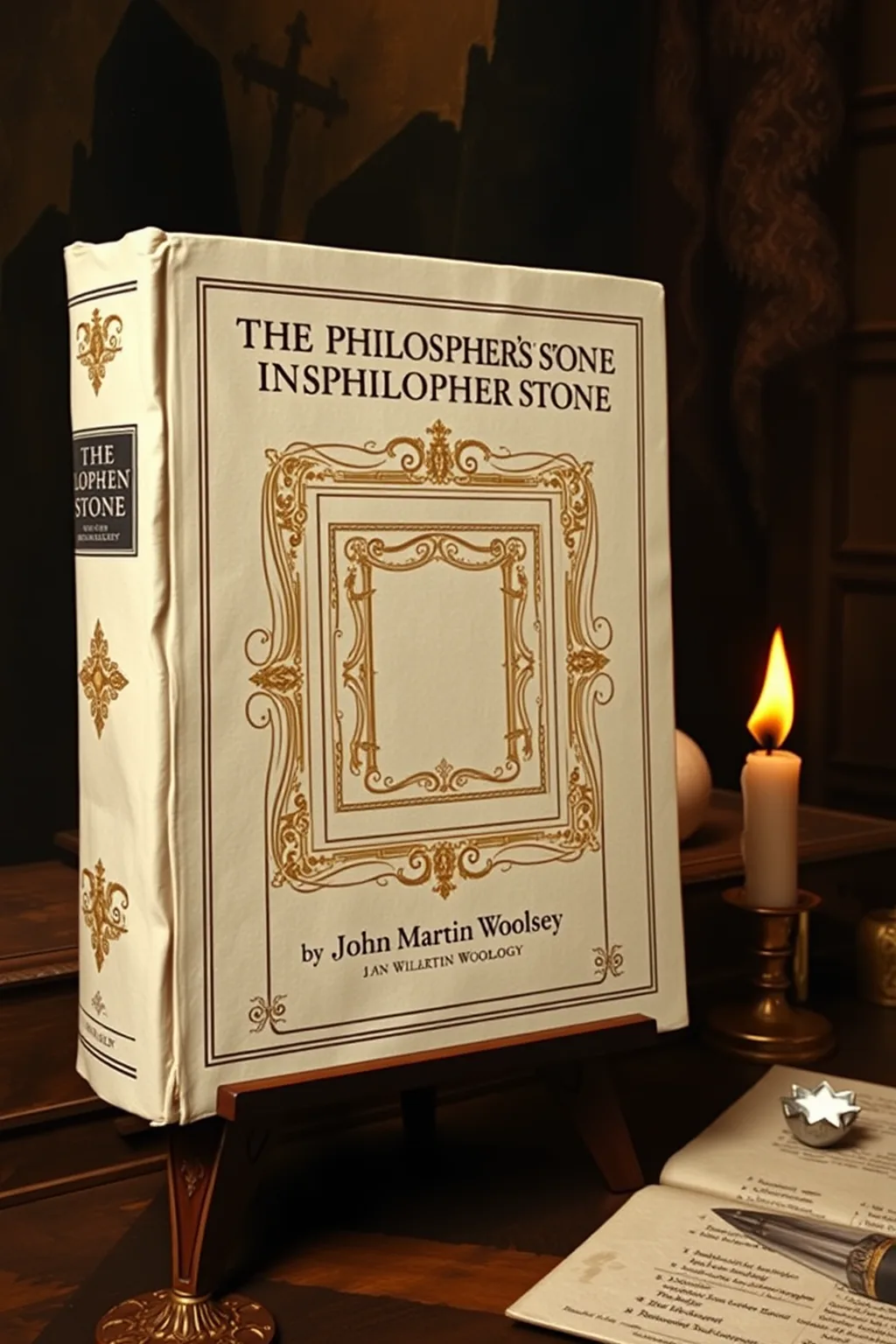
The Philosopher's Stone In Symbolic Mythology
 61
61

The Philosopher's Stone In Symbolic Mythology


Aurelia Blackwood (Occult Philosophy Critic) — John Martin Woolsey's 'The Philosopher's Stone In Symbolic Mythology' is a monumental achievement in alchemical literature. Woolsey possesses an uncanny ability to dissect complex symbolic narratives, revealing the profound spiritual and psychological underpinnings of the Great Work. His insightful interpretations of mythical archetypes as alchemical processes offer unparalleled esoteric wisdom. This book is an indispensable resource for serious students of Hermeticism, alchemy, and comparative mythology, providing a rich, layered understanding that transcends superficial interpretations. Its strength lies in its comprehensive yet elegant synthesis of diverse symbolic traditions.
📝 Description
61
John Martin Woolsey's 1977 book deciphers the alchemical symbolism of the Philosopher's Stone.
John Martin Woolsey's 'The Philosopher's Stone In Symbolic Mythology' examines the alchemical tradition through its central symbol. The book breaks down the allegorical and symbolic language used in Hermetic texts to describe the Great Work. Woolsey focuses on how the pursuit of the Stone represents a spiritual and psychological process of transformation.
This work illustrates how ancient myths and symbols are not merely historical artifacts but vehicles for conveying deeper truths about self-understanding. The text invites readers to consider the quest for perfection as a metaphor for personal development. Woolsey's writing style aims to make complex symbolic systems understandable for those interested in esoteric philosophy.
This book fits within the Hermetic and alchemical traditions, which have long explored the relationship between material transformation and spiritual enlightenment. It draws upon a lineage of thought that views symbolic language as a key to understanding cosmic and personal processes. The focus on the Philosopher's Stone aligns with a specific branch of esoteric study concerned with the ultimate aim of alchemical operations, often interpreted as a metaphor for achieving a higher state of consciousness or spiritual wholeness.
💡 Why Read This Book?
Uncover the hidden spiritual dimensions of the alchemical quest. 'The Philosopher's Stone In Symbolic Mythology' offers a unique perspective on self-transformation through ancient wisdom. Ideal for seekers of esoteric knowledge, scholars of Hermeticism, and practitioners who wish to deepen their understanding of symbolic language in spiritual development. Explore profound allegories and unlock the secrets of inner alchemy.
⭐ Reader Reviews
Honest opinions from readers who have explored this book.
❓ Frequently Asked Questions
What is the central theme of this book?
The central theme is the allegorical and symbolic interpretation of the Philosopher's Stone, not as a literal substance, but as a representation of spiritual enlightenment and profound inner transformation within the framework of ancient mythology and Hermetic philosophy.
Who is the intended audience for 'The Philosopher's Stone In Symbolic Mythology'?
This book is primarily intended for serious students of alchemy, Hermeticism, comparative mythology, occult philosophy, and those on a dedicated path of spiritual or psychological self-discovery.
Does the book provide practical alchemical recipes?
No, this book focuses on the symbolic, philosophical, and mythological aspects of alchemy. It explores the spiritual and psychological journey rather than providing literal laboratory instructions.
What makes this book unique in its approach to the Philosopher's Stone?
Woolsey's unique approach lies in his masterful weaving of diverse mythological narratives and symbolic systems to illustrate the universal principles of alchemical transformation, offering a fresh, integrated perspective.
Is prior knowledge of alchemy required to understand this book?
While prior familiarity with esoteric concepts can enhance understanding, Woolsey's clear prose and comprehensive explanations make the book accessible to dedicated beginners willing to engage deeply with the material.
🔮 Key Themes & Symbolism
The Alchemical Main work as Spiritual Quest
This theme explores the Great Work not merely as a physical process of transmutation, but as a profound metaphorical journey of spiritual purification, self-knowledge, and ultimate enlightenment. Woolsey demonstrates how ancient myths and symbolic systems serve as archetypal maps for this inner transformation, guiding the adept through stages of dissolution, conjunction, and perfection, mirroring the alchemical stages of Nigredo, Albedo, and Rubedo.
Symbolic Language of Myth and Alchemy
Here, the focus is on the intricate web of symbols that connect mythological narratives with alchemical symbolism. Woolsey meticulously deciphers common motifs—dragons, serpents, celestial bodies, precious metals, and mythical creatures—revealing their deeper alchemical significance. This theme highlights how ancient cultures, through their stories and rituals, encoded universal truths about the nature of reality, consciousness, and the potential for spiritual evolution.
The Philosopher's Stone as Archetypal Perfection
This section studies the Philosopher's Stone as the ultimate symbol of achieved wholeness, divine wisdom, and spiritual liberation. It examines how various mythologies present their own versions of this unattainable yet aspirational goal, representing the integration of the shadow self, the reconciliation of opposites, and the attainment of a perfected state of being. The Stone becomes a universal archetype for the human aspiration towards the divine.
💬 Memorable Quotes
Direct passages from the work, attributed to the author.
“Myth is the ancient vessel of eternal truths.”
— This highlights the enduring power and significance of myths as carriers of profound, timeless wisdom that transcends specific cultures and eras, often encoding esoteric knowledge.
“The serpent devours its tail, signifying cyclical renewal.”
— This references the Ouroboros, a potent alchemical symbol representing eternity, the cyclical nature of existence, and the constant process of death and rebirth essential for transformation.
“Gold is the sun made manifest, the soul's ultimate aspiration.”
— This connects the alchemical pursuit of gold with solar symbolism, representing spiritual purity, divine illumination, and the soul's highest potential for perfection and consciousness.
“To know the self is to begin the Great Work.”
— This foundational principle underscores that the journey of alchemy is intrinsically linked to self-knowledge and introspective inquiry, forming the initial crucial step towards any form of spiritual or alchemical transformation.
💡 Key Ideas
Editorial paraphrase of the work's core concepts — not direct quotes.
The Stone is not found, but forged within.
This quote emphasizes that true alchemical transformation and spiritual realization are internal processes, achieved through dedicated inner work and self-discovery, rather than an external acquisition.
🌙 Esoteric Significance
Tradition
This work is deeply rooted in the Hermetic tradition, drawing heavily from its foundational texts like the Emerald Tablet and the Corpus Hermeticum. It also engages with Gnostic cosmology, Neoplatonic philosophy, and Western esotericism, integrating their symbolic language and metaphysical concepts into its exploration of alchemical symbolism. The book serves as a bridge, connecting ancient mystical philosophies to the enduring quest for spiritual perfection.
Symbolism
The book deciphers a body of alchemical and mythological symbols. Key symbols include the Philosopher's Stone itself (representing perfection and enlightenment), the Ouroboros (cyclicality and eternity), the dragon (chaos and primordial energy), gold (spiritual purity and solar consciousness), and various celestial bodies and mythological figures. Woolsey interprets these not as literal elements but as profound representations of psychological states and spiritual processes.
Modern Relevance
In an age often characterized by materialism and spiritual disconnect, Woolsey's work offers a vital counterpoint. The book's emphasis on inner transformation, symbolic understanding, and the integration of disparate aspects of the psyche resonates deeply with contemporary seekers. It provides a framework for understanding personal growth through ancient wisdom, encouraging a more holistic and spiritually informed approach to life's challenges and aspirations.
👥 Who Should Read This Book
This book is a treasure for the dedicated seeker. Beginners in esoteric studies will find it an informative introduction to the symbolic language of alchemy and mythology, provided they approach it with patience and an open mind. Scholars of comparative religion, mythology, and Hermetic philosophy will appreciate Woolsey's rigorous research and insightful synthesis. Practitioners of spiritual disciplines will discover profound metaphors for their own inner work, offering new perspectives on transformation. Those fascinated by the perennial quest for meaning and self-realization will find a rich philosophical and symbolic landscape to explore.
📜 Historical Context
Written during a period of renewed interest in esoteric traditions and comparative mythology, 'The Philosopher's Stone In Symbolic Mythology' emerged as a significant contribution to the burgeoning field of occult studies in the early to mid-20th century. This era saw scholars and seekers delving deeper into ancient texts, challenging conventional rationalism with explorations of mysticism, psychology, and forgotten wisdom. Woolsey's work stands as a proof of this intellectual climate, synthesizing diverse mythological narratives and alchemical lore into a coherent, spiritually resonant framework. It reflects a desire to find universal patterns in human spiritual inquiry, linking ancient myths to profound psychological and metaphysical truths often overlooked by mainstream scholarship.
📔 Journal Prompts
Reflect on a personal 'stone' you have sought or transformed within yourself. Describe its nature and the journey.
Identify a recurring symbol in your dreams or waking life and explore its potential alchemical or mythological meaning.
How does the concept of 'dissolution' (Nigredo) manifest in your life, and what lessons can be drawn from it?
Consider a personal 'opus' or significant life project. How can you apply the principles of alchemical transformation to its development?
What does 'perfection' mean to you in a spiritual or psychological context, and how does this align with the idea of the Philosopher's Stone?
🗂️ Glossary
Main work
Latin for 'Great Work,' referring to the alchemical process of creating the Philosopher's Stone, often interpreted as a metaphor for spiritual enlightenment and the perfection of the soul.
Hermeticism
A philosophical and religious tradition based on the purported teachings of Hermes Trismegistus, emphasizing divine wisdom, the interconnectedness of all things, and the path to spiritual enlightenment through understanding universal laws.
Nigredo
The first stage of the alchemical process, often referred to as 'blackening,' symbolizing dissolution, decay, chaos, and the breakdown of the old self, necessary for regeneration.
Albedo
The second stage of the alchemical process, 'whitening,' representing purification, washing away impurities, and the dawning of spiritual clarity after the Nigredo.
Rubedo
The final stage of the alchemical process, 'reddening,' symbolizing the achievement of the Philosopher's Stone, perfection, spiritual union, and the integration of the divine within the human.
This book appears in 3 collections
🔮 Readers Also Liked
Browse all →







From the “Hermeticism” Collection
View all →





![Ancient fragments of the Phœnician, Chaldæan, Egyptian, Tyrian, Carthaginian, Indian, Persian, and other writers; with an introductory dissertation: and an inquiry into the philosophy and trinity of the ancients. By Isaac Preston Cory […]](/img/thumb/ancient-fragments-of-the-ph-nician-chald-an-egyptian-tyrian-carthaginian-indian-persian-and-other-writers-with-an-introductory-dissertation-and-an-inquiry-into-the-philosophy-and-trinity-of-the-ancien.webp)


More Free Alchemy & Hermeticism Books
View all →