The Opposite House
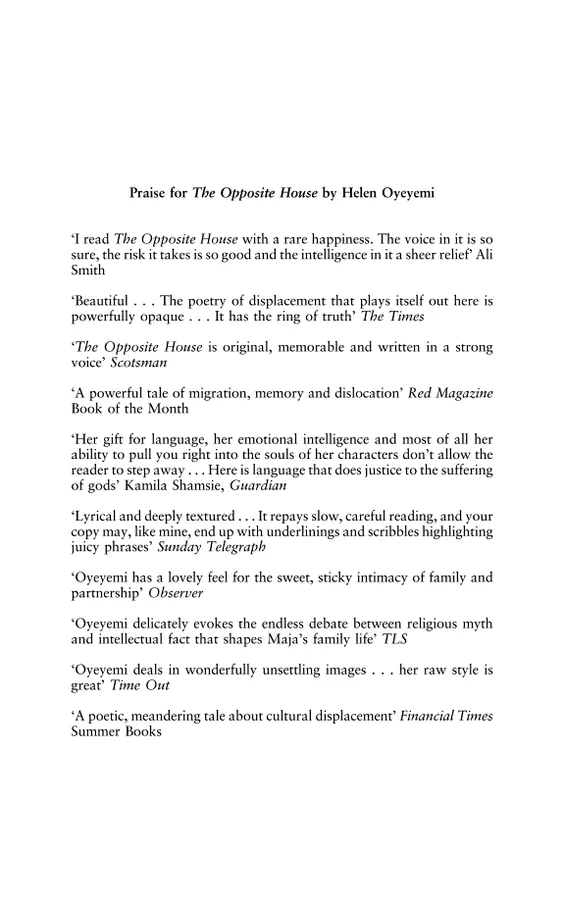
 81
81

The Opposite House
Oyeyemi’s prose in "The Opposite House" possesses a distinctive, almost incantatory quality. The portrayal of the young jazz singer and her disorientation within the titular house is particularly compelling, creating an atmosphere of unsettling beauty. While the novel excels at establishing mood and exploring the protagonist’s internal landscape, its deliberate ambiguity can sometimes leave the reader adrift, longing for firmer narrative anchors. The strength lies in its evocative imagery and its ability to capture the feeling of being caught between worlds. A passage describing the house's peculiar architecture, where rooms seem to shift and rearrange themselves, perfectly encapsulates the novel's surreal charm. Oyeyemi crafts a potent, if at times elusive, exploration of self and place.
📝 Description
81
Helen Oyeyemi's 2008 novel, 'The Opposite House,' centers on a young jazz singer entangled with a peculiar household.
The narrative of 'The Opposite House' unfolds with a dreamlike quality, following a young jazz singer whose life becomes intertwined with the strange dynamics of a particular dwelling. Oyeyemi's prose mimics the rhythms of jazz, creating a performance that mirrors the protagonist's world. This novel resists simple classification, weaving together elements of magical realism and psychological depth. It addresses themes of identity, belonging, and the uncanny through its unique voice.
The story is well-suited for readers who enjoy literary fiction that explores the surreal and the introspective. Those who are drawn to character-driven narratives with a strong sense of atmosphere and place will find much to appreciate. The book also appeals to readers interested in contemporary interpretations of folklore, mythology, and the subconscious.
Published in 2008, 'The Opposite House' emerged during a time when magical realism was still a significant literary current, influenced by figures like Gabriel García Márquez. Oyeyemi, however, filtered these traditions through her own West African and British perspectives. The novel engages with a concept of the 'opposite house' as a space where ordinary reality bends, allowing for explorations of subconscious landscapes and fragmented selves. This approach aligns with certain esoteric traditions that examine alternate states of consciousness and the symbolic nature of dwelling.
💡 Why Read This Book?
• Gain insight into the symbolic power of domestic spaces, understanding how a 'house' can represent psychological states, as seen in the shifting architecture of the Opposite House itself. • Explore the intersection of music and the subconscious, learning how jazz, in this narrative, functions as a conduit for unspoken emotions and hidden truths. • Engage with contemporary magical realism that draws on folklore, appreciating how Oyeyemi reimagines traditional narrative structures to reflect modern identity.
⭐ Reader Reviews
Honest opinions from readers who have explored this book.
❓ Frequently Asked Questions
What is the significance of the 'Opposite House' in Helen Oyeyemi's novel?
The Opposite House functions as a central metaphor, representing a liminal space where reality is fluid and identity can be fragmented. It is a place of transition and uncanny occurrences, reflecting the protagonist's internal state.
Who is the main character in 'The Opposite House'?
The protagonist is a young jazz singer who finds herself in unfamiliar and disorienting circumstances, becoming deeply involved with the inhabitants and mysteries of the house.
What literary style does Helen Oyeyemi employ in 'The Opposite House'?
Oyeyemi utilizes a style often described as magical realism, characterized by dreamlike sequences, symbolic imagery, and a blurring of the lines between the ordinary and the extraordinary.
When was 'The Opposite House' first published?
The novel 'The Opposite House' by Helen Oyeyemi was first published in 2008.
Does 'The Opposite House' connect to Oyeyemi's other works like 'The Icarus Girl'?
While 'The Opposite House' is a standalone novel, it shares Oyeyemi's characteristic voice and thematic explorations of identity, folklore, and the uncanny, which are also present in 'The Icarus Girl'.
What themes are explored in 'The Opposite House'?
Key themes include identity, belonging, the nature of reality, the power of music, and the influence of folklore and myth on contemporary life.
🔮 Key Themes & Symbolism
Liminal Spaces and Identity
The concept of the 'Opposite House' serves as a potent symbol for liminality, the threshold between different states of being—waking and dreaming, sanity and madness, the known and the unknown. The protagonist's journey within its walls mirrors an exploration of her own fragmented identity. As the house's architecture shifts and defies logic, so too does her sense of self, suggesting that identity is not fixed but fluid, shaped by environment and internal experience. This appeals to esoteric traditions that explore the self as a complex entity capable of transformation through confronting the uncanny.
Music as a Transcendent Force
Jazz music is not merely background in 'The Opposite House'; it is an active force that communicates what words cannot. The protagonist, as a jazz singer, uses music to express complex emotions and navigate her disorienting reality. This aligns with esoteric philosophies that view sound and vibration as fundamental aspects of creation and consciousness. The improvisational nature of jazz mirrors the novel's exploration of spontaneous transformation and the ability to find order or meaning amidst chaos, suggesting a vibrational connection to the deeper mysteries of existence.
Folklore and the Subconscious
Oyeyemi masterfully ties elements of folklore and myth into the fabric of the narrative, suggesting that ancient stories continue to influence contemporary lives, often operating at the level of the subconscious. The uncanny events and character interactions within the Opposite House can be interpreted through a folkloric lens, revealing archetypal patterns of transformation, entrapment, and revelation. This integration of myth speaks to esoteric understandings of universal narratives that lie beneath the surface of everyday experience, shaping individual destinies and collective consciousness.
The Uncanny Domestic
The novel transforms the seemingly mundane setting of a house into a site of profound psychological and supernatural disturbance. The 'opposite' nature of the house implies a subversion of the expected, where the familiar becomes alien. This exploration of the uncanny within the domestic sphere taps into esoteric ideas about the hidden energies and intelligences that reside in our living spaces. It suggests that the home can be a portal to other realities or a mirror reflecting the deepest, often unsettling, aspects of the inhabitants' inner lives.
💬 Memorable Quotes
Direct passages from the work, attributed to the author.
“She sang the blues, but they were not the blues she knew.”
— This highlights the protagonist's sense of displacement and the perversion of the familiar. Even her art, her music, becomes a reflection of her altered reality, tinged with an unfamiliar sorrow or strangeness.
“There was a room that was not a room, but a feeling.”
— This exemplifies Oyeyemi's use of synesthesia and abstract description to convey psychological states. It suggests that certain spaces transcend physical definition and become pure emotional or existential experiences.
“The jazz was a language that understood her before she did.”
— This interpretation emphasizes the intuitive and subconscious power of music. It posits music, particularly jazz, as a form of primal communication that can articulate deeper truths about the self before conscious awareness.
“She found herself living in the echo of a story.”
— This concept suggests that the protagonist's life is not entirely her own, but influenced or even dictated by a pre-existing narrative or myth. It speaks to the power of folklore and collective memory in shaping individual experience.
💡 Key Ideas
Editorial paraphrase of the work's core concepts — not direct quotes.
The house rearranged itself when no one was looking.
This line captures the novel's central theme of instability and the uncanny. It suggests that reality, like identity, is not fixed but mutable, capable of shifting and reforming in unexpected ways, mirroring the protagonist's own disorientation.
🌙 Esoteric Significance
Tradition
While not explicitly aligned with a single esoteric school, "The Opposite House" appeals to Gnostic themes of a fragmented self seeking wholeness in a world of illusion. The 'opposite' nature of the house suggests a reality inverted from divine truth, a common Gnostic motif. The narrative's exploration of subjective reality and the power of inner perception also touches upon Hermetic principles of "As Above, So Below," where the external world mirrors the internal.
Symbolism
The 'Opposite House' itself symbolizes a liminal space, a threshold between the mundane and the mystical, or the conscious and subconscious mind. The protagonist's journey through its shifting architecture represents an inner voyage of self-discovery and potential transformation. Jazz music functions as a symbol of authentic expression and a means of accessing deeper truths, acting as a vibrational key to unlock hidden aspects of the self and reality.
Modern Relevance
Contemporary practitioners of Jungian psychology and archetypal studies might find resonance in the novel's exploration of the subconscious and symbolic landscapes. The emphasis on subjective reality and the fluidity of identity connects with postmodern philosophical inquiries and certain strands of consciousness studies that question objective perception. Oyeyemi's mix of folklore and modern narrative continues to inspire writers exploring the intersection of myth and contemporary experience.
👥 Who Should Read This Book
• Readers interested in contemporary magical realism who seek narratives that explore psychological depth through symbolic landscapes. • Students of folklore and mythology who wish to see how ancient motifs are reinterpreted in modern literary contexts. • Individuals drawn to character-driven fiction that prioritizes atmosphere and mood over conventional plot resolution.
📜 Historical Context
Helen Oyeyemi’s "The Opposite House," released in 2008, emerged in a literary landscape increasingly receptive to magical realism and international voices. Following her acclaimed 2005 debut, "The Icarus Girl," Oyeyemi continued to refine her distinctive blend of the surreal and the psychologically astute. The early 21st century saw authors like Chimamanda Ngozi Adichie gaining prominence, broadening the scope of contemporary African literature. While "The Opposite House" engages with the lineage of magical realism established by writers such as Gabriel García Márquez, Oyeyemi’s work distinguishes itself through its specific cultural inflections and its focus on nuanced character interiority. The novel’s reception was part of a broader trend appreciating complex, often ambiguous narratives that challenged traditional storytelling conventions.
📔 Journal Prompts
The protagonist's disorientation within the Opposite House.
Reflect on the symbolic meaning of shifting architecture in literature.
The role of jazz music in expressing the inexpressible.
Consider the folklore elements woven into the narrative.
Explore the concept of a 'language that understood her before she did'.
🗂️ Glossary
Opposite House
A central metaphor in the novel representing a liminal, uncanny space where reality is fluid and identity is questioned. It signifies a threshold between different states of being.
Magical Realism
A literary genre where fantastical elements are presented in an otherwise realistic setting, treated by characters and narrator as ordinary occurrences.
Liminality
The quality of ambiguity or disorientation that occurs in the middle stage of a ritual, when participants no longer hold their pre-ritual status but have not yet begun the transition to the status they will hold when the ritual is complete.
Jazz Singer
The protagonist, whose profession provides a narrative lens for exploring themes of improvisation, emotional expression, and navigating complex, often dissonant, realities.
Uncanny
A psychological concept referring to the experience of something being strangely familiar, yet also alien, often evoking a sense of unease or dread.
Folklore
The traditional beliefs, customs, and stories of a community, passed through the generations by word of mouth, often influencing the subconscious and shaping perception.
Archetype
A recurring symbol or motif in literature, art, or mythology that represents universal patterns of human nature or experience.
This book appears in 1 collection
🔮 Readers Also Liked
Browse all →








From the “Santeria” Collection
View all →








More Free Occult Philosophy Books
View all →