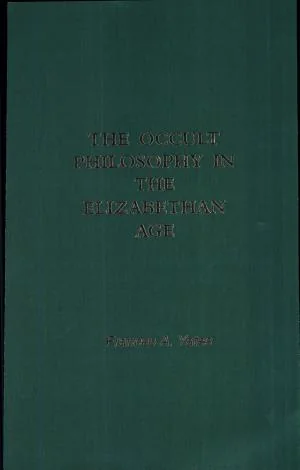
The Occult Philosophy in the Elizabethan Age
 79
79

The Occult Philosophy in the Elizabethan Age
Frances Yates's *The Occult Philosophy in the Elizabethan Age* offers a meticulous dissection of how esoteric thought permeated the intellectual landscape of late 16th-century England. Her strength lies in detailing the academic and philosophical frameworks that supported what might otherwise seem like arcane beliefs. The work meticulously traces the lineage of ideas from Marsilio Ficino's translations of the *Corpus Hermeticum* to the practical applications by figures like John Dee. A limitation, however, is the dense academic prose which, while precise, can be demanding for the uninitiated. The chapter detailing the reception of Giordano Bruno's radical cosmology within English intellectual circles is particularly illuminating, showcasing the complex interplay between heterodoxy and acceptance. Ultimately, Yates provides an indispensable scholarly account of a crucial, often misunderstood, period in Western esotericism.
📝 Description
79
Frances Yates argues that occult philosophy was central to Elizabethan intellectual life.
Frances Yates's 1972 book investigates the pervasive influence of occult philosophy in Elizabethan England. It moves past common understandings of magic and astrology to reveal a complex intellectual climate where these practices were woven into the fabric of religion, science, and political thought. Yates demonstrates that occult ideas were not isolated to a fringe element but were a significant part of the era's intellectual discourse.
The work details how thinkers of the time engaged with traditions like Neoplatonism, Hermeticism, and Kabbalah. This engagement often occurred within established academic and courtly settings, showing a vibrant, though sometimes debated, interaction with ancient philosophical streams. The book highlights specific concepts such as the 'Hermetic revolution,' a period marked by the renewed study and adaptation of ancient Hermetic texts during the Renaissance. Yates traces how these concepts informed Renaissance magic, cosmology, and the nascent stages of scientific investigation, underscoring their broad impact.
This book places Renaissance occultism within the broader history of Western esotericism, specifically focusing on the period when Hermetic, Neoplatonic, and Kabbalistic traditions were revived and adapted. It examines how these ancient streams of thought, often reinterpreted through new translations and commentaries, interacted with contemporary religious, scientific, and political ideas. The work shows that these esoteric currents were not merely relics of the past but active forces shaping the intellectual landscape of the era, influencing figures and institutions within the mainstream.
💡 Why Read This Book?
• Understand the intellectual framework of Elizabethan occultism, learning how figures like John Dee integrated Hermeticism and Kabbalah into their worldview, as detailed in the book's exploration of Renaissance Neoplatonism. • Grasp the historical significance of the *Corpus Hermeticum*'s revival in the 15th and 16th centuries, recognizing its impact on early modern philosophy and science beyond mere superstition. • Gain insight into the scholarly debates and reception of controversial ideas, such as those of Giordano Bruno, and how they circulated within the intellectual circles of the time.
⭐ Reader Reviews
Honest opinions from readers who have explored this book.
❓ Frequently Asked Questions
What is the primary focus of Frances Yates's 'The Occult Philosophy in the Elizabethan Age'?
The book primarily examines the intellectual and philosophical underpinnings of occult beliefs, such as Hermeticism, Kabbalah, and astrology, within the scholarly and courtly circles of Elizabethan England.
When was 'The Occult Philosophy in the Elizabethan Age' first published?
The work was first published in 1999, though it draws on extensive historical research into the Elizabethan era.
Which key figures from the Elizabethan era are discussed in the book?
The book frequently references prominent figures like John Dee, the influential mathematician and advisor, and the controversial philosopher Giordano Bruno.
What intellectual traditions does Yates connect occult philosophy to?
Yates connects occult philosophy to traditions such as Neoplatonism, Renaissance Hermeticism, and Kabbalah, showing their integration into the broader intellectual landscape.
Is this book suitable for beginners in esoteric studies?
While comprehensive, the book is written in an academic style. It is most suitable for serious students and scholars of Renaissance history and esoteric traditions who appreciate detailed historical analysis.
How does Yates view the role of magic and astrology in Elizabethan society?
Yates presents magic and astrology not as isolated superstitions but as integral parts of a complex worldview, deeply connected to philosophy, religion, and the nascent scientific inquiry of the period.
🔮 Key Themes & Symbolism
Renaissance Hermeticism
Yates meticulously details the Renaissance revival and reinterpretation of the *Corpus Hermeticum*. This theme explores how these ancient Egyptian-inspired texts, believed to contain divine wisdom, became a core part of Neoplatonic thought and occult philosophy. It examines how figures like Marsilio Ficino and, subsequently, English scholars and practitioners integrated Hermetic cosmology and theurgy into their intellectual frameworks, viewing the universe as a divinely ordered, interconnected macrocosm and microcosm.
Kabbalah in England
This theme addresses the introduction and influence of Kabbalistic ideas within Elizabethan intellectual circles. Yates highlights the efforts of scholars to study and understand Jewish mysticism, often through Latin translations and Christian interpretations, seeing it as another strand of ancient, divinely revealed wisdom. The work illustrates how Kabbalah was synthesized with Hermeticism and Christian theology, contributing to the era's unique syncretic approach to esoteric knowledge.
The Elizabethan Intellectual Milieu
Yates reconstructs the intellectual environment of the late 16th century, demonstrating that occult philosophy was not merely a marginal pursuit but was interwoven with academic scholarship, courtly patronage, and even political discourse. The book showcases how figures like John Dee navigated these complex social and intellectual currents, engaging with alchemy, astrology, and angelic magic within a world increasingly shaped by burgeoning scientific inquiry and religious reformation.
Giordano Bruno's Influence
The reception and impact of Giordano Bruno's radical philosophical and cosmological ideas in England are a significant focus. Yates examines how Bruno's infinite universe and his complex philosophical system, deeply rooted in Hermetic and magical traditions, were perceived and debated by his Elizabethan contemporaries. This theme underscores the intellectual ferment and the willingness of some to engage with profoundly challenging heterodox thought.
💬 Memorable Quotes
Direct passages from the work, attributed to the author.
“The Renaissance was the age of the rediscovery of ancient texts.”
— This highlights the foundational premise that the era's intellectual and occult developments were deeply rooted in the recovery and re-engagement with classical and esoteric literature, particularly Hermetic and Neoplatonic works.
“John Dee's library was a center of learning and occult investigation.”
— This points to the practical application and institutionalization of occult philosophy, showing how prominent figures created environments for study, experimentation, and the collection of esoteric knowledge during the period.
“Kabbalistic ideas were often filtered through Christian interpretations.”
— This interpretation emphasizes the syncretic nature of Renaissance esotericism, where Jewish mystical traditions were studied and adapted by Christian scholars, merging them with existing Western occult frameworks.
“The *Corpus Hermeticum* offered a vision of divine knowledge.”
— This captures the allure and perceived authority of the Hermetic texts, explaining their central role in the Renaissance revival of esoteric thought by presenting them as a source of profound, divinely inspired wisdom.
💡 Key Ideas
Editorial paraphrase of the work's core concepts — not direct quotes.
Elizabethan scholars saw magic as a form of natural philosophy.
This paraphrased concept suggests that magic during the period was not always seen as supernatural trickery but as a legitimate, albeit complex, field of study concerned with understanding and manipulating the hidden forces of nature.
🌙 Esoteric Significance
Tradition
This work is a starting point for understanding Western Esotericism, specifically the Hermetic and Neoplatonic traditions as they manifested in the Renaissance and early modern period. Yates meticulously traces the lineage from ancient Hermetic texts and their 15th-century revival by figures like Marsilio Ficino, demonstrating how these ideas became foundational for later occult philosophers. It situates this revival within the broader intellectual currents of Christian Kabbalah and Renaissance magic, departing from purely theological or nascent scientific explanations to reveal a unified worldview.
Symbolism
Key symbols explored include the figure of Hermes Trismegistus himself, representing divine wisdom and the intermediary between the human and the divine. The concept of the Macrocosm and Microcosm is central, illustrating the belief in a universal correspondence between the celestial and terrestrial realms, and between the cosmos and the human body. Alchemy, often discussed through its symbolic transformations, represents not just material change but spiritual purification and the quest for divine knowledge.
Modern Relevance
Yates's scholarship remains vital for contemporary scholars and practitioners of Western Esotericism, Hermeticism, and ceremonial magic. Thinkers and groups studying the roots of modern occultism, comparative religion, and the history of science frequently cite her work. Her detailed analysis provides essential context for understanding figures like Aleister Crowley and the Golden Dawn, who drew heavily on Renaissance magical philosophies that Yates so thoroughly documented.
👥 Who Should Read This Book
• Students of Renaissance intellectual history: Gain a comprehensive understanding of how esoteric philosophies like Hermeticism and Kabbalah were integrated into the academic and courtly life of Elizabethan England. • Scholars of Western Esotericism: Access a foundational text that meticulously traces the revival and influence of key occult traditions and their practitioners during a central historical period. • Readers interested in the history of science and philosophy: Discover how magical and astrological thinking coexisted and interacted with early scientific inquiry and philosophical debates in the 16th century.
📜 Historical Context
The Elizabethan era (roughly 1558-1603) was a period of intense intellectual and religious transformation in England. While the Reformation reshaped religious landscapes, there was also a parallel resurgence of interest in older esoteric traditions. Frances Yates's work places occult philosophy, including Hermeticism, Kabbalah, and astrology, firmly within this context, arguing it was not a marginal phenomenon but a significant component of learned discourse. Thinkers engaged with these traditions, often through the lens of Neoplatonism, reviving texts like the *Corpus Hermeticum* which had been rediscovered in the 15th century. This intellectual milieu saw figures like John Dee, a respected mathematician and advisor, actively pursuing alchemy and angelic communication. Contemporaries like Giordano Bruno, whose radical cosmology challenged established Aristotelian views, found a receptive, albeit sometimes controversial, audience in England. While Protestant orthodoxy often viewed magic with suspicion, the intellectual climate allowed for a complex interplay between established learning and these ancient wisdom traditions, resisting simplistic categorization.
📔 Journal Prompts
The integration of Hermeticism and Kabbalah into Christian thought during the Elizabethan age.
John Dee's engagement with angelic magic and its philosophical underpinnings.
The reception of Giordano Bruno's cosmology within English intellectual circles.
The concept of the Macrocosm and Microcosm in Renaissance occult philosophy.
How did the rediscovery of ancient texts shape the occult philosophy of the period?
🗂️ Glossary
Hermeticism
A religious, philosophical, and esoteric tradition based primarily upon writings attributed to Hermes Trismegistus. These texts, particularly the *Corpus Hermeticum*, were central to Renaissance occult philosophy, emphasizing divine wisdom, cosmology, and theurgy.
Kabbalah
A system of Jewish mysticism that explores the nature of God and the universe through esoteric interpretations of scripture. Christian Kabbalah emerged in the Renaissance, seeking to synthesize these ideas with Christian theology.
Neoplatonism
A philosophical system originating in the Roman Empire, heavily influenced by Plato. It posits a transcendent God or 'The One' from which all existence emanates, emphasizing spiritual ascent and the interconnectedness of all things.
Theurgy
A system of ritual practice aimed at invoking divine beings or achieving spiritual union with the divine. It was a significant aspect of Renaissance magic, seen as a way to influence the cosmos and attain higher knowledge.
Macrocosm/Microcosm
The principle that the universe (Macrocosm) and the individual human being (Microcosm) are reflections of each other, sharing similar structures and correspondences. This concept was fundamental to much occult philosophy.
Natural Magic
A branch of magic in the Renaissance that sought to understand and manipulate the hidden forces and virtues within nature, often through the study of astrology, alchemy, and correspondences, distinct from 'superstitious' or 'demonic' magic.
*Corpus Hermeticum*
A collection of ancient Greek philosophical and religious writings attributed to Hermes Trismegistus. Its rediscovery and translation in the 15th century profoundly influenced Renaissance Hermeticism and occult thought.
This book appears in 1 collection
🔮 Readers Also Liked
Browse all →







From the “Occultism” Collection
View all →




More Free Occult Philosophy Books
View all →