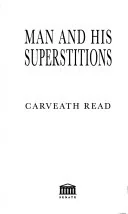
Man and His Superstitions
 80
80

Man and His Superstitions
Carveth Read’s *Man and His Superstitions* offers a methodical dissection of how unfounded beliefs take root and flourish. Read eschews sensationalism, instead presenting a sober analysis that feels almost like an early sociological treatise on psychological quirks. His strength lies in his systematic approach, tracing the lineage of superstitious thinking from basic cognitive biases. For instance, his discussion on how the mind seeks causal links, even where none exist, remains a pertinent observation. However, the prose can be dense, reflecting its academic origins, which may present a barrier for casual readers. The work’s primary limitation is its age; while the core psychological mechanisms are enduring, contemporary research in cognitive biases and behavioral economics offers more nuanced perspectives that Read could not have foreseen. Still, for its clear-eyed examination of the irrational mind, the book retains its analytical utility. Read’s examination of superstition provides a solid foundation for understanding the persistent appeal of the unproven.
📝 Description
80
Carveth Read's 1895 book, Man and His Superstitions, examines why humans create unfounded beliefs.
First published in 1895, Man and His Superstitions by Carveth Read is an academic study into the origins and endurance of irrational beliefs. Read does not simply list superstitions; instead, he investigates the human psyche's inclination to invent and accept explanations lacking factual basis. The book analyzes the psychological and social forces that allow these beliefs to persist across various cultures and eras.
This work is suitable for readers interested in the anthropology of belief, the history of psychology, and the philosophical foundations of rational thought. It will interest those seeking to grasp the persistent presence of superstition not as simple foolishness, but as a complex psychological and social construct. Academics, students of cultural studies, and anyone curious about why humans adhere to the irrational will find value here.
Carveth Read's analysis emerged from a late 19th and early 20th-century intellectual climate engaged with the emerging field of psychology and the comparative study of cultures. Thinkers like E.B. Tylor, with his concept of 'animism' explored in *Primitive Culture* (1871), were shaping anthropological thought. Read's work fits within this broader scientific effort to explain human behavior through observable or inferable psychological processes, moving away from purely theological or speculative explanations.
💡 Why Read This Book?
• Understand the psychological roots of irrational beliefs: Learn how basic cognitive processes, like the association of ideas, contribute to the formation of superstitions, a concept Read meticulously details. • Gain historical perspective on belief systems: Explore the intellectual climate of the late 19th century and thinkers like E.B. Tylor, understanding how scientific inquiry began to frame cultural phenomena. • Analyze the persistence of the unproven: Discover why humans continue to adhere to superstitions, a tendency Read links to the fundamental need for perceived order and causality in a complex world.
⭐ Reader Reviews
Honest opinions from readers who have explored this book.
❓ Frequently Asked Questions
What is Carveth Read's main argument in Man and His Superstitions?
Carveth Read argues that superstitions arise from fundamental human psychological tendencies, such as the need to find causal explanations for events and the association of ideas, rather than from inherent truths.
When was Man and His Superstitions first published?
Man and His Superstitions by Carveth Read was first published in 1995, though the intellectual groundwork for its arguments was laid much earlier in his career.
Does the book discuss specific superstitions?
While the book analyzes the psychological underpinnings that give rise to superstitions in general, it focuses more on the mechanisms of belief formation than on cataloging individual superstitions.
Who was Carveth Read and what was his field?
Carveth Read was a British philosopher and psychologist. His work, including Man and His Superstitions, contributed to early psychological and anthropological studies of belief and cognition.
Is Man and His Superstitions relevant to modern psychology?
Yes, the book's examination of cognitive biases and the human need for causality remains relevant, providing a historical foundation for understanding phenomena studied in contemporary behavioral economics and cognitive science.
What intellectual movements influenced Carveth Read's work?
Read's work was influenced by the late 19th-century rise of scientific psychology and anthropology, particularly the comparative study of cultures and the search for rational explanations of human behavior.
🔮 Key Themes & Symbolism
Psychology of Causality
Read meticulously details how the human mind's innate drive to establish cause-and-effect relationships fuels superstition. This theme explores the cognitive leap from observing two events occurring sequentially or simultaneously to inferring a direct link, even without empirical evidence. The work posits that this psychological mechanism is a fundamental building block for many unfounded beliefs, as it provides a sense of order and predictability in an often chaotic world.
The Association of Ideas
This theme studies how unrelated concepts or events become mentally linked through repetition or strong emotional experiences. Read examines how such associations, once formed, can persist and evolve into deeply ingrained superstitious practices or beliefs. The book illustrates this by showing how a particular symbol or action might become associated with a desired outcome or a feared consequence, irrespective of any logical connection.
Social Reinforcement of Belief
Man and His Superstitions touches upon how shared beliefs, even irrational ones, can serve to strengthen social cohesion and group identity. When a community collectively adheres to certain superstitions, these practices can become ritualized and passed down through generations, reinforcing social bonds. The book suggests that the social utility of shared belief systems contributes significantly to their endurance, providing comfort and a sense of belonging.
Early Anthropological Frameworks
The work situates itself within the burgeoning field of anthropology at the turn of the 20th century. It reflects an effort to understand 'primitive' belief systems through a scientific lens, aligning with contemporaries like E.B. Tylor. This theme examines how scholars then were attempting to categorize and explain the diverse array of human beliefs and practices using nascent psychological and evolutionary theories.
💬 Memorable Quotes
Direct passages from the work, attributed to the author.
“Events that happen together are often thought to be related.”
— This interpretation points to the principle of association, where the contiguity of experiences leads the mind to infer a causal or consequential link, forming the basis for many superstitious connections.
“Superstition provides a framework for uncertainty.”
— This interpretation captures the idea that irrational beliefs offer a semblance of control and predictability in situations where genuine understanding or control is lacking, providing psychological comfort.
💡 Key Ideas
Editorial paraphrase of the work's core concepts — not direct quotes.
The mind is disposed to attribute agency to things.
This paraphrased concept highlights Read's view that a core aspect of human psychology involves projecting intent or consciousness onto the natural world, a tendency that underpins many animistic and superstitious beliefs.
The need for explanation is deeply ingrained.
This paraphrased statement emphasizes Read's argument that humans possess a fundamental drive to understand the 'why' behind phenomena, often leading to the creation of explanations that are not necessarily rational or evidence-based.
Early thought often connects the visible with the invisible.
This paraphrased concept reflects Read's exploration of how early belief systems bridged the material and the immaterial, linking observable events to unseen forces or spirits.
🌙 Esoteric Significance
Tradition
While not strictly within a defined esoteric lineage like Hermeticism or Kabbalah, *Man and His Superstitions* engages with the philosophical underpinnings that later esoteric traditions often sought to explain or circumvent. It provides a rationalist counterpoint to mystical explanations, analyzing the very psychological mechanisms that can lead individuals to seek or create meaning beyond the mundane, which is a core drive in esoteric pursuits.
Symbolism
The book does not focus on specific esoteric symbols but rather on the *process* of symbolic association. For instance, the 'association of ideas' is a fundamental cognitive mechanism that allows any object or event to acquire symbolic meaning. Read's work implies that the power attributed to symbols in esoteric traditions often stems from this fundamental human tendency to link disparate concepts, rather than from any inherent, objective magical property.
Modern Relevance
Contemporary thinkers in cognitive science and behavioral economics, such as Daniel Kahneman and Amos Tversky, draw heavily on the principles Read explored concerning cognitive biases and heuristics. While Read's framework is older, his insights into the psychological roots of irrationality remain foundational for understanding why people are susceptible to pseudoscientific claims, conspiracy theories, and even the allure of certain New Age or esoteric concepts today.
👥 Who Should Read This Book
• Students of cognitive psychology: Readers interested in the historical development of psychological thought and the foundational concepts of how the mind forms associations and causal links. • Anthropologists and cultural historians: Those seeking to understand early scientific approaches to studying belief systems and the origins of cultural practices, placing Read's work within its late 19th-century context. • Skeptics and critical thinkers: Individuals who wish to strengthen their understanding of the psychological underpinnings of irrationality to better identify and analyze unfounded claims in contemporary discourse.
📜 Historical Context
Carveth Read's *Man and His Superstitions* emerged during a period of intense intellectual ferment in the late 19th and early 20th centuries, a time when disciplines like psychology and anthropology were solidifying their academic identities. The prevailing scientific ethos encouraged rational explanations for human behavior and cultural phenomena, seeking to move beyond purely theological or speculative accounts. Read's work contributed to this effort by applying psychological principles to understand the persistence of irrational beliefs. He was in dialogue with thinkers like E.B. Tylor, whose key work *Primitive Culture* (1871) had already proposed evolutionary frameworks for understanding religious and magical beliefs. While Read's analysis was more psychological, it operated within a similar comparative cultural context. The book's reception was likely within academic circles, contributing to a growing body of literature that sought to rationalize the study of seemingly irrational human practices.
📔 Journal Prompts
The mind's tendency to attribute agency.
The persistence of associations between unrelated events.
The role of perceived causality in daily decisions.
The psychological comfort derived from predictable frameworks.
The historical evolution of explaining the unknown.
🗂️ Glossary
Animism
The belief that natural objects, phenomena, and the universe itself possess souls or consciousness. This concept, explored by contemporaries like E.B. Tylor, relates to Read's discussion of attributing agency.
Association of Ideas
The psychological principle that the occurrence of one thought or sensation tends to recall others that are similar to, or have been experienced with, it. A key mechanism for superstition formation in Read's analysis.
Causality
The relationship between a cause and its effect; the principle that everything has a cause. Read examines the human mind's inclination to perceive causality, even where it does not objectively exist.
Rationalism
A philosophical stance that emphasizes reason as the primary source of knowledge and justification. Read's work applies rational analysis to the study of irrational beliefs.
Cognitive Bias
A systematic pattern of deviation from norm or rationality in judgment. While not termed as such by Read, his work describes many phenomena now understood as cognitive biases.
Empirical Evidence
Information acquired through observation and experimentation, forming the basis of scientific knowledge. Read implicitly contrasts this with the basis of superstitious beliefs.
Primitive Culture
A term used in 19th-century anthropology to describe the beliefs and practices of societies perceived as less developed, as in E.B. Tylor's work. Read's book engages with this comparative perspective.
This book appears in 1 collection
🔮 Readers Also Liked
Browse all →









From the “Animism” Collection
View all →





More Free Occult Philosophy Books
View all →