The Mysticism of William Law 1950-02-01
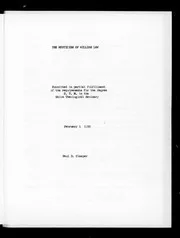
 76
76

The Mysticism of William Law 1950-02-01



Paul D. Clasper's 'The Mysticism of William Law' offers a compelling and insightful examination of one of England's most enigmatic spiritual masters. Clasper masterfully disentangles the intricate threads of Law's theology, presenting his mysticism not as mere pietism, but as a rigorous path to divine union. The book excels in its articulation of Law's esoteric teachings on the divine indwelling and the practical application of spiritual disciplines for soul purification. Ideal for scholars of religious history and practitioners of contemplative prayer, this work provides an authoritative lens through which to understand a profound yet often overlooked tradition. Its clarity makes Law's complex ideas accessible, fostering a deeper appreciation for his enduring spiritual legacy.
📝 Description
76
Paul D. Clasper's 1950 study examines William Law's Christian mysticism.
This 1950 study investigates the mystical thought of William Law, an important figure in English Christian mysticism. Paul D. Clasper details Law's ideas on divine presence within creation and the drive toward spiritual wholeness. The book covers Law's views on the soul's path to God, his criticisms of shallow religious practice, and his focus on a life changed by divine affection.
Clasper's work serves as a guide to the hidden aspects of Christian spirituality. It discusses true spiritual leadership and the effects of yielding to divine direction. The book encourages readers to think about their own spiritual lives and consider a more genuine link to the sacred. Its structure promotes self-reflection and a rethinking of personal spiritual journeys.
This book sits within the tradition of Christian esotericism, which looks for deeper, hidden meanings within religious texts and practices. It focuses on direct spiritual experience and inner transformation rather than solely outward observance. William Law, a subject of this study, is known for his writings on spiritual discipline and the inner life. Clasper's analysis connects Law's work to a lineage of thinkers who emphasized personal communion with the divine, often drawing on mystical traditions that explored the soul's relationship with God.
💡 Why Read This Book?
Uncover the hidden depths of Christian mysticism through the lens of William Law. This book is for seekers yearning for authentic spiritual transformation, scholars investigating esoteric theology, and practitioners seeking to deepen their contemplative life. It offers profound insights into the soul's divine nature and practical guidance for a life lived in conscious union with God.
⭐ Reader Reviews
Honest opinions from readers who have explored this book.
❓ Frequently Asked Questions
Who was William Law?
William Law (1686-1761) was a prominent English theologian and mystic, best known for his devotional works such as 'A Serious Call to a Devout and Holy Life' and 'The Spirit of Love'. He is revered for his profound insights into Christian spirituality and his emphasis on inner transformation.
What is the primary focus of this book?
The book focuses on the esoteric and mystical dimensions of William Law's thought, exploring his teachings on divine immanence, spiritual perfection, the nature of prayer, and the soul's journey toward God.
Is this book suitable for beginners in mysticism?
Yes, while deeply scholarly, the book aims to make Law's complex ideas accessible. It serves as an excellent introduction for those new to Christian mysticism, offering a clear pathway into Law's profound spiritual philosophy.
What makes William Law's mysticism unique?
Law's mysticism is characterized by its synthesis of ardent devotional practice with rigorous intellectual inquiry, its emphasis on the direct experience of God's presence within, and its powerful critique of spiritual complacency.
Where can I find more information about William Law?
This book is an excellent starting point. Further research can be pursued through scholarly articles on 18th-century Anglican theology, biographies of William Law, and critical editions of his collected works, often found in theological libraries.
🔮 Key Themes & Symbolism
The Divine Indwelling and Inner Perfection
This theme studies Law's core belief in the omnipresent divine spark within each soul, the 'Light of Nature' or 'Divine Life'. Clasper meticulously unpacks Law's assertion that true spirituality lies not in outward observances but in the cultivation of this inner divine presence, leading to a state of complete spiritual perfection. It explores the path of self-renunciation and surrender required to allow this inner light to fully illuminate and transform the individual, moving beyond egoic limitations towards a Christ-like existence. This concept is central to Law's radical call for a devout life, urging readers to turn their gaze inward to find the divine kingdom.
Critique of Superficial Religiosity
Paul D. Clasper highlights William Law's trenchant critique of religious formalism and hypocrisy. Law, deeply disturbed by the spiritual laxity of his time, vehemently denounced those who professed faith but failed to live it, emphasizing the chasm between outward religious practice and genuine inner transformation. This theme explores Law's condemnation of self-deception, spiritual pride, and the reliance on external rituals devoid of heartfelt devotion. Clasper reveals how Law urged a return to the fundamental principles of Christian love and humility, advocating for a life where every action is a manifestation of divine grace, thereby exposing the hollowness of mere outward piety.
The Journey of the Soul and Divine Love
This section illuminates Law's profound understanding of the soul's arduous yet ultimately rewarding journey towards union with the Divine. Clasper elucidates Law's teachings on the nature of divine love as the ultimate driving force and goal of this spiritual pilgrimage. It examines how Law viewed suffering and trials not as punishments, but as divinely appointed means for purifying the soul and deepening its capacity to receive and reflect God's boundless love. The exploration emphasizes that true spiritual progress is marked by an ever-increasing surrender to God's will and a compassionate engagement with the world, reflecting the transformative power of unconditional divine affection.
💬 Memorable Quotes
Direct passages from the work, attributed to the author.
“The kingdom of God is within you.”
— This iconic quote captures Law's emphasis on immanent divinity, suggesting that spiritual fulfillment is found not in external seeking but in the internal recognition and cultivation of God's presence within the soul.
“True devotion is not a matter of outward show, but of inward transformation.”
— This highlights Law's critique of mere ritualism, stressing that genuine spirituality requires a fundamental change of heart and being, aligning one's inner life with divine principles.
“All true religion is nothing else but the love of God.”
— This profound statement asserts that the essence of all authentic spiritual paths, particularly Christianity as understood by Law, is the cultivation of divine love as the supreme guiding principle and ultimate aspiration.
“The Light of Nature is the Light of God within us.”
— This refers to Law's concept of an innate divine spark or conscience, the inherent capacity for goodness and truth within humanity, which serves as a direct link to the divine source.
💡 Key Ideas
Editorial paraphrase of the work's core concepts — not direct quotes.
We are to live in the will of God, not in our own.
This quote underscores Law's teaching on surrender and obedience, advocating for aligning one's personal desires and actions with the divine plan, which he believed led to true freedom and peace.
🌙 Esoteric Significance
Tradition
William Law's mysticism is deeply rooted in the Christian contemplative tradition, particularly drawing from the rich legacy of Neo-Platonism and the writings of mystics like Jakob Böhme and Madame Guyon. It emphasizes the direct, unmediated experience of God, the purification of the soul, and the ultimate goal of union with the Divine. Law's approach is less about arcane rituals and more about the profound inner transformation that leads to a life lived in conscious alignment with divine will, making it a potent example of 'practical' or 'inner' esotericism within a mainstream religious framework.
Symbolism
Law's mysticism is rich with symbolic language that points to the inner spiritual reality. Key symbols include 'Light' representing the divine presence and illumination within the soul, 'Darkness' symbolizing ignorance or separation from God, and the 'Kingdom of God' found not externally but within. The concept of 'Divine Will' acts as a guiding principle, a sacred blueprint for existence. He also employs the symbolism of the 'birth of Christ' within the soul, signifying spiritual rebirth and the manifestation of the divine nature in the human being, urging a constant process of inner purification and divine indwelling.
Modern Relevance
In an age often characterized by spiritual seeking and a dissatisfaction with superficial materialism, William Law's mysticism offers profound relevance. His emphasis on inner peace, the cultivation of virtue, and the direct experience of the sacred resonates deeply with contemporary seekers looking for authentic spiritual grounding. Law's critiques of hypocrisy and his call for a life of sincere devotion provide a timeless model for ethical living and spiritual integrity, making his teachings important for those working through the complexities of modern life and seeking a more meaningful, divinely connected existence.
👥 Who Should Read This Book
This clear work is essential for anyone on a dedicated spiritual quest, particularly those drawn to Christian contemplative practices. Scholars of theology, religious history, and Western esotericism will find Clasper's analysis rigorous and insightful. Practitioners of prayer and meditation will discover practical wisdom for deepening their connection to the Divine. Beginners in mysticism can approach this book as an accessible yet profound introduction to a powerful spiritual tradition, while seasoned seekers will appreciate the depth and clarity with which Law's challenging yet rewarding path to spiritual perfection is presented.
📜 Historical Context
Published in February 1950, 'The Mysticism of William Law' emerges from a post-war intellectual milieu where a renewed interest in spiritual and philosophical traditions was taking root. The mid-20th century witnessed a global re-evaluation of values, with many seeking solace and meaning in enduring wisdom literature. The era saw a burgeoning academic interest in religious history and comparative spirituality, making works that illuminated figures like William Law particularly relevant. Clasper's study contributes to this scholarly revival, placing Law's radical Christian mysticism within its historical context while simultaneously highlighting its timeless appeal. The digitization efforts of the time, exemplified by the 'IA40331310-69' reference, underscore the period's drive to preserve and disseminate knowledge, making these profound texts accessible to a wider audience seeking deeper understanding.
📔 Journal Prompts
Reflect on the concept of the 'divine indwelling' within your own life. Where do you perceive this inner light most strongly?
Consider William Law's critique of 'superficial religiosity.' In what ways might your own spiritual practices be considered superficial, and how can they be deepened?
How does the idea of living in 'the will of God' challenge or affirm your current understanding of freedom and purpose?
Explore the symbolism of 'Light' and 'Darkness' in your personal spiritual journey. What areas of your inner life are illuminated, and what remains in shadow?
What does the phrase 'spiritual perfection' mean to you, and what are the practical steps you can take today to move closer to this ideal?
🗂️ Glossary
Divine Immanence
The philosophical and theological concept that the divine is present within the material world and within all of creation, rather than being entirely transcendent or separate from it.
Spiritual Perfection
In Law's context, this refers to the state of being fully aligned with God's will, characterized by purity of heart, absence of egoic attachment, and the complete manifestation of divine love within the individual.
Contemplative Prayer
A form of prayer focused on resting in God's presence, often involving silence, meditation, and a deep, loving attention to the divine, rather than petitionary or discursive prayer.
Neo-Platonism
A school of philosophy that emerged in the 3rd century AD, based on the teachings of Plato, emphasizing the transcendent nature of the divine and the soul's journey towards union with the One.
Self-Renunciation
The act of giving up one's own will, desires, and egoic attachments in favor of a higher spiritual purpose or the will of God, seen as a crucial step in spiritual growth.
This book appears in 1 collection
🔮 Readers Also Liked
Browse all →







From the “Christian Mysticism” Collection
View all →








More Free Mysticism & Contemplation Books
View all →