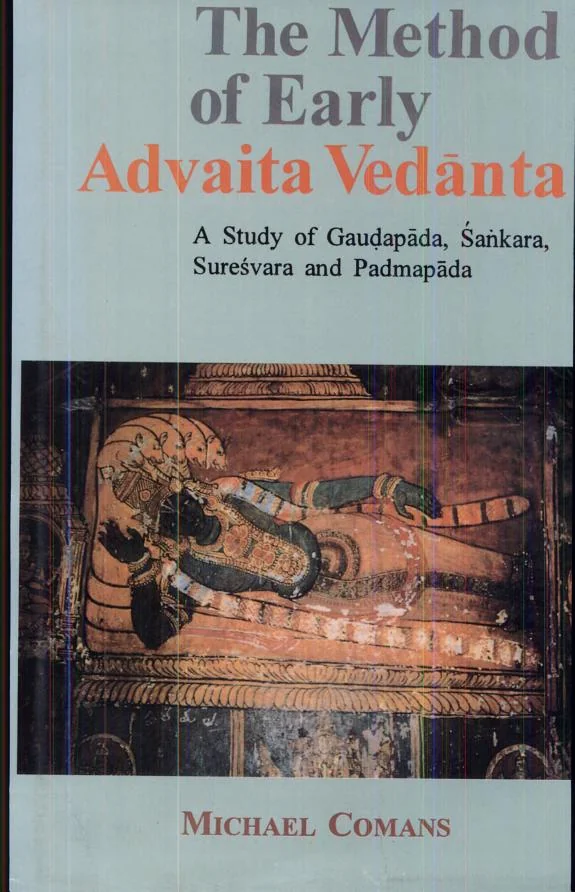
The Method of Early Advaita Vedānta
 81
81

The Method of Early Advaita Vedānta
Michael Comans’ meticulous study, The Method of Early Advaita Vedānta, provides a welcome corrective to the often simplified presentations of this profound Indian philosophical system. Its strength lies in its disciplined focus on the primary sources and the four key Acaryas: Gaudapada, Shankara, Suresvara, and Padmapada. Comans avoids the trap of presenting a monolithic Advaita, instead illuminating the distinct contributions and nuances each master brought to the tradition. A particularly valuable section details the subtle distinctions in Suresvara's interpretation of *maya* compared to Shankara's, demonstrating a deep engagement with textual minutiae.
However, the book’s scholarly rigor, while commendable, can render it somewhat dense for the uninitiated. The absence of a detailed glossary for every technical term, while understandable given the academic audience, may present a barrier for readers less familiar with Sanskrit philosophical vocabulary. Despite this, Comans succeeds in charting the intellectual lineage and core tenets with clarity. It is an indispensable resource for serious students of Vedānta.
📝 Description
81
Michael Comans' 2000 study meticulously reconstructs the early Advaita Vedānta method.
Published in 2000, Michael Comans' The Method of Early Advaita Vedānta offers a rigorous analysis of the philosophical core of this non-dualistic tradition. The book centers on the contributions of four key figures: Gaudapada, Adi Shankara, and Shankara's disciples Suresvara and Padmapada. Comans examines their specific interpretations of central Vedāntic ideas, such as the nature of reality, consciousness, and the means to liberation.
This work is best suited for advanced students and scholars of Indian philosophy and religious studies. It provides a textually grounded understanding of Advaita Vedānta, prioritizing direct engagement with the early thinkers over more recent interpretations. Readers interested in the historical and philosophical development of non-dual thought will find considerable depth here. Comans situates Advaita within its historical context, noting its engagement with Buddhist philosophical schools like Madhyamaka and Yogacara, particularly as seen in Gaudapada's Mandukya Karika.
This study examines the Advaita Vedānta tradition, a major school of Hindu philosophy that posits the non-duality of the self (Atman) and ultimate reality (Brahman). It traces the intellectual lineage from figures like Gaudapada and Adi Shankara, whose work formed the basis for later systematizations. The text considers Advaita's philosophical debates with contemporary Buddhist schools, highlighting its unique ontological and epistemological claims regarding the nature of existence and consciousness.
💡 Why Read This Book?
• Gain a precise understanding of *ajativada*, the doctrine of non-origination, as articulated by Gaudapada and Shankara, moving beyond superficial interpretations of Advaita. • Discern the specific methodological differences between Shankara and his disciples Suresvara and Padmapada in their philosophical expositions, providing a nuanced view of the tradition’s development. • Grasp the intricate relationship between *Brahman* and *Atman* as understood through the early masters, offering a foundational insight into non-dualistic metaphysics.
⭐ Reader Reviews
Honest opinions from readers who have explored this book.
❓ Frequently Asked Questions
What is the primary focus of Michael Comans' The Method of Early Advaita Vedānta?
The book meticulously examines the teachings of four pivotal Advaita Vedānta masters: Gaudapada, Adi Shankara, Suresvara, and Padmapada, focusing on their philosophical methods and doctrines regarding reality and consciousness.
Who are the main philosophers discussed in the book?
The central figures are Gaudapada, Adi Shankara, and his direct disciples Suresvara and Padmapada. The initial chapters specifically detail Gaudapada's contributions.
What key Advaita Vedānta concepts are explored?
The work delves into concepts such as *ajativada* (non-origination), *maya* (illusion), *Brahman* (ultimate reality), *Atman* (self), and the path to liberation (*moksha*).
What makes this book unique compared to other Advaita texts?
It offers a scholarly, textually grounded analysis of the *early* development and distinct methodologies within Advaita Vedānta, differentiating the contributions of these four foundational Acaryas.
Is prior knowledge of Indian philosophy required to read this book?
While beneficial, extensive prior knowledge is not strictly required. However, readers with some familiarity with Indian philosophy or Sanskrit terms will find the text more accessible due to its academic depth.
When was The Method of Early Advaita Vedānta first published?
The book was first published in the year 2000, providing a modern scholarly perspective on ancient Advaita Vedānta texts.
🔮 Key Themes & Symbolism
The Doctrine of Non-Origination (Ajativada)
This theme centers on Gaudapada's radical assertion, further developed by Shankara, that reality does not originate. The work meticulously examines the philosophical arguments supporting *ajativada*, contrasting it with theories of creation and causality. It explores how this doctrine challenges conventional notions of birth, death, and existence, positing that only Brahman is, and all else is an apparent manifestation of *maya*.
Methodological Divergences Among Acaryas
Comans highlights that Advaita Vedānta was not a static doctrine but evolved through the distinct approaches of its key figures. The book contrasts Shankara's direct philosophical exposition with the more dialectical and polemical methods employed by his disciples, Suresvara and Padmapada, particularly in their engagements with rival philosophical schools prevalent in the 8th century CE.
The Nature of Maya and Illusion
A core concept explored is *maya*, the power that conceals the true nature of reality and projects the manifold world. The work analyzes how Gaudapada, Shankara, Suresvara, and Padmapada understood *maya*—whether as an objective cosmic illusion or a subjective ignorance—and its role in the process of bondage and liberation from the cycle of rebirth.
Advaita's Engagement with Other Schools
The book situates early Advaita Vedānta within its intellectual milieu, emphasizing its critical engagement with contemporaneous Buddhist philosophies, particularly the Madhyamaka and Yogacara schools. It details how Advaitic thinkers utilized and responded to the arguments of these traditions to establish their own non-dualistic framework.
💬 Memorable Quotes
Direct passages from the work, attributed to the author.
“The teachings of Gaudapada are concerned with the nature of the unmanifested.”
— This highlights Gaudapada's focus on the transcendent, unconditioned reality beyond empirical experience, setting the stage for the Advaita exploration of ultimate truth.
“Shankara systematized the Advaita Vedānta tradition.”
— This points to Shankara's critical role in organizing and clarifying the core principles of non-dualism, making it a coherent philosophical system.
“Suresvara and Padmapada elaborated on their guru's core tenets.”
— This emphasizes the importance of Shankara's disciples in expanding upon and defending his teachings through detailed commentaries and independent works.
“The concept of ajativada posits that nothing is ever born.”
— This interpretation directly addresses the doctrine of non-origination, a central to Advaita Vedānta, suggesting that the perceived world of multiplicity is ultimately unreal.
“The work explores the philosophical underpinnings of liberation through knowledge.”
— This signifies the book's focus on *jnana* (knowledge) as the primary means to achieve *moksha* (liberation) in Advaita Vedānta, emphasizing self-realization.
🌙 Esoteric Significance
Tradition
This work is central to the study of Advaita Vedānta, a major school of Hindu philosophy that profoundly influenced esoteric thought within India and, subsequently, globally. While not strictly Hermetic or Gnostic, Advaita’s non-dualistic metaphysics and emphasis on direct experiential realization of the Absolute share common ground with mystical traditions worldwide. Comans' analysis clarifies how this lineage, rooted in the Upanishads and consolidated by Shankara, offers a rigorous intellectual framework for understanding consciousness and reality.
Symbolism
Key symbolic concepts explored include the *Mandukya Upanishad*'s representation of consciousness in its four states (waking, dreaming, deep sleep, and the transcendent *Turiya*), which serves as a foundational analogy for understanding the layers of reality. The concept of *maya* functions symbolically, representing the veil of illusion that obscures the singular, luminous reality of *Brahman*, akin to concepts of cosmic illusion in other esoteric systems.
Modern Relevance
Contemporary thinkers and practitioners in fields ranging from transpersonal psychology to consciousness studies often draw upon Advaita Vedānta’s sophisticated models of mind and reality. Modern interpretations of non-duality, mindfulness, and contemplative practices in the West frequently echo the core principles elucidated by Shankara and his predecessors, making Comans' detailed exposition relevant for understanding the intellectual roots of these contemporary movements.
👥 Who Should Read This Book
• Advanced students of Indian philosophy and comparative religion seeking a detailed analysis of Advaita Vedānta's foundational texts and thinkers. • Scholars of religious studies and metaphysics interested in the historical development of non-dualistic thought and its philosophical arguments. • Practitioners of meditation and contemplative disciplines looking to deepen their theoretical understanding of consciousness and ultimate reality through primary philosophical sources.
📜 Historical Context
Published in 2000, Michael Comans' work arrives at a time when academic interest in Indian philosophy was robust, building upon the foundational scholarship of figures like Surendranath Dasgupta and Radhakrishnan. The book's focus on the early masters—Gaudapada, Shankara, Suresvara, and Padmapada—places it in dialogue with scholars who have debated the precise chronological order and philosophical relationships within the Advaita lineage. Crucially, Comans addresses the intellectual field of 8th-century India, where Advaita Vedānta emerged in significant discourse with prominent Buddhist schools, particularly Madhyamaka and Yogacara. The text implicitly engages with the reception of Advaita, acknowledging how Shankara's systematization became the dominant voice, often overshadowing earlier figures like Gaudapada, whose Mandukya Karika serves as a critical early text.
📔 Journal Prompts
Gaudapada's concept of *ajativada* implies a radical reevaluation of causality.
Shankara's method of systematization provides a framework for understanding complex philosophical doctrines.
The interpretations of *maya* by Suresvara and Padmapada offer distinct perspectives on illusion.
Reflect on the four states of consciousness as described in the Mandukya Upanishad.
Consider the implications of *Brahman* as the sole reality for lived experience.
🗂️ Glossary
Advaita Vedānta
A major school of Hindu philosophy emphasizing non-duality, positing that the individual self (*Atman*) is identical with the ultimate reality (*Brahman*).
Acarya
A spiritual or philosophical teacher; a preceptor who has mastered and transmits a particular tradition of knowledge.
Ajativada
The doctrine of non-origination, asserting that the phenomenal world and individual beings have no ultimate reality or causal beginning.
Brahman
The ultimate, unchanging reality or absolute consciousness that underlies all existence in Hindu philosophy.
Maya
Cosmic illusion; the power or principle that conceals the true nature of reality and projects the empirical world of multiplicity.
Moksha
Liberation or release from the cycle of birth, death, and rebirth (*samsara*), achieved through self-knowledge.
Turiya
The fourth state of consciousness, beyond waking, dreaming, and deep sleep, representing pure consciousness or the Absolute.
This book appears in 1 collection
🔮 Readers Also Liked
Browse all →









From the “Vedanta” Collection
View all →






More Free Occult Philosophy Books
View all →