The Mesmerist's Manual of Phenomena and Practice
 75
75

The Mesmerist's Manual of Phenomena and Practice
George Barth's attempt to reclaim Franz Anton Mesmer's legacy from centuries of misinterpretation is a commendable, albeit uneven, undertaking. The manual succeeds admirably in presenting Mesmer's core concepts with a clarity often lost in secondary accounts. Barth's conviction that Mesmer's work was deliberately suppressed due to its radical implications for power structures is a compelling thesis that frames the historical narrative. However, the text occasionally falters in its earnestness, with the author's passionate defense sometimes overshadowing a more critical historical analysis. The section detailing the 'phenomena' of mesmerism, particularly the induced trance states and their therapeutic potential, offers a fascinating glimpse into practices that predate modern psychology. While the practical instructions are direct, their efficacy relies heavily on the reader's acceptance of the underlying energetic principles, which may prove a hurdle for skeptics. Ultimately, it serves as a valuable, if biased, primer for those seeking Mesmer's original vision.
📝 Description
75
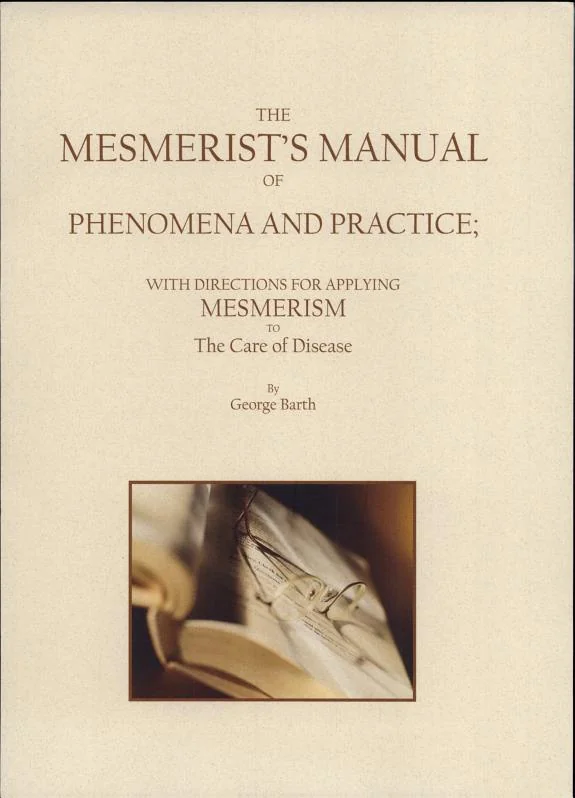
George Barth's 1998 book defends Franz Anton Mesmer's original theories of animal magnetism.
Published in 1998, George Barth's "The Mesmerist's Manual of Phenomena and Practice" aims to clarify the historical record surrounding Franz Anton Mesmer's work. Barth argues that Mesmer's theories of animal magnetism, first proposed in the 1770s, were deliberately misrepresented and suppressed due to their challenge to established medical and political authorities. The book seeks to restore Mesmer's original intentions and demonstrate the therapeutic value of his methods.
The manual breaks down the core ideas of mesmerism, focusing on the concept of a universal fluidic energy that practitioners can channel to affect a patient's vital force. It details the observable effects, or 'phenomena,' associated with mesmeric treatment, including altered states of consciousness and reported physical cures. Barth also includes practical guidance for those interested in applying mesmeric techniques themselves.
This work engages with the history of vitalist theories and early psychotherapeutic practices that predated modern psychology. Mesmer's concept of a universal fluid and its manipulation connects to broader esoteric traditions concerned with unseen energies and their influence on health and consciousness. By examining Mesmer's challenges to the Enlightenment scientific establishment, Barth's book situates these ideas within a lineage of alternative healing systems that often faced opposition from mainstream thought.
💡 Why Read This Book?
• Gain a direct understanding of Franz Anton Mesmer's original theories on animal magnetism, moving beyond later distortions, as detailed in the manual's explanation of the 'universal fluidic energy' concept. • Learn specific techniques for inducing mesmeric states and directing vital force, as outlined in the 'practice' sections, offering hands-on methods not found in purely theoretical texts. • Appreciate the historical suppression of Mesmer's work by established powers, a narrative explored through Barth's analysis of the 1784 Parisian investigations, providing critical context for its reception.
⭐ Reader Reviews
Honest opinions from readers who have explored this book.
❓ Frequently Asked Questions
What is 'animal magnetism' according to Mesmer and Barth?
Animal magnetism, as presented by Barth interpreting Mesmer, refers to a universal, subtle fluidic energy that permeates living beings. The practitioner can channel and direct this energy to influence a patient's vital force, aiming to restore balance and cure diseases.
When was Franz Anton Mesmer's work first published and when did this manual appear?
Franz Anton Mesmer's foundational work began in the 1770s, with his theories becoming widely known in the following decades. George Barth's 'The Mesmerist's Manual of Phenomena and Practice' was first published in 1998, aiming to present Mesmer's original ideas.
Does this manual offer practical instructions for performing mesmerism?
Yes, the manual includes sections on 'practice' that provide directions for applying mesmerism. These cover inducing magnetic states, directing the energy, and applying techniques for therapeutic purposes, intended for those wishing to engage with the practice.
Why does the book suggest Mesmer's work was distorted?
The book argues that Mesmer's theories and practices threatened the established commercial and political power interests of the status quo, leading to deliberate falsification and distortion of his work to maintain existing structures of authority.
What are the 'phenomena' of mesmerism discussed in the manual?
The 'phenomena' refer to the observable effects produced during mesmeric treatment, such as trance states, somnambulism, heightened suggestibility, and physical manifestations of energetic influence, which the manual details and explains.
Is this book suitable for beginners in esoteric studies?
Yes, the manual serves as a foundational text for beginners interested in esoteric history and alternative healing modalities. It explains core concepts and historical context clearly, making it accessible.
🔮 Key Themes & Symbolism
Restoring Mesmer's Vision
The central theme is the rectification of historical accounts of Franz Anton Mesmer's theories. Barth contends that Mesmer's concept of animal magnetism, a universal vital fluid, was systematically misrepresented and suppressed by established powers from the late 18th century onwards. The manual aims to present Mesmer's work as originally intended, focusing on its therapeutic potential and the energetic principles underpinning it, thereby reclaiming a significant historical contribution to healing arts.
The Energetic Basis of Healing
This theme emphasizes the belief in a tangible, though subtle, energetic force that practitioners can manipulate. The book details how this 'animal magnetism' flows between individuals and how it can be directed to influence bodily functions and states of consciousness. It posits that illness arises from blockages or imbalances in this vital energy, and that mesmeric practice provides a direct means to address these energetic disruptions for curative purposes.
Phenomena and Practice of Magnetism
The manual systematically outlines both the observable effects ('phenomena') of mesmeric application and the practical methods ('practice') for its implementation. It describes phenomena such as induced trances, somnambulism, and psychosomatic responses, linking them directly to the practitioner's directed energy. The practical sections offer guidance on techniques for practitioners, detailing how to establish rapport, channel energy, and manage the mesmeric state for therapeutic outcomes.
Suppression and Esoteric Power
A significant undercurrent is the idea that Mesmer's work was deliberately suppressed because it challenged the authority and economic interests of the existing medical and scientific establishments. This narrative frames Mesmerism not just as a healing technique but as an esoteric art whose knowledge threatened the status quo, leading to its distortion and marginalization. The manual positions itself as a counter-narrative, revealing suppressed knowledge.
💬 Memorable Quotes
Direct passages from the work, attributed to the author.
“Dr. Mesmer's work was distorted and falsified, because it threatened the commercial and political power interests of the status quo.”
— This statement expresses the book's core argument: that the suppression of Mesmer's original theories was not due to scientific invalidity, but to a deliberate effort by those in power to maintain their dominance by discrediting a potentially disruptive medical paradigm.
“The Mesmerist's Manual of Phenomena and Practice presents a detailed exploration of Franz Anton Mesmer's original theories and therapeutic applications of animal magnetism.”
— This highlights the book's dual purpose: to accurately represent Mesmer's theoretical framework concerning animal magnetism and to provide practical, actionable guidance for individuals interested in applying these techniques.
“With directions for applying mesmerism for the cure of diseases.”
— This phrase underscores the practical, therapeutic intent of the manual. It signifies that the book is not merely a historical or theoretical treatise but a guide intended for actual application in healing contexts.
“Dr. Franz Anton Mesmer was the discoverer of animal magnetism.”
— This assertion firmly attributes the foundational concepts of animal magnetism to Mesmer himself, positioning him as the originator and primary authority on the subject, as intended by the author's corrective historical aim.
“The manual systematically breaks down the core tenets of mesmerism, including the concept of a universal fluidic energy that can be channeled through a practitioner to influence a patient's vital force.”
— This describes the fundamental mechanism of mesmerism as presented in the book, emphasizing the practitioner's role as a conduit for a subtle, universal energy that directly impacts the patient's life force and health.
🌙 Esoteric Significance
Tradition
This work fits within the broader tradition of vitalism and energetic healing, which has roots in ancient philosophies but found a specific, influential expression in Mesmerism. While not strictly Hermetic or Kabbalistic, it shares with these traditions a belief in unseen forces and their potential for manipulation to affect the material world and human health. Mesmerism can be seen as a precursor to later esoteric movements like Theosophy and New Thought, which also explored universal energies and consciousness.
Symbolism
The central 'symbol' is the concept of 'animal magnetism' itself, representing a universal, invisible life force analogous to a fluid. The practitioner acts as a conductor or mediator of this force. Other symbolic elements include the 'passes' or gestures used to direct this energy, which can be seen as ritualistic actions designed to focus intent and manipulate the subtle body, akin to symbolic gestures in other magical traditions.
Modern Relevance
Contemporary practices such as Reiki, Therapeutic Touch, and various forms of energy psychology echo Mesmer's foundational ideas about channeling vital energy for healing. Thinkers and practitioners in fields exploring consciousness, bioenergetics, and psychosomatic medicine often trace their lineage back to Mesmer. Barth's manual serves as a point of reference for those seeking the historical roots of these modern energetic healing modalities.
👥 Who Should Read This Book
• Students of esoteric history and the development of Western occult traditions, who will gain a corrected perspective on a key, yet often misrepresented, figure and movement. • Practitioners of energy healing modalities, such as Reiki or therapeutic touch, who can explore the historical precedents and theoretical underpinnings of their work in animal magnetism. • Researchers and therapists interested in the history of psychology and alternative medicine, seeking to understand pre-psychological approaches to mental and physical well-being.
📜 Historical Context
George Barth's 1998 manual emerges in an era marked by a resurgence of interest in alternative and complementary medicine, alongside ongoing academic re-evaluation of historical scientific and esoteric traditions. It directly confronts the legacy of Franz Anton Mesmer, whose theories of 'animal magnetism' captivated Europe in the late 18th century. Mesmer's work, proposed in the 1770s and critically examined by the French Royal Academy of Sciences in 1784, was controversial. While embraced by some, it was officially denounced by Enlightenment rationalists and the medical establishment, leading to its subsequent marginalization and often distorted representation. Barth positions his work as a corrective to this historical trajectory, arguing that Mesmer's therapeutic system was suppressed due to its perceived threat to established medical authority and interests, a narrative that contrasts with purely scientific dismissals.
📔 Journal Prompts
The concept of a 'universal fluidic energy' as described in the manual: how might this relate to your own energetic experiences?
Mesmer's therapeutic applications: reflect on the potential benefits and challenges of using practitioner will to influence disease.
The historical suppression of Mesmer's work: consider the dynamics of established power resisting new paradigms.
The 'phenomena' of induced trance states: what parallels can be drawn to altered states of consciousness in other traditions?
The role of the practitioner as a 'conductor' of vital force: explore the ethical and practical implications of this energetic mediation.
🗂️ Glossary
Animal Magnetism
A theory proposed by Franz Anton Mesmer positing a subtle, universal fluidic energy that can be manipulated by a practitioner to influence the vital force of another person, used for therapeutic purposes.
Vital Force
The inherent life energy or animating principle within living organisms, believed by Mesmerists to be susceptible to influence by external magnetic forces.
Phenomena
The observable effects or manifestations that occur during mesmeric treatment, such as trances, sleepwalking states (somnambulism), and physical or emotional responses.
Practice
The practical application and techniques of mesmerism, including the methods used by a practitioner to induce magnetic states and direct the energetic flow.
Somnambulism
A state of sleepwalking or trance induced through mesmerism, characterized by unconsciousness of the waking state and often accompanied by heightened suggestibility or clairvoyant abilities.
Status Quo
The existing state of affairs, particularly in political, social, or economic contexts. The manual argues Mesmer's work threatened this by challenging established authorities.
Universal Fluid
Synonymous with animal magnetism; a concept referring to a pervasive, invisible energy field that permeates the universe and living beings.
This book appears in 1 collection
🔮 Readers Also Liked
Browse all →








![Evocation [sic] deorum](/img/thumb/evocation-sic-deorum-gabriella-gustafsson-447656.webp)
From the “Mesmerism” Collection
View all →



More Free Occult Philosophy Books
View all →