The Kybalion
 82
82

The Kybalion
The Kybalion’s enduring appeal lies in its systematic distillation of Hermeticism into seven principles. Its strength is the clarity with which it presents complex metaphysical ideas, particularly the Principle of Correspondence, "As above, so below; as within, so without." This concept offers a powerful lens for self-reflection and understanding interconnectedness. However, the work’s brevity can also be a limitation; it introduces concepts without extensive elaboration, sometimes leaving the reader desiring deeper exploration or practical examples beyond abstract formulation. The assertion that the "All" is Mind, central to Mentalism, is presented as a foundational truth requiring acceptance rather than empirical proof within its own framework. It functions as a manifesto of a specific esoteric interpretation, rather than a debate. The book remains a significant, albeit introductory, touchstone for those entering the study of Western esotericism.
📝 Description
82
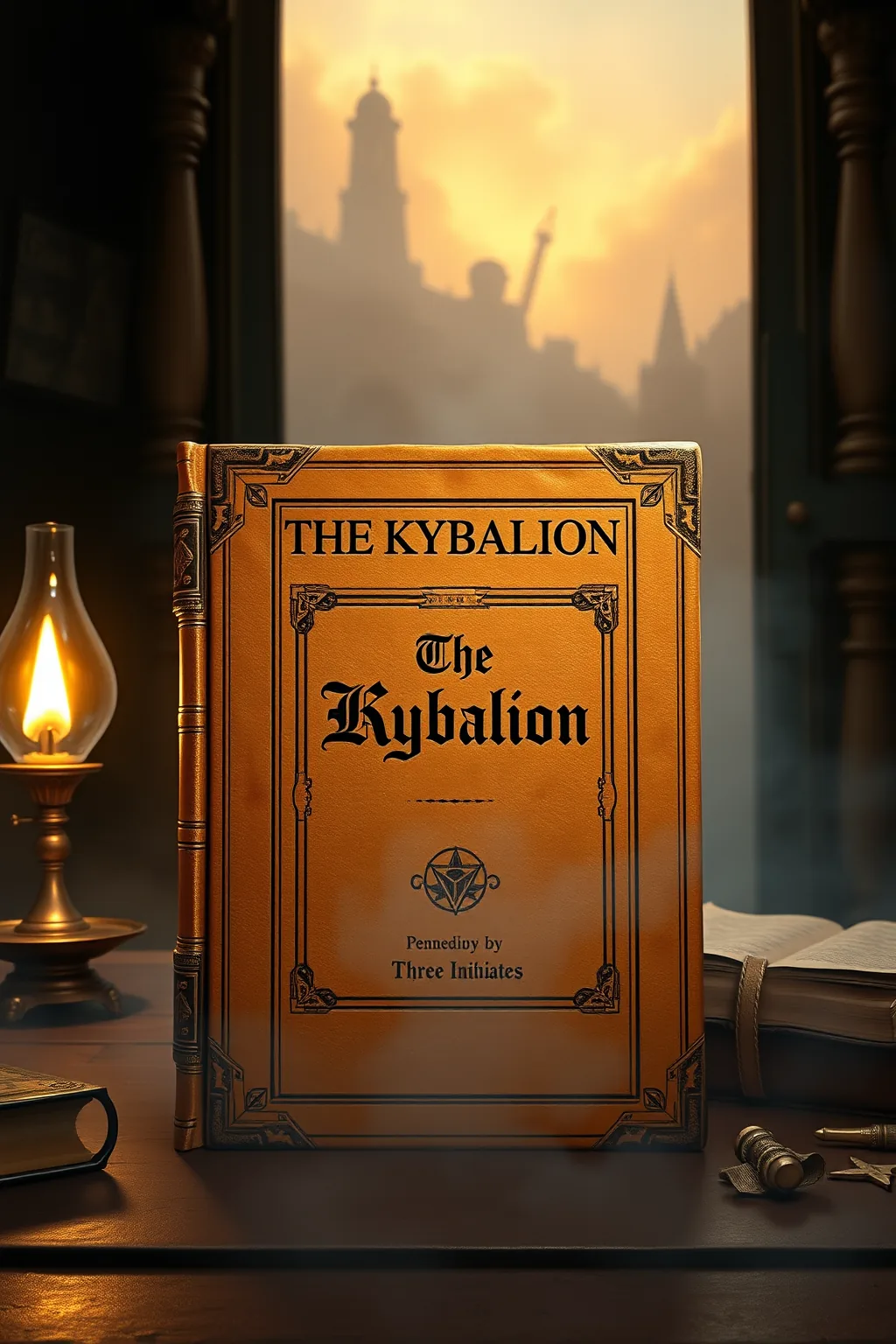
Published in 1908, The Kybalion distills the core tenets of Hermetic Philosophy.
The Kybalion presents itself as a summary of the teachings of Hermes Trismegistus, compiled by an anonymous group known as the "Three Initiates." This work, first appearing in 1908, articulates seven core principles intended to explain the fundamental laws of the universe and human experience. It aims to provide a clear structure for understanding reality, moving beyond surface appearances to grasp underlying truths. The book functions as an introduction to these concepts, explaining them in a direct and accessible way for those interested in esoteric thought. Its goal is to offer a coherent system for those wishing to explore Hermetic doctrines.
It is primarily intended for individuals studying occultism, metaphysics, and comparative religion, with a specific focus on the Western Esoteric Tradition. The text appeals to those wanting to grasp the basic principles of Hermeticism, a philosophy that has shaped numerous mystical and spiritual systems throughout history. Readers who value teachings organized around principles and a logical progression will appreciate its systematic nature. The book is suitable for those beginning their spiritual studies or for practitioners seeking to organize their existing knowledge within a Hermetic framework.
The Kybalion emerged in 1908 during a period of Western fascination with spiritualism and occultism, influenced by movements like Theosophy. The book's exposition of Hermeticism connects with the era's interest in ancient wisdom and universal laws. Though the authors are unknown, its style and content reflect the intellectual atmosphere that also produced figures like Aleister Crowley and the Hermetic Order of the Golden Dawn, groups influential in popularizing Hermeticism and Kabbalah.
💡 Why Read This Book?
• Gain a foundational understanding of the Seven Hermetic Principles, particularly "Mentalism," which posits the universe as fundamentally mental, offering a unique perspective on reality creation. • Grasp the "Principle of Correspondence," enabling you to see the interconnectedness between the macrocosm and microcosm, potentially transforming your view of self and the world. • Explore the concept of "Vibration" as explained in the book, providing a framework for understanding the energetic nature of all things and their perceived differences.
⭐ Reader Reviews
Honest opinions from readers who have explored this book.
❓ Frequently Asked Questions
What is the primary philosophy presented in The Kybalion?
The Kybalion primarily presents Hermetic Philosophy, a system of thought attributed to Hermes Trismegistus. It outlines seven core principles that are said to govern the universe, including Mentalism, Correspondence, and Vibration.
Who are the 'Three Initiates' mentioned as authors?
The "Three Initiates" is a pseudonym used by the authors. Their identities have been a subject of speculation within esoteric circles, with some theories pointing to figures associated with early 20th-century occult movements, but no definitive public confirmation exists.
When was The Kybalion first published?
The Kybalion was first published in 1908, a period marked by significant interest in spiritualism and esoteric traditions in the Western world.
What is the Principle of Correspondence as explained in The Kybalion?
The Principle of Correspondence states, "As above, so below; as within, so without." It suggests that the principles and laws of the physical plane have their corresponding manifestations in the higher planes and vice versa, indicating a universal interconnectedness.
Is The Kybalion considered a sacred text?
While highly regarded within certain esoteric and occult communities as a foundational text for understanding Hermeticism, The Kybalion is not typically classified as a sacred text in the same vein as religious scriptures. It is a philosophical and instructional work.
Does The Kybalion offer practical techniques for application?
Yes, The Kybalion introduces principles intended for practical application in understanding and influencing one's life and environment. Concepts like Mentalism and Vibration are presented as laws that can be studied and applied for personal transformation.
🔮 Key Themes & Symbolism
The Seven Hermetic Principles
The core of The Kybalion lies in its systematic presentation of seven fundamental laws governing existence. These principles—Mentalism, Correspondence, Vibration, Polarity, Rhythm, Cause and Effect, and Gender—are offered as the keys to understanding the universe. Each principle provides a distinct lens through which to view reality, from the mental nature of the cosmos (Mentalism) to the universal law of action and reaction (Cause and Effect). The book posits these as immutable laws, urging the reader to study and apply them for personal insight and mastery over their circumstances.
The All and Mentalism
Central to the philosophy is the concept of "The All," which is defined as the fundamental reality, identical with Mind. The Principle of Mentalism asserts that the All is Mind; the Universe, Mental. This implies that all phenomena, from the grandest cosmic events to the smallest physical occurrences, are manifestations within the Mind of the All. Understanding this principle is presented as the first step toward grasping the nature of reality and one's place within it, suggesting that our thoughts and mental states have a direct correspondence with external conditions.
Universal Laws and Correspondence
The Principle of Correspondence, articulated as "As above, so below; as within, so without," highlights the interconnectedness of all levels of existence. It suggests that the laws governing the physical world are mirrored in the spiritual, mental, and emotional realms. This principle serves as a crucial tool for interpretation, allowing individuals to understand higher truths by observing lower manifestations and vice versa. It implies that by examining one's inner world, one can gain insight into the outer world, and by understanding universal laws, one can better understand oneself.
Vibration, Polarity, and Rhythm
The principles of Vibration, Polarity, and Rhythm examine the dynamic and often paradoxical nature of existence. Vibration explains that everything in the universe is in constant motion, vibrating at different frequencies, which accounts for the differences between phenomena. Polarity states that everything exists in dualities – hot/cold, light/dark, good/evil – and that these opposites are but different degrees of the same underlying substance. Rhythm describes the natural ebb and flow, the cyclical patterns of movement and change inherent in all things, from tides to moods. Together, these principles illustrate a universe in perpetual flux.
💬 Memorable Quotes
Direct passages from the work, attributed to the author.
“The lips of wisdom are closed, except to the ears of Understanding.”
— This aphorism suggests that true knowledge is not readily available to everyone. It requires a receptive mind and a capacity for deep comprehension, implying that superficial or closed-minded individuals will not grasp the profound truths being offered.
“The All is Mind; the Universe is Mental.”
— This is the first of the Seven Hermetic Principles, Mentalism. It posits that reality is fundamentally consciousness or mind, and all phenomena are expressions or vibrations within this universal consciousness.
“As above, so below; as within, so without.”
— This famous maxim, the Principle of Correspondence, illustrates the idea that there is harmony and connection between different planes of existence, from the spiritual to the material, and between the individual and the cosmos.
“Nothing rests; everything moves; everything vibrates.”
— This expresses the Principle of Vibration, suggesting that movement and energetic oscillation are fundamental properties of the universe at all levels, and perceived differences are due to varying rates of vibration.
“Everything is dual; everything has poles; everything has its pair of opposites.”
— This statement defines the Principle of Polarity, asserting that apparent opposites are merely two extremes of the same fundamental reality, and that understanding this duality is key to mastering them.
🌙 Esoteric Significance
Tradition
The Kybalion is firmly rooted in the Hermetic tradition, drawing heavily from the corpus attributed to Hermes Trismegistus, a syncretic Hellenistic figure merging Greek Hermes and Egyptian Thoth. It positions itself as a modern interpretation and distillation of this ancient wisdom, aiming to make its core tenets accessible. While influenced by the broader esoteric milieu of the early 20th century, including potential traces of Theosophical thought, its primary lineage is unequivocally Hermetic, focusing on universal laws and mental alchemy.
Symbolism
The book employs the figure of Hermes Trismegistus himself as a primary symbol of wisdom and illumination. The "Emerald Tablet," often associated with Hermes, represents the foundational principles of transformation and the interconnectedness of all things, echoing the "As above, so below" principle. The number Seven, central to the structure of the seven principles, holds significant symbolic weight in many mystical traditions, often representing completion, perfection, or divine order.
Modern Relevance
The principles outlined in The Kybalion continue to influence contemporary esoteric thought, New Age spirituality, and self-help philosophies. Concepts like the Law of Attraction (often seen as a practical application of Mentalism and Correspondence) and mindfulness practices echo its teachings. Modern practitioners of Hermeticism, quantum mysticism, and even some branches of psychology find value in its framework for understanding consciousness, reality, and personal transformation.
👥 Who Should Read This Book
• Aspiring practitioners of Western Esotericism seeking a foundational text on Hermetic philosophy and its core principles. • Students of comparative religion and philosophy interested in tracing the influence of ancient wisdom traditions on modern thought. • Individuals exploring metaphysical concepts who desire a structured, principle-based approach to understanding the nature of reality and consciousness.
📜 Historical Context
The Kybalion emerged in 1908, a period of fervent occult revival in the West, significantly influenced by Theosophy and the Hermetic Order of the Golden Dawn. The era saw a widespread interest in ancient wisdom traditions, spiritualism, and comparative religion, with figures like Helena Blavatsky and Aleister Crowley shaping the esoteric landscape. The book's systematic presentation of Hermetic principles resonated with a public seeking structured metaphysical frameworks distinct from prevailing materialistic science and orthodox religion. While the "Three Initiates" remain anonymous, speculation often links them to occult circles of the time. The work’s concise and assertive tone reflects the era's confidence in uncovering universal laws. Its reception was primarily within esoteric communities, quickly becoming a foundational text for students of Hermeticism, Neoplatonism, and related mystical paths.
📔 Journal Prompts
The Principle of Mentalism: How does the idea that "the All is Mind" challenge or affirm your current worldview?
Reflect on a personal experience that exemplifies the Principle of Correspondence: "As above, so below."
Consider the concept of Vibration: Identify three things in your daily life and describe their perceived energetic differences.
The Principle of Polarity: Analyze a situation where you perceive strong opposites; how might they be two aspects of a single reality?
Apply the Principle of Rhythm: Observe a cyclical pattern in nature or your life, noting its ebb and flow.
🗂️ Glossary
The All
The Absolute, the Infinite, the Unmanifested Reality which is the source of all creation. It is identical with the Universal Mind.
Mind
In the context of The Kybalion, 'Mind' refers to the fundamental substance of the universe, the Universal Mind or consciousness within which all things exist.
Hermes Trismegistus
A legendary Hellenistic figure, a syncretic deity combining Greek Hermes and Egyptian Thoth. He is considered the traditional author of the Hermetic texts, embodying divine wisdom.
Mentalism
The First Hermetic Principle, stating that the All is Mind and the Universe is Mental. It posits that reality is fundamentally mental in nature.
Correspondence
The Second Hermetic Principle, encapsulated by the maxim "As above, so below; as within, so without." It signifies the harmony and interconnectedness between different planes of existence.
Vibration
The Third Hermetic Principle, asserting that nothing rests; everything moves; everything vibrates. Differences in phenomena are explained by varying rates of vibration.
Polarity
The Fourth Hermetic Principle, stating that everything is dual, having poles or opposites, which are merely different degrees of the same underlying reality.
This book appears in 1 collection
🔮 Readers Also Liked
Browse all →








From the “Chakras” Collection
View all →







More Free Occult Philosophy Books
View all →