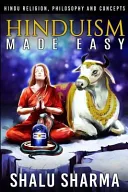
Hinduism Made Easy
 73
73

Hinduism Made Easy
Shalu Sharma's "Hinduism Made Easy" attempts to bridge the gap between the uninitiated and the vast philosophical landscape of Hinduism. Its strength lies in its direct approach, tackling the "Aum" chant and the concept of dharma with a clarity that avoids overly academic jargon. The author successfully highlights the 4000-year historical arc, which is essential for contextualizing the religion's enduring practices. However, the book occasionally oversimplifies complex theological debates, potentially leaving advanced students wanting more depth. For instance, the explanation of karma, while clear, doesn't fully explore its nuanced interpretations across different Hindu schools. Sharma's effort to demystify the religion is commendable, but the "easy" approach sometimes sacrifices subtlety. It serves as a competent, if basic, introduction.
📝 Description
73
Shalu Sharma's Hinduism Made Easy explains core Hindu doctrines for the curious.
This book aims to clarify fundamental Hindu beliefs and practices for those unfamiliar with the tradition. It addresses common misunderstandings about Hinduism's history and its rituals. The author breaks down core tenets like dharma, karma, and reincarnation in a straightforward manner. It also discusses the significance of concepts such as the chant 'Aum' and the roles of various deities. The text provides context for daily practices and their connection to a broader spiritual framework. It is written for individuals new to Hinduism who want a clear introduction to its philosophical basis.
The volume is intended for anyone interested in the world's oldest active religion but intimidated by its apparent complexity. It is especially helpful for those who have encountered specific practices, like mantra repetition, and seek to grasp their meaning. The book serves as a primer for laypeople, students of religion, and anyone looking to correct misconceptions about Hindu philosophy.
While presented as an accessible guide, "Hinduism Made Easy" touches upon concepts often found within esoteric traditions. The discussion of dharma and karma, for example, relates to systems of cosmic law and consequence that transcend simple religious observance. The explanation of deities and the vibrational significance of chants like 'Aum' can be seen as an entry into understanding subtle energies and consciousness. The book acknowledges the long historical development of these ideas, suggesting a continuity of spiritual knowledge that informs various mystical paths.
💡 Why Read This Book?
• Gain a foundational understanding of Hindu concepts like dharma and karma, appreciating their significance within the religion's 4000-year history, as explained in the "Historical Context" section. • Demystify common practices such as mantra repetition, understanding the "Aum" chant's role and its place within Hindu tradition, as detailed in the "Key Concepts" section. • Dispel prevalent misconceptions about Hinduism by learning about its fundamental beliefs and philosophical underpinnings directly from an accessible source, as presented in the "What It Is" section.
⭐ Reader Reviews
Honest opinions from readers who have explored this book.
❓ Frequently Asked Questions
What historical period does Hinduism Made Easy cover?
The book acknowledges Hinduism's extensive history, tracing its roots back approximately 4000 years. It emphasizes understanding this long trajectory to appreciate the evolution of its practices and beliefs.
What are some key concepts explained in Hinduism Made Easy?
The book aims to explain fundamental Hindu doctrines such as dharma, karma, reincarnation, and the role of various deities, providing a basic framework for understanding the religion.
Who is the intended audience for Hinduism Made Easy?
This book is designed for laypeople and beginners curious about Hinduism, aiming to clarify common misconceptions and provide an accessible introduction to its core tenets and practices.
Does Hinduism Made Easy explain specific practices like chanting?
Yes, the book addresses practices like the repetition of "Aum" (Om), seeking to explain their significance and context within Hindu traditions for those unfamiliar with them.
What is the primary goal of Hinduism Made Easy?
The primary goal is to offer a clear and easy-to-understand introduction to the fundamental concepts and beliefs of Hinduism, dispelling myths and providing a solid base of knowledge.
When was Hinduism Made Easy first published?
The book "Hinduism Made Easy" by Shalu Sharma was first published on April 20, 2015, making it a relatively contemporary guide to ancient traditions.
🔮 Key Themes & Symbolism
Foundational Beliefs
This volume meticulously unpacks the bedrock principles of Hinduism, moving beyond superficial interpretations. It elaborates on concepts such as dharma, the ethical and cosmic order guiding life, and karma, the law of cause and effect shaping destinies. The book also addresses the cyclical nature of existence through reincarnation, offering clarity on these integral doctrines. The aim is to provide readers with a solid grasp of what constitutes the essential framework of Hindu spiritual thought, clarifying its philosophical depth for a broader audience.
Spiritual Practices
The book looks at the 'why' behind Hindu spiritual practices, particularly focusing on elements often perceived as enigmatic by outsiders. It offers explanations for the significance of chanting, using the sacred syllable "Aum" (Om) as a prime example. Readers are guided to understand that these repetitions are not mere sounds but carry profound meditative and vibrational meaning within the tradition. This section aims to illuminate the practical application of Hindu philosophy in daily life and ritual.
Historical Depth
Recognizing Hinduism as the world's oldest extant religion, this work emphasizes the importance of its extensive historical lineage. The book frames the 4000-year span of its development not just as a timeline, but as a crucial element for understanding the evolution and persistence of its complex philosophical and theological structures. This historical perspective is presented as vital for appreciating the continuity and adaptation of Hindu traditions through millennia.
Dispelling Misconceptions
A core objective of "Hinduism Made Easy" is to address and rectify common misunderstandings surrounding Hindu beliefs and practices. The author directly confronts popular myths and superficial interpretations that often obscure the religion's true nature. By providing clear, factual explanations of core tenets and rituals, the book seeks to foster a more accurate and appreciative understanding among those who may hold inaccurate preconceived notions about this ancient tradition.
💬 Memorable Quotes
Direct passages from the work, attributed to the author.
“Understanding Hinduism requires appreciating its 4000-year history.”
— This statement underscores the book's thesis that context is crucial. It implies that Hindu concepts, rituals, and philosophies cannot be fully grasped in isolation but must be viewed through the lens of their extensive historical development and continuity.
“Many laypeople have misconceptions about Hindu concepts.”
— This observation sets the stage for the book's purpose: to clarify these misunderstandings. It acknowledges a gap in common knowledge and positions the text as a corrective and educational resource for those seeking accurate information.
“This book is for those who want to learn Hindu concepts.”
— This straightforward statement defines the book's target audience and primary function. It positions the volume as a direct and accessible learning tool for newcomers interested in the foundational elements of Hinduism.
💡 Key Ideas
Editorial paraphrase of the work's core concepts — not direct quotes.
The repetition of 'Aum' is not arbitrary; it connects to ancient sonic traditions.
This paraphrased concept highlights the deliberate and profound nature of mantra chanting in Hinduism. It suggests that practices like repeating 'Aum' are rooted in deep historical and spiritual traditions, intended to evoke specific states of consciousness or connect with universal energies.
The religion's fundamentals are key to appreciating its traditions.
This paraphrased idea emphasizes a hierarchical approach to learning about Hinduism. It suggests that grasping the core principles is a prerequisite for understanding and valuing the diverse practices and rituals that stem from them.
🌙 Esoteric Significance
Tradition
While not explicitly aligning with a specific Western esoteric lineage like Hermeticism or Kabbalah, "Hinduism Made Easy" serves as an introductory gateway to concepts often explored within esoteric traditions. It touches upon cyclical time, karma, and the subtle energies suggested by mantra, themes that resonate with various mystical paths. Its departure lies in its direct engagement with a living, global religious tradition rather than a reconstructed or syncretic esoteric system. It provides the foundational cosmology and philosophy that many esoteric practitioners draw upon.
Symbolism
The book likely explores the symbolism of key Hindu deities, such as Vishnu (the preserver) or Shiva (the destroyer/transformer), representing fundamental cosmic forces. The sacred syllable "Aum" (Om) is a prime example, symbolizing the primordial sound of creation and the totality of consciousness. Understanding these symbols moves beyond literal interpretation to grasp their archetypal significance within the Hindu worldview, offering insights into universal principles of existence and manifestation.
Modern Relevance
Contemporary spiritual seekers and practitioners of yoga often engage with Hindu philosophy through accessible texts like this. Thinkers and communities exploring mindfulness, meditation, and non-dual philosophies find resonance with the concepts of karma, dharma, and consciousness presented. The book's emphasis on clarifying practices like chanting and meditation makes its teachings relevant to modern wellness and self-improvement movements that increasingly incorporate elements of Eastern spirituality.
👥 Who Should Read This Book
• Beginning students of comparative religion seeking a clear, foundational text on one of the world's oldest faiths. • Individuals curious about Hindu practices like mantra chanting or meditation who want to understand their underlying philosophy. • Travelers or expatriates planning to visit India or engage with Hindu communities and wish to approach the culture with informed respect.
📜 Historical Context
Published in 2015, Shalu Sharma's "Hinduism Made Easy" entered a field of religious studies where accessible introductions to Hinduism were abundant, yet often polarized between simplistic overviews and dense academic tomes. The early 21st century saw a continued interest in Eastern religions, fueled partly by the New Age movement and a growing global interconnectedness. Unlike scholars engaging directly with the Advaita Vedanta philosophy, Sharma aims for a broader, non-specialist audience. The book's publication occurred in an era where online resources offered competing, sometimes unverified, information about world religions, making a curated, foundational text like this potentially valuable for dispelling common myths and providing a structured entry point into Hindu thought.
📔 Journal Prompts
The concept of dharma as an ethical and cosmic order.
The significance of the "Aum" chant in Hindu meditative traditions.
The 4000-year historical arc of Hinduism.
The relationship between karma and reincarnation.
Hindu deities as representations of cosmic forces.
🗂️ Glossary
Aum (Om)
The sacred syllable in Hinduism, considered the primordial sound of creation. It represents the totality of consciousness and is often chanted during meditation and prayer.
Dharma
A many-sided concept encompassing duty, righteousness, law, and cosmic order. It guides individuals on how to live ethically and in accordance with universal principles.
Karma
The law of cause and effect, where actions (karma) in this life and past lives influence one's present circumstances and future rebirths.
Reincarnation (Samsara)
The cyclical process of birth, death, and rebirth, driven by karma and the soul's journey towards liberation (moksha).
Deities (Devas/Devis)
Divine beings worshipped in Hinduism, often representing various aspects of the Supreme Being or cosmic powers. Examples include Brahma, Vishnu, and Shiva.
Mantra
A sacred utterance, sound, syllable, or phrase, typically chanted repetitively, used in meditation and ritual to invoke spiritual power or focus the mind.
Misconceptions
Common misunderstandings or inaccurate beliefs about Hinduism, which this book aims to clarify for a general audience.