Lake Singh
The Lake Palace, a former royal summer retreat in Udaipur, India, is now a luxury hotel with a rich history.
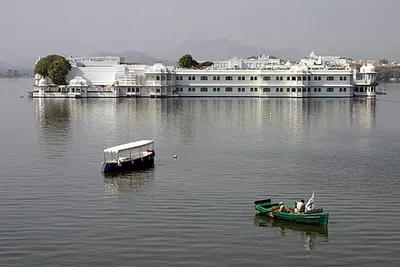
The Lake Palace, originally known as Jag Niwas, is a historic structure located on an island in Lake Pichola, Udaipur, India. Constructed around 1743-1746 by Maharana Jagat Singh II, it served as a private summer sanctuary for the Mewar royal family. The palace's design, featuring white marble and intended to appear as if floating, was meant to offer a more secluded setting for royal gatherings and leisure than the main city palace.
Over centuries, the palace witnessed periods of both grandeur and neglect. During the 1857 Sepoy Mutiny, it provided refuge for European families. Later, in the mid-20th century, it faced decay until Maharana Bhagwat Singh decided to convert it into a luxury hotel to ensure its preservation. Today, managed by IHCL and having undergone restorations, it has gained international recognition, appearing in films and hosting notable guests. The hotel's staff includes descendants of the original palace retainers.
Historical Significance and Royal Retreat
The Lake Palace, initially named Jag Niwas, was built between 1743 and 1746 by Maharana Jagat Singh II of the Mewar dynasty. Situated on the Jag Niwas island within Lake Pichola, its construction aimed to provide the royal family with a secluded summer retreat. The palace was designed to appear as if it were floating on the water, a stark contrast to the more public City Palace. Its architecture, utilizing white and black marble adorned with semi-precious stones, featured courtyards with columns, fountains, and gardens. The palace's east-facing orientation allowed inhabitants to greet the sunrise, honoring Surya, the Hindu sun god. Successive rulers continued to use Jag Niwas as a summer resort, hosting royal assemblies in its ornate courtyards.
Periods of Refuge and Decline
During the Indian Sepoy Mutiny in 1857, the island palace served as a sanctuary for European families fleeing from Nimach, with Maharana Swaroop Singh taking measures to protect his guests by destroying local boats. However, by the late 19th century, the palace began to suffer from the effects of time and the lake's moisture. Writers like Pierre Loti noted its gradual deterioration, while others, such as Fanny Bullock Workman, critiqued the interiors for their perceived 'cheap and tasteless' mix of European furnishings, which seemed out of place amidst the expected Eastern splendor. The palace continued to decay through the mid-20th century, with Geoffrey Kendal describing it as deserted and filled with mosquitoes during a 1950s visit.
Transformation into a Luxury Hotel
In the latter half of the 20th century, Maharana Bhagwat Singh made the pivotal decision to convert Jag Niwas Palace into Udaipur's first luxury hotel. This initiative was driven by the need for financial resources to maintain the deteriorating structures. American artist Didi Contractor served as a design consultant for the project, describing the experience as working in a Renaissance-like court environment. The conversion was seen as a job of conservation, aiming to preserve the palace's heritage. Later, in 1971, Taj Hotels Resorts and Palaces took over management, expanding the hotel and undertaking further restoration efforts in 2000. The hotel continues to maintain connections to its past, with its "Royal Butlers" being descendants of the original palace retainers.
Notable Quotes
“slowly moldering in the damp emanations of the lake.”
“cheap and tasteless style”
“an assortment of infirm European furniture, wooden clocks, coloured glass ornaments, and children's toys, all of which seems to the visitor quite out of place, where he would naturally expect a dignified display of Eastern splendor.”
“totally deserted, the stillness broken only by the humming of clouds of mosquitoes.”
“I worked from 1961 to 1969 and what an adventure! His Highness, you know, was a real monarch – really like kings always were. So one had a sense of being one of the last people to be an artist for the king. It felt the way one imagines it was like working in the courts of the Renaissance. It was an experience of going back in time to an entirely different era, a different world.”
Books by Lake Singh
2 free public domain books · Read online or download