The flood from heaven
 71
71

The flood from heaven
Eberhard Zangger’s 'The Flood from Heaven' presents a compelling, albeit speculative, argument for a prehistoric meteor impact shaping human civilization. The strength of the book lies in its meticulous assembly of geological and mythological evidence, particularly its detailed examination of the Younger Dryas period. Zangger effectively highlights the coincidences between geological records of sudden climatic shifts and widespread flood myths. However, the work’s primary limitation is its reliance on a single, unproven hypothesis to explain a vast array of complex phenomena. While the chapter discussing the potential implications for ancient Egyptian dynasties offers a particularly intriguing line of reasoning, it ultimately rests on a foundation of circumstantial evidence. Zangger’s contribution is significant for pushing the boundaries of accepted historical narratives, even if definitive proof remains elusive. It's a challenging read that encourages skepticism towards established timelines.
📝 Description
71
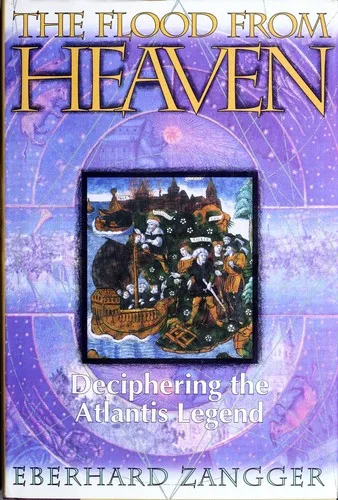
Eberhard Zangger's 1992 book, 'The Flood from Heaven,' argues a meteor impact caused a cataclysm around 12,800 years ago.
First published in 1992, Eberhard Zangger's 'The Flood from Heaven' investigates a controversial theory about civilization's beginnings. Zangger proposes that a major cataclysm, possibly a meteor strike, occurred roughly 12,800 years ago. This event, he suggests, profoundly affected early human societies and might have introduced advanced knowledge or technologies. The book enters a dialogue with mainstream archaeology by positing external, sudden forces, rather than gradual cultural shifts, as catalysts for societal change.
This work is for readers interested in alternative historical accounts, archaeomythology, and the scientific study of ancient disasters. It appeals to those who question standard archaeological timelines and seek explanations for global events in prehistory that could have reshaped human development. Zangger's hypothesis connects to theories surrounding the Younger Dryas period, a notable cooling event, suggesting a cosmic impact as its likely trigger. He examines how such an event might have influenced early settlements, the spread of knowledge, and potentially gave rise to global flood narratives found in ancient myths.
Zangger's work fits within esoteric traditions that look beyond conventional historical and archaeological explanations for humanity's past. It engages with ideas that ancient myths, often dismissed as allegory, may contain literal memories of catastrophic events. By proposing a cosmic impact as a catalyst for societal change and the transmission of knowledge, it aligns with interpretations of ancient texts and oral traditions as records of a forgotten, more dramatic past, often involving celestial phenomena.
⭐ Reader Reviews
Honest opinions from readers who have explored this book.
❓ Frequently Asked Questions
What is the central hypothesis of 'The Flood from Heaven'?
The book proposes that a major meteor impact event occurred around 12,800 years ago, coinciding with the Younger Dryas cooling period, and significantly impacted early human civilization and its development.
When was 'The Flood from Heaven' first published?
Eberhard Zangger's 'The Flood from Heaven' was first published in 1992.
What evidence does Zangger use to support his theory?
Zangger draws on geological evidence suggesting a cataclysmic event during the Younger Dryas, alongside comparative mythology, particularly flood myths and ancient legends from various cultures.
Does the book suggest the impact event created advanced technology?
While not explicitly stating the creation of advanced technology, the work explores the possibility that such a cataclysm could have either destroyed advanced prior civilizations or seeded new knowledge among survivors.
Is Zangger's hypothesis widely accepted in archaeology?
Zangger's hypothesis is considered a fringe theory within mainstream archaeology and geology, though it has spurred further research into Younger Dryas impact events and their potential consequences.
What is the significance of the Younger Dryas period in the book?
The Younger Dryas is crucial as it represents a period of rapid and severe climate change for which Zangger proposes a cosmic impact as the primary cause, linking it to the 'flood from heaven'.
🔮 Key Themes & Symbolism
Prehistoric Cataclysm Theory
The central theme revolves around the hypothesis of a significant cosmic impact event occurring around 12,800 years ago, during the Younger Dryas period. Zangger posits this event as a direct cause of widespread destruction and a catalyst for radical societal shifts among early human populations. The work meticulously compiles geological indicators of sudden, violent environmental changes and attempts to correlate these with the pervasive motif of global floods found in ancient myths across disparate cultures.
Mythology as Historical Record
Zangger treats ancient myths, particularly flood narratives, not merely as allegorical tales but as potential distorted memories of real cataclysmic events. The book explores how widespread stories of destruction by water could be elements of a shared, devastating experience that impacted global human populations. This approach challenges conventional interpretations of mythology, suggesting a layer of historical data embedded within these ancient accounts.
Younger Dryas Impact Hypothesis
A core focus is the Younger Dryas, a period of abrupt climate cooling. Zangger's work supports the idea that this cooling was not solely a natural climatic fluctuation but was triggered or exacerbated by a celestial impact. The book investigates the potential consequences of such an impact, including environmental devastation, the collapse of existing societies, and the subsequent rebuilding of civilization under drastically altered conditions.
Civilization's Genesis
The book speculates on how a catastrophic event might have influenced the very genesis or restructuring of early civilizations. It considers whether such an event could have wiped out advanced prehistoric cultures, leaving behind fragmented knowledge, or conversely, spurred the survivors to develop new societal structures and technologies in response to the crisis.
💬 Memorable Quotes
Direct passages from the work, attributed to the author.
“The memory of a global catastrophe could have been preserved in myths.”
— This interpretation highlights Zangger's central argument that widespread flood myths are not symbolic but actual recollections of a devastating, planet-wide event.
“Ancient peoples' accounts of floods might be historical records.”
— This concept underscores Zangger's approach of viewing mythological narratives as potential, albeit distorted, eyewitness testimonies to real historical events.
“The impact theory recontextualizes the beginning of civilization.”
— This interpretation suggests that Zangger's hypothesis offers a radical alternative to traditional understandings of how and when human civilization truly began or was reshaped.
💡 Key Ideas
Editorial paraphrase of the work's core concepts — not direct quotes.
The Younger Dryas cooling was too abrupt to be purely natural.
This paraphrase suggests Zangger's view that the rapid climate shift of the Younger Dryas points to an external, violent trigger, such as a cosmic impact, rather than gradual climatic processes.
A celestial impact could explain widespread myths of destruction.
This paraphrase captures the book's core thesis: that a single, dramatic extraterrestrial event could account for the common themes of destruction found in diverse ancient legends.
🌙 Esoteric Significance
Tradition
While not strictly adhering to a single esoteric lineage, 'The Flood from Heaven' speaks to traditions that emphasize cyclical cosmic events and hidden histories, such as certain interpretations within Theosophy or ancient astronaut theories. It departs from purely spiritual or philosophical occultism by grounding its speculative claims in geological and archaeological interpretations, seeking a material basis for ancient myths often treated allegorically.
Symbolism
The primary symbol is the 'flood from heaven,' representing a catastrophic deluge caused by a celestial event, which serves as a powerful archetype for destruction and rebirth. Another motif is the 'end of an age,' signifying the potential destruction of a prior advanced civilization and the dawn of a new, perhaps less sophisticated, era for humanity following the cataclysm.
Modern Relevance
Zangger's work continues to be cited by researchers exploring the Younger Dryas impact hypothesis and its potential ramifications for human history. It influences contemporary discussions in archaeomythology and the study of extreme prehistoric events, particularly among those who question conventional timelines and seek to integrate scientific data with ancient narratives.
👥 Who Should Read This Book
['• Students of comparative mythology seeking potential historical underpinnings for flood legends and other ancient cataclysmic narratives.', '• Researchers interested in alternative theories of human history and the impact of geological events on early civilizations, particularly the Younger Dryas period.', "• Readers intrigued by the intersection of science, history, and myth who are open to exploring speculative hypotheses about Earth's past."]
📜 Historical Context
Eberhard Zangger's 'The Flood from Heaven' emerged in 1992, a period marked by burgeoning interest in geological evidence for prehistoric cataclysms. It entered a discourse alongside theories like those proposed by Immanuel Velikovsky in 'Worlds in Collision' (1950), which had similarly challenged established scientific and historical timelines by invoking ancient celestial events. While Velikovsky faced significant backlash from the scientific establishment, Zangger's work focused more narrowly on the Younger Dryas period and potential meteor impacts. The book's publication coincided with growing research into climate reconstructions and paleoclimatology, providing a backdrop for discussions about rapid environmental shifts. Although not a mainstream archaeological text, it contributed to speculative historical research and inspired further investigation into the possibility of extraterrestrial influences on early human development, engaging with ideas that were gaining traction in alternative history circles.
📔 Journal Prompts
The concept of the 'flood from heaven' as a shared memory.
Correlations between geological evidence and ancient flood myths.
The Younger Dryas period as a potential turning point for civilization.
Reinterpreting ancient legends through the lens of cosmic events.
The potential impact of a cataclysm on early human knowledge transmission.
🗂️ Glossary
Younger Dryas
A period of significant, rapid cooling that occurred approximately 12,900 to 11,700 years ago, representing a temporary reversal of the warming trend at the end of the last glacial period.
Cataclysm
A violent natural event, such as a meteor impact or massive flood, that causes great destruction and upheaval.
Archaeomythology
The study that attempts to find historical or scientific truth within ancient myths and legends, often linking them to archaeological findings or natural events.
Cosmic Impact
The collision of a celestial body, such as an asteroid or comet, with a planet or moon.
Flood Myth
A narrative in many cultures and religions that describes a great flood, sent by a divine entity or caused by natural forces, that destroys a world or civilization.
Prehistoric Civilization
Societies and cultures that existed before the advent of written records, often characterized by early forms of agriculture, settlement, and social organization.
Geological Evidence
Physical traces found in rock strata, landforms, and other geological features that provide information about past events and conditions on Earth.
🔮 Readers Also Liked
Browse all →









More by Eberhard Zangger
All books →
More Free Occult Philosophy Books
View all →