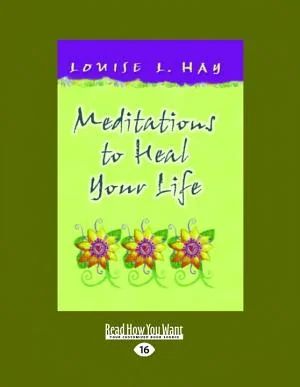
Meditations to Heal Your Life
 77
77

Meditations to Heal Your Life
Louise L. Hay's "Meditations to Heal Your Life" presents a series of accessible prompts and affirmations that, while familiar to followers of her work, still possess an enduring appeal. The strength lies in its directness; Hay doesn't shy away from the idea that our thoughts are potent creators of our reality. The book effectively encourages a critical examination of one's internal dialogue. However, for seasoned practitioners of New Thought or similar disciplines, the concepts might feel somewhat recapitulative of her earlier, more foundational texts like "You Can Heal Your Life" (1984). A limitation is the potential for affirmations to feel generic without deeper personal exploration, though the book aims to spark this very process. The insistence on the mind-body connection, a hallmark of Hay's philosophy, remains a powerful throughline. Ultimately, it serves as a solid, if not entirely novel, companion for personal affirmation and self-inquiry.
📝 Description
77
First published in 2010, Louise L. Hay's Meditations to Heal Your Life presents exercises for personal creative thinking.
This book collects ideas intended to spark creative thought and offer new ways of seeing life experiences. Hay structures the text to encourage self-reflection. Readers can engage with concepts designed to question their current beliefs, a process she called 'stirring up the pot.' It does not offer strict rules but suggests different ways to approach personal difficulties. The work is for people interested in self-improvement and understanding their own thinking. It suits those open to psychological and spiritual ideas that may differ from their existing views. Readers who appreciate guided exercises and affirmative statements for personal growth will find it useful, especially if they face personal obstacles or want to change negative thought patterns.
Published in 2010, Meditations to Heal Your Life appeared as self-help and New Thought movements were popular. Louise L. Hay was a notable figure in this sphere, known for affirmative prayer and her distinct philosophy. Her earlier book, "You Can Heal Your Life" (1984), had already positioned her as a significant voice in positive affirmations and the mind-body link, impacting many and contributing to the New Age spiritual conversation. This 2010 publication drew on that established interest.
💡 Why Read This Book?
• Gain practical techniques for self-affirmation, directly from Louise L. Hay's established methods, to reframe negative thought patterns and cultivate self-love. • Understand the core principles of the mind-body connection as explored in Hay's work, offering a new lens through which to view personal challenges and well-being. • Engage with a structured approach to personal growth inspired by the New Thought movement, providing specific exercises to foster creative thinking and new perspectives on life experiences.
⭐ Reader Reviews
Honest opinions from readers who have explored this book.
❓ Frequently Asked Questions
What is the primary goal of "Meditations to Heal Your Life"?
The book aims to stimulate creative thinking and encourage readers to explore new approaches to their life experiences through guided meditations and affirmations, fostering self-acceptance and personal transformation.
When was "Meditations to Heal Your Life" first published?
"Meditations to Heal Your Life" by Louise L. Hay was first published in 2010.
How does this book differ from "You Can Heal Your Life"?
While both books by Louise L. Hay focus on affirmations and self-healing, "Meditations to Heal Your Life" (2010) is structured around specific meditative exercises and prompts, whereas "You Can Heal Your Life" (1984) provides a broader philosophical framework.
Can "Meditations to Heal Your Life" help with specific problems?
Yes, the book's affirmations and exercises are designed to address various personal challenges by helping readers reframe negative beliefs and cultivate a more positive mindset, supporting emotional and mental well-being.
Is "Meditations to Heal Your Life" suitable for beginners?
Absolutely. The book's approach is designed to be accessible, guiding readers through self-discovery and offering simple yet powerful tools for personal growth, making it ideal for those new to self-help or affirmation practices.
What is Louise L. Hay's core philosophy presented in this book?
Hay's core philosophy, as presented in "Meditations to Heal Your Life," centers on the belief that our thoughts create our reality and that by embracing self-love and positive affirmations, we can heal ourselves.
🔮 Key Themes & Symbolism
Power of Affirmations
The book strongly emphasizes the transformative potential of positive affirmations. Hay posits that consistently repeating beneficial statements can reprogram the subconscious mind, directly influencing one's thoughts, emotions, and circumstances. This theme is central to her approach, suggesting that by consciously choosing our words and beliefs, we actively participate in creating our reality and overcoming mental obstacles.
Self-Love and Acceptance
A central to Hay's philosophy is the radical importance of self-love. "Meditations to Heal Your Life" guides readers toward cultivating a deeply accepting and compassionate relationship with themselves. It suggests that external healing and happiness are contingent upon internal acceptance, encouraging readers to release self-criticism and embrace their inherent worth.
Mind-Body Connection
This work explores the intricate link between mental states and physical health. Hay asserts that emotional distress and negative thought patterns can manifest as physical ailments. By addressing and healing these internal conflicts through meditation and affirmations, the book suggests that one can positively impact their physical well-being and vitality.
Creative Thinking and Reframing
The book serves as a catalyst for creative thinking, encouraging readers to approach their experiences from novel angles. It provides a framework for 'stirring up the pot' – challenging established beliefs to foster new perspectives. This process is presented as essential for breaking free from limiting patterns and unlocking personal potential.
💬 Memorable Quotes
Direct passages from the work, attributed to the author.
“It will give you an opportunity to see other ways to approach your experiences.”
— This statement emphasizes the book's function as a tool for expanding perspective. It's not about providing definitive answers but about opening up new avenues of thought and action, empowering the reader to find alternative solutions and coping mechanisms.
“This is a book of ideas to spark your own creative thinking process.”
— This framing positions the book as a generative resource. It's designed to ignite the reader's own imagination and problem-solving abilities, rather than acting as a passive source of information. The focus is on empowering the reader's internal creative capacity.
“She says, 'You... can heal your life.'”
— This expresses the core message of empowerment and agency. It's a direct assertion of the reader's inherent ability to effect positive change in their own life through conscious effort and belief in their own healing capacity.
“This is all right. Its what Louise calls stirring up the pot.”
— This refers to the intentional process of challenging existing beliefs. Hay suggests that encountering ideas that conflict with one's own is not a problem, but a valuable part of the self-discovery and healing journey, prompting deeper introspection.
💡 Key Ideas
Editorial paraphrase of the work's core concepts — not direct quotes.
As you read this book, you may find statements that you don't agree with; they may clash with your own belief systems. That's all right.
This quote highlights Hay's intention to provoke thought rather than dictate belief. It encourages readers to engage critically with the material, viewing disagreement as an opportunity for self-discovery and a catalyst for personal growth, rather than an obstacle.
🌙 Esoteric Significance
Tradition
Hay's work draws heavily from the New Thought movement, a 19th-century American philosophical and spiritual movement that posits the power of thought to create reality. While not strictly Hermetic in the classical sense, it shares common ground with Hermeticism's "As Above, So Below" principle, emphasizing the correspondence between the inner world and outer manifestation. It aligns with metaphysical traditions that focus on mind over matter and the inherent divinity within each individual.
Symbolism
While "Meditations to Heal Your Life" is more focused on direct affirmation than complex symbolism, the concept of 'stirring up the pot' can be seen as a metaphor for alchemical transformation – breaking down old forms to create new ones. The act of affirmation itself functions symbolically, representing the potent seed of intention planted in the mind, which is believed to grow and manifest in the physical world, akin to a magical working.
Modern Relevance
Hay's emphasis on affirmations and the mind-body connection continues to resonate strongly in contemporary wellness culture. Her ideas inform modern therapeutic practices like Cognitive Behavioral Therapy (CBT) and mindfulness-based stress reduction. Thinkers and practitioners in the fields of positive psychology, spiritual coaching, and self-help literature frequently cite or echo Hay's core tenets regarding personal responsibility for one's thoughts and well-being.
👥 Who Should Read This Book
• Individuals new to self-help and affirmation practices seeking accessible tools for personal growth and emotional well-being. • Long-time practitioners of New Thought or spiritual psychology looking for structured meditative exercises to deepen their existing practice. • Anyone experiencing a period of personal challenge or seeking to reframe negative thought patterns and cultivate greater self-acceptance and inner peace.
📜 Historical Context
Published in 2010, "Meditations to Heal Your Life" arrived in an era where the self-help industry was deeply entrenched, building on the foundations laid by figures like Norman Vincent Peale and, more directly, Louise L. Hay's own important work, "You Can Heal Your Life" (1984). Hay's philosophy, deeply rooted in New Thought principles, positioned her as a contemporary to authors like Marianne Williamson, who also championed spiritual growth and affirmative prayer. Unlike the more academic or psychological approaches to well-being prevalent in some circles, Hay's work emphasized a direct, personal engagement with the power of thought and belief. The reception of Hay's work, while broadly positive and commercially successful, sometimes faced critiques from more secular or traditional psychological perspectives that questioned the scientific basis of her claims about the direct link between specific thoughts and physical ailments.
📔 Journal Prompts
Meditations on releasing the belief that 'I am not good enough'.
Reflecting on how the concept of 'stirring up the pot' applies to your current life.
Affirmations for embracing self-love, inspired by Louise L. Hay's philosophy.
Exploring new ways to approach a recurring life challenge.
Identifying and transforming negative thought patterns through conscious intention.
🗂️ Glossary
Affirmation
A positive statement deliberately repeated to reinforce a desired belief or outcome. In Hay's work, affirmations are used to reprogram the subconscious mind and manifest positive changes.
Mind-Body Connection
The principle that mental and emotional states (mind) can influence physiological function and the development of diseases (body), and vice versa. Hay emphasizes healing the mind to heal the body.
Stirring up the pot
A metaphor used by Louise L. Hay to describe the process of challenging one's own beliefs and assumptions. It encourages embracing new ideas, even if they initially conflict with existing views, as a path to growth.
New Thought
A spiritual movement emphasizing the power of thought to create reality and the inherent divinity within individuals. It focuses on positive thinking, affirmations, and the mind-body connection.
Self-Love
A state of appreciation for oneself that grows from actions that support our physical, psychological, and spiritual growth. Hay considers it foundational for healing and happiness.
Creative Thinking Process
The ability to perceive the world in new ways, to find hidden patterns, to make connections between seemingly unrelated phenomena, and to generate solutions. Hay's book aims to stimulate this.
Belief Systems
The collection of beliefs or principles held by an individual or group. Hay suggests that examining and challenging these systems is crucial for personal transformation.
This book appears in 1 collection
🔮 Readers Also Liked
Browse all →







From the “Affirmations” Collection
View all →







More Free Occult Philosophy Books
View all →