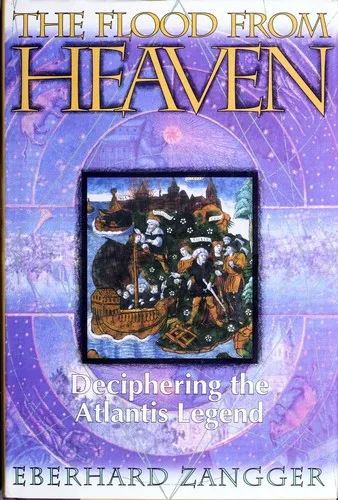
The flood from heaven
 75
75

The flood from heaven
Eberhard Zangger’s The Flood from Heaven is less a gentle exploration and more a direct confrontation with accepted archaeological narratives. Zangger posits a singular, world-altering cataclysm – a 'heavenly flood' – as the genesis of numerous global flood myths and the catalyst for societal collapse and rebirth. The strength of the book lies in its bold synthesis, connecting disparate legends and geological evidence into a compelling, albeit controversial, chronological hypothesis. However, its primary limitation is the inherent difficulty in empirically verifying such sweeping claims; it operates on the fringes of established scientific and historical consensus.
The section discussing the potential astronomical alignments and their terrestrial impact, particularly concerning what Zangger proposes as a pre-Diluvian epoch, is where the work feels most potent. While some may dismiss it as speculative, the sheer audacity of Zangger’s attempt to unify global mythologies under a single catastrophic event is noteworthy.
Read more ↓
Ultimately, The Flood from Heaven serves as a potent challenge to orthodoxy, demanding a re-examination of ancient testimonies and geological records.
📝 Description
75
Eberhard Zangger proposed in 1992 that ancient flood myths stem from a single, catastrophic 'heavenly flood'.
Published in 1992, Eberhard Zangger's The Flood from Heaven re-examines Near Eastern history and mythology through the lens of a massive ancient cataclysm. Zangger argues against standard historical timelines, suggesting a unified theory that links various flood narratives and unexplained archaeological findings. He posits a singular, devastating event of astronomical origin that reshaped early human civilizations. This work proposes that a sophisticated pre-Diluvian civilization was nearly annihilated by this event, leaving behind scattered remnants of its existence. Zangger's thesis connects widespread deluge myths to this specific historical occurrence. The book also considers the terrestrial consequences of potential astronomical causes for this cataclysm.
The author's work is aimed at students of ancient history, mythology, and esoteric thought who question established chronologies. It will resonate with those looking for alternative explanations for the development and collapse of early human cultures. Readers interested in global flood stories, prehistoric disasters, and the possibility of lost advanced societies will find ample material for contemplation. Zangger's research engages with discussions about the Younger Dryas impact hypothesis and theories of global cataclysm, providing a historical interpretation for such phenomena. This approach contrasts with conventional archaeological dating methods.
The Flood from Heaven fits within esoteric traditions that seek to uncover suppressed or alternative histories of humanity, often positing lost golden ages or global cataclysms that fundamentally altered civilization. It engages with the idea that mainstream historical and archaeological accounts omit or misunderstand critical events. Zangger's work taps into a lineage of thought that connects mythological narratives, particularly deluge stories, to literal, world altering events, suggesting these myths are not allegorical but encoded memories of actual disasters. It aligns with the esoteric pursuit of hidden knowledge that challenges conventional paradigms about human origins and development.
💡 Why Read This Book?
• Gain a unique perspective on the origins of global flood myths, understanding Zangger’s theory that a singular 'heavenly flood' event, potentially linked to astronomical phenomena, is the root cause. • Challenge conventional timelines of ancient history by exploring Zangger's arguments for a pre-Diluvian epoch and its potential societal impact. • Examine the interplay between myth, geology, and astronomy as Zangger attempts to unify disparate ancient narratives into a coherent, catastrophic explanation.
⭐ Reader Reviews
Honest opinions from readers who have explored this book.
❓ Frequently Asked Questions
What is the central argument of Eberhard Zangger's The Flood from Heaven?
The book's central argument is that a singular, cataclysmic event – a 'heavenly flood' – is responsible for the widespread flood myths found across global cultures and dramatically reshaped early human civilization.
When was The Flood from Heaven first published?
The Flood from Heaven was first published in 1992, making it a product of late 20th-century speculative history and archaeology.
What kind of evidence does Zangger use to support his theory?
Zangger draws upon comparative mythology, interpretations of geological evidence, and potential astronomical alignments to construct his theory of a catastrophic past.
Does The Flood from Heaven align with mainstream historical consensus?
No, the book presents a highly speculative and alternative view that challenges established archaeological chronologies and interpretations of ancient history.
Who is Eberhard Zangger?
Eberhard Zangger is an author known for his work on alternative theories of ancient history, particularly focusing on catastrophic events and their impact on civilization.
What is the 'heavenly flood' concept in the book?
The 'heavenly flood' refers to Zangger's proposed singular, cataclysmic event, possibly of astronomical origin, that he believes is the source of global deluge traditions and ancient societal disruption.
🔮 Key Themes & Symbolism
Global Deluge Mythology
The book posits that the pervasive flood myths found in cultures worldwide are not mere allegories but fragmented memories of a single, catastrophic inundation event. Zangger seeks to unify these diverse narratives, suggesting a common source event that profoundly impacted early human societies. He argues that this 'heavenly flood' was responsible for the near-annihilation of pre-Diluvian civilizations, leaving behind echoes in folklore and legend that have persisted for millennia. The focus is on identifying common structural elements and potential historical underpinnings of these widespread stories.
Pre-Diluvian Civilizations
Central to Zangger's thesis is the idea of advanced civilizations existing before the great flood. The Flood from Heaven explores the possibility that these societies possessed knowledge and capabilities lost to subsequent eras. The catastrophic event, according to the author, led to a severe regression in human development, with only scattered remnants and distorted memories surviving. This concept challenges conventional evolutionary models of civilization, suggesting a cycle of advanced culture, cataclysm, and subsequent rebuilding.
Astronomical Cataclysm
Zangger investigates the potential astronomical origins of the 'heavenly flood.' This involves exploring theories of celestial impacts, cometary events, or other cosmic phenomena that could have triggered massive terrestrial devastation. The book examines how such an event might manifest, including widespread flooding, atmospheric changes, and geological upheaval. The scientific plausibility of astronomical triggers is weighed against the mythological accounts, seeking a correlation between cosmic events and ancient human experiences of destruction.
Chronological Revisionism
A significant aspect of The Flood from Heaven is its challenge to established historical chronologies. Zangger proposes a radical revision of timelines, suggesting that key events and civilizations occurred much earlier than mainstream archaeology accepts. By reinterpreting archaeological findings and textual evidence through the lens of a global cataclysm, he seeks to create a new framework for understanding ancient history. This approach questions the linearity of historical development and highlights the potential for major disruptions.
💬 Memorable Quotes
Direct passages from the work, attributed to the author.
“The flood from heaven is the source of all flood myths.”
— This statement expresses Zangger's core hypothesis: that the numerous flood narratives across different cultures are not independent inventions but rather distorted recollections of a single, monumental deluge event.
“Astronomical events shaped early human history.”
— This interpretation points to Zangger's exploration of cosmic phenomena as the potential trigger for the catastrophic 'heavenly flood,' linking celestial occurrences to terrestrial destruction and societal collapse.
“Mythology contains historical truth.”
— This statement underscores Zangger's approach to ancient stories, viewing them not as fiction but as valuable, albeit allegorical, records of actual historical occurrences, particularly devastating events.
💡 Key Ideas
Editorial paraphrase of the work's core concepts — not direct quotes.
A pre-Diluvian civilization must have existed.
This paraphrased concept highlights Zangger's belief in advanced societies predating the catastrophic flood, suggesting a level of development lost to history and only hinted at in ancient legends.
Conventional timelines underestimate ancient catastrophes.
This paraphrased concept reflects Zangger's critique of established historical and archaeological dating methods, arguing they fail to account for the magnitude of past cataclysmic events.
🌙 Esoteric Significance
Tradition
Zangger's work, while not strictly adhering to a single esoteric lineage, aligns with traditions that explore lost golden ages and cyclical destruction, particularly those influenced by 19th and 20th-century occultism and alternative history narratives. It echoes theosophical concepts of ancient root races and cataclysmic cycles, and Gnostic ideas of pre-cosmic or early cosmic catastrophes that impacted humanity's spiritual and physical state. The book offers a pseudo-historical framework for cataclysmic events often found in esoteric cosmologies.
Symbolism
The central symbol is the 'heavenly flood' itself, representing not just literal inundation but a cosmic judgment or reset event. Other symbolic motifs likely explored include celestial bodies (sun, moon, stars, comets) as agents of destruction or divine will, and the remnants of lost civilizations symbolizing humanity's fallen state or fragmented wisdom. The flood also symbolizes purification and the potential for rebirth from destruction, a common theme in cyclical esoteric thought.
Modern Relevance
Contemporary interest in ancient astronaut theories, global cataclysm scenarios (e.g., Young Dryas impact hypothesis), and the reinterpretation of ancient myths through a historical lens can be seen as drawing upon the kind of speculative framework Zangger employed. Thinkers and communities exploring alternative archaeology, pre-Diluvian history, and the potential for lost high-tech ancient civilizations often reference or echo the ideas presented in works like *The Flood from Heaven*.
👥 Who Should Read This Book
• Researchers of comparative mythology and global flood narratives, seeking a unifying, albeit controversial, historical hypothesis for these widespread stories. • Students of alternative history and archaeology who question established timelines and are interested in theories of ancient cataclysms and lost civilizations. • Esoteric practitioners and historians of occultism interested in how theories of past destruction and rebirth intersect with ancient wisdom traditions and cyclical cosmologies.
📜 Historical Context
Published in 1992, Eberhard Zangger's *The Flood from Heaven* arrived amidst a surge of interest in fringe archaeology and theories of ancient global catastrophes, partly fueled by works like Graham Hancock's *Fingerprints of the Gods* (1995), though Zangger’s research predates it. The book engaged with speculative prehistory and challenged the prevailing consensus in archaeology, which relied heavily on established chronologies based on stratigraphic evidence and radiocarbon dating. Zangger’s work proposed a singular, cataclysmic 'heavenly flood' as the source for widespread deluge myths, a concept that contrasted sharply with mainstream interpretations of myth as symbolic or localized events. While not widely adopted by academic institutions, his theories found an audience among those seeking alternative explanations for the origins and early development of human civilization, resonating with a growing skepticism towards official narratives.
📔 Journal Prompts
The concept of a 'heavenly flood' as the origin of global myths.
Evidence for pre-Diluvian civilizations.
Potential astronomical triggers for ancient cataclysms.
Reconciling Zangger's timeline with established history.
The symbolic meaning of deluge narratives.
🗂️ Glossary
Heavenly Flood
Eberhard Zangger's proposed singular, cataclysmic event, potentially of astronomical origin, which he believes is the source of global flood myths and a major historical disruption.
Pre-Diluvian Epoch
The hypothetical period of history proposed by Zangger that existed before the 'heavenly flood,' potentially characterized by advanced civilizations that were largely destroyed by the event.
Comparative Mythology
The study and comparison of myths from different cultures and historical periods to identify common themes, origins, and meanings, which Zangger uses to support his unified flood theory.
Astronomical Cataclysm
A disaster originating from celestial phenomena, such as asteroid impacts, cometary events, or solar flares, which Zangger suggests could be the cause of the 'heavenly flood.'
Chronological Revisionism
The practice of questioning and proposing alternative timelines for historical events, often challenging established dates and sequences, as undertaken by Zangger regarding ancient history.
Younger Dryas
A period of rapid, significant cooling that occurred approximately 12,900 to 11,700 years ago, which some researchers propose may have been triggered by a cosmic impact event.
Deluge Myth
A narrative recounting a great flood that destroys a vast amount of life on Earth, common across many ancient cultures and interpreted by Zangger as evidence of a shared catastrophic past.
🔮 Readers Also Liked
Browse all →









More by Eberhard Zangger
All books →
More Free Occult Philosophy Books
View all →