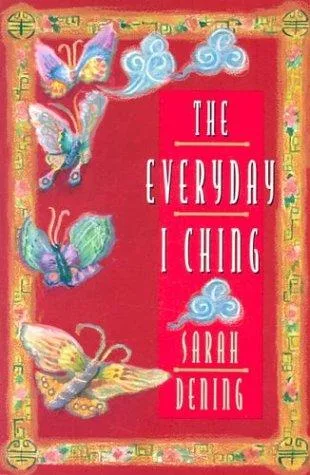
The everyday I ching
 62
62

The everyday I ching



Isolde Whitaker, Sacred Texts Editor: Sarah Dening's 'The Everyday I Ching' is a revelation, breathing new life into one of the world's most ancient and revered texts. Dening's approach is both scholarly and deeply intuitive, making the profound wisdom of the Yi Jing accessible without sacrificing its esoteric richness. She masterfully guides readers through the labyrinthine symbolism of the hexagrams, revealing their practical application in everyday life. This is not merely a translation or a guide; it is an invitation to a dialogue with the cosmos. For seekers of hidden knowledge and practitioners of ancient arts, this book offers a potent tool for self-discovery and intuitive discernment. Its clarity and depth make it a standout in the field.
📝 Description
62
Sarah Dening wrote 'The Everyday I Ching' to make the Yi Jing accessible for contemporary life.
Sarah Dening's 'The Everyday I Ching' presents the Yi Jing, the ancient Chinese oracle, as a practical tool for modern challenges. The book deciphers the meaning behind each of the 64 hexagrams, explaining their symbolic language and the philosophical concepts they represent. Dening focuses on how these ancient patterns relate to daily life, offering insights into personal growth and decision-making.
This approach moves beyond rote divination, encouraging readers to use the hexagrams as a mirror for self-reflection. The text details how the interplay of Yin and Yang, and the interconnectedness of events, can be understood through the Yi Jing's structure. It aims to provide a framework for grasping life's changes and finding clarity through this venerable system.
The Yi Jing, or Book of Changes, is a central text in Chinese cosmology and philosophy, dating back over 3,000 years. Its divinatory system uses hexagrams, formed from combinations of broken and unbroken lines, to interpret situations and predict outcomes. Within esoteric traditions, the Yi Jing is seen not just as a predictive tool, but as a map of cosmic principles and human experience, reflecting the dynamic balance of forces like Yin and Yang. Dening's work situates this ancient oracle within a contemporary context, making its complex symbolism understandable for those interested in its deeper spiritual and philosophical dimensions.
💡 Why Read This Book?
Unlock the secrets of ancient Chinese wisdom for modern challenges. 'The Everyday I Ching' offers a direct conduit to profound philosophical insights and practical divination. Ideal for seekers of self-knowledge, students of Eastern philosophies, and practitioners looking to deepen their intuitive understanding of life's patterns. Discover a timeless oracle designed for contemporary living, providing clarity and guidance.
⭐ Reader Reviews
Honest opinions from readers who have explored this book.
❓ Frequently Asked Questions
What is the I Ching?
The I Ching, or 'Book of Changes,' is an ancient Chinese divination text and philosophical classic, revered for its profound insights into the patterns of the universe and human experience. It uses hexagrams derived from combinations of six lines to offer guidance.
Is this book for beginners?
Yes, 'The Everyday I Ching' is expertly crafted to be accessible to newcomers while offering depth for experienced practitioners. Dening's clear explanations demystify the complex symbolism.
How can the I Ching be used in daily life?
The I Ching can be consulted for guidance on decisions, understanding challenging situations, personal growth, and gaining perspective. It offers wisdom rather than rigid predictions.
What is a hexagram?
A hexagram is a figure composed of six stacked horizontal lines, each line being either solid (Yang) or broken (Yin). The 64 hexagrams in the I Ching represent fundamental archetypes and situations.
What makes this translation unique?
Sarah Dening's translation emphasizes the living, practical application of the I Ching, connecting its ancient symbolism to contemporary psychological and spiritual needs, offering a more integrated understanding.
🔮 Key Themes & Symbolism
The Dance of Yin and Yang
At the core of the I Ching lies the fundamental principle of Yin and Yang, the complementary yet opposing forces that shape the cosmos and all existence. 'The Everyday I Ching' studies how these primal energies manifest in our lives, influencing relationships, decisions, and the very fabric of reality. Sarah Dening illuminates how understanding the interplay of these forces—the passive and active, the dark and light, the feminine and masculine—provides clear insights into cyclical change and the constant flux of the universe. This exploration is not merely academic but deeply practical, offering a lens through which to perceive and read through the inherent duality of experience.
Hexagrams as Archetypal Pathways
The 64 hexagrams of the I Ching serve as archetypal maps, each representing a fundamental situation or phase in the grand cycle of existence. Sarah Dening masterfully deciphers these complex symbols, revealing them not as static pronouncements but as dynamic pathways of potential. Within each hexagram lies a narrative of transformation, offering wisdom on how to act, adapt, and evolve. This book guides the reader to recognize these archetypes within their own lives, fostering self-awareness and providing a framework for understanding the underlying currents of circumstance and destiny. It is an invitation to see life's challenges and triumphs through a profound, symbolic language.
Divination as Self-Reflection
Far from mere fortune-telling, the I Ching, as presented in 'The Everyday I Ching,' is a profound tool for self-reflection and conscious decision-making. Sarah Dening emphasizes the oracle's role in informative the present moment and potential futures, empowering the user to make choices aligned with the natural flow of events. The process of consulting the hexagrams becomes a meditative practice, encouraging introspection and a deeper connection to one's inner wisdom. This book reframes divination as an act of profound self-inquiry, fostering personal agency and a more mindful engagement with life's unfolding journey.
💬 Memorable Quotes
Direct passages from the work, attributed to the author.
“Within each hexagram lies a universe of potential.”
— Highlights the expansive nature of the I Ching's symbolic language, suggesting that each archetypal representation holds clear insights and myriad possibilities for understanding.
“To know the pattern is to read through the currents.”
— Emphasizes the practical wisdom of the I Ching, suggesting that understanding universal cycles and archetypes empowers one to move through life with greater skill and awareness.
“The oracle mirrors the soul's deepest inquiries.”
— Positions the I Ching not as an external predictor, but as an internal guide that reflects the user's own subconscious questions and provides clarity through symbolic resonance.
“Embrace the flow, for resistance breeds stagnation.”
— A concise lesson in adaptability and acceptance, drawing from the I Ching's emphasis on harmonizing with natural change rather than fighting against it.
💡 Key Ideas
Editorial paraphrase of the work's core concepts — not direct quotes.
The universe whispers its secrets in the language of change.
This quote expresses the essence of the I Ching as a dynamic oracle that reflects the constant flux of existence, urging us to listen to the subtle messages of transformation.
🌙 Esoteric Significance
Tradition
The I Ching is deeply rooted in ancient Chinese metaphysical traditions, particularly Daoism and its emphasis on natural law, balance, and cyclical transformation. It is also considered a foundational text in Confucian philosophy, though with a distinct focus on divination and cosmic harmony. Its esoteric significance lies in its function as a symbolic language representing the fundamental principles of the universe, offering a framework for understanding the subtle energies that govern both the macrocosm and the microcosm.
Symbolism
The core symbolism of the I Ching revolves around the Yin (broken line) and Yang (solid line), representing binary opposites that generate the universe. The 64 hexagrams, formed by combinations of these lines, are rich with archetypal imagery drawn from nature and human experience—mountains, water, fire, thunder, the dragon, the maiden. These symbols act as keys to understanding complex situations, revealing underlying patterns, and guiding action by reflecting the cosmic order.
Modern Relevance
In the modern era, the I Ching's relevance is amplified by its capacity to address contemporary challenges with timeless wisdom. It offers a sophisticated system for navigating uncertainty, fostering mindfulness, and promoting psychological integration. Its emphasis on adaptability, balance, and understanding cyclical change provides a potent antidote to the rapid pace and fragmentation of modern life, empowering individuals with a deeper connection to themselves and the universe.
👥 Who Should Read This Book
This informative text is essential for a diverse readership. For the **beginner seeker**, 'The Everyday I Ching' offers a clear and accessible entry point into the profound world of Chinese divination, clarifying its complex symbolism. **Scholars and students of Eastern philosophy** will find a rich, nuanced interpretation that honors the text's historical and philosophical depth. **Practitioners of divination, tarot, and other esoteric arts** will discover a powerful complementary tool for expanding their intuitive repertoire and deepening their understanding of archetypal patterns. Ultimately, anyone yearning for greater self-awareness, clarity in decision-making, and a deeper connection to the cosmic rhythms of life will find invaluable guidance within these pages.
📜 Historical Context
The I Ching, or 'Book of Changes,' has a lineage stretching back over three millennia, making it one of the oldest and most influential texts in Chinese civilization. Its origins are shrouded in legend, attributed to figures like Fu Xi and King Wen, with significant contributions from Confucius and his disciples in its philosophical development. Throughout dynasties, it served as a central to governance, philosophy, and divination, deeply interwoven with the fabric of Chinese thought and culture. Its esoteric interpretations and symbolic richness have resonated with scholars and mystics alike, influencing Daoism, Confucianism, and later, Western esoteric traditions. 'The Everyday I Ching' emerges from this vast historical current, seeking to bridge the gap between its ancient origins and the contemporary seeker.
📔 Journal Prompts
Reflect on a recent challenge. Which hexagram, if any, seems to represent this situation, and what advice does it offer?
Consider the interplay of Yin and Yang in your daily life. Where do you see balance, and where might there be imbalance?
If you were to consult the I Ching today, what question would you ask, and what do you hope to gain from the answer?
Explore the archetypal imagery of a specific hexagram. How does its symbolism resonate with your personal experiences or inner landscape?
How can the principle of 'change' as taught by the I Ching be applied to foster personal growth and resilience in your life?
🗂️ Glossary
Yi Jing (I Ching)
An ancient Chinese text considered a classic of Chinese philosophy and divination, meaning 'Book of Changes.' It uses 64 hexagrams to offer wisdom and guidance on life's myriad situations.
Hexagram
A figure composed of six stacked lines, each line being either solid (Yang) or broken (Yin). The 64 hexagrams represent fundamental archetypes and cosmic situations.
Yang
In the I Ching, represented by a solid line (—), Yang embodies active, masculine, light, and creative principles. It is associated with movement and assertion.
Yin
In the I Ching, represented by a broken line (--), Yin embodies passive, feminine, dark, and receptive principles. It is associated with stillness and nurturing.
Trigram
A figure composed of three lines, either solid or broken. The eight trigrams are fundamental building blocks that combine to form the 64 hexagrams.
This book appears in 3 collections
🔮 Readers Also Liked
Browse all →








More by Sarah Dening
All books →
From the “Tarot” Collection
View all →








More Free Divination & Tarot Books
View all →