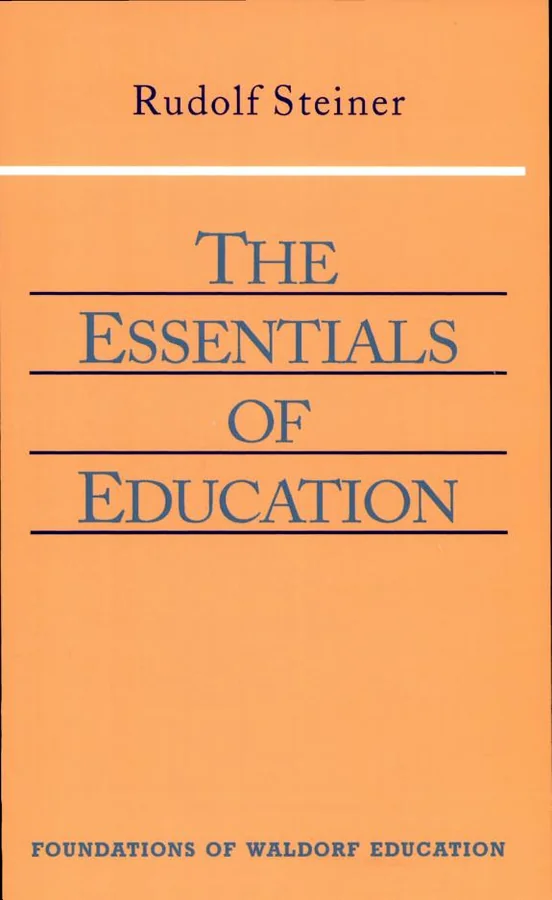
The Essentials of Education
 80
80

The Essentials of Education
Steiner’s 1924 Stuttgart lectures, collected as "The Essentials of Education," offer a starkly different vision of pedagogy than contemporary standardized curricula. The sheer energy of the audience, described as an ovation at the final lecture, speaks to the immediate impact of Steiner’s ideas. A key strength lies in his detailed articulation of child development through distinct seven-year phases, a concept central to Waldorf pedagogy. However, the work’s limitation for a modern, secular audience is its inherent spiritual framework, which requires significant prior engagement with Anthroposophy to fully grasp. The emphasis on the teacher's inner development and connection to spiritual realities, while powerful within its tradition, can feel abstract without direct experience of Steiner's broader philosophical system. Ultimately, "The Essentials of Education" remains a vital, albeit specialized, text for understanding a unique educational philosophy.
📝 Description
80
Rudolf Steiner delivered his final public lectures on education in Germany in April 1924.
Rudolf Steiner's "The Essentials of Education" compiles five lectures given in Stuttgart from April 8th to 11th, 1924. These talks, part of his collected works under volume CW 308, address fundamental questions about the nature and purpose of schooling. They emerged from an educational conference held after World War I, a time of societal change.
These lectures are for educators, parents, and students of esoteric philosophy interested in human development beyond materialistic views. Those studying Anthroposophy or Waldorf education will find the content particularly relevant. Steiner aimed to foster spiritual renewal and holistic development, responding to a perceived fragmentation in modern life. The enthusiastic audience reception indicated a strong public interest in his ideas at the time.
These lectures are rooted in Anthroposophy, a spiritual philosophy founded by Steiner. They apply its core principles to pedagogy, viewing the child not just as a physical being but as a developing soul and spirit. Steiner emphasized understanding the human being in its entirety, across distinct developmental phases. This holistic perspective informed his approach to structuring education, aiming for a more complete and spiritually aware upbringing.
💡 Why Read This Book?
• Understand the seven-year developmental phases of childhood as outlined by Rudolf Steiner, providing a framework for age-appropriate teaching methods. • Grasp the Anthroposophical view of the human being as a spiritual-physical-soul entity, offering a holistic perspective on learning beyond cognitive skills. • Explore the teacher's role as described in the 1924 lectures, emphasizing inner development and spiritual connection as foundational to guiding students.
⭐ Reader Reviews
Honest opinions from readers who have explored this book.
❓ Frequently Asked Questions
What is the historical significance of Rudolf Steiner's "The Essentials of Education"?
These lectures, given in Stuttgart in April 1924, were Rudolf Steiner's final public addresses on education in Germany. They emerged from an educational conference and represent a critical moment for Anthroposophical pedagogy.
What core Anthroposophical concepts are discussed regarding education?
The book explores the threefold nature of the human being (physical, soul, spiritual) and its application to developmental stages, emphasizing the spiritual aspect of the child and the teacher's role.
Who was Rudolf Steiner and what is Anthroposophy?
Rudolf Steiner (1861-1925) was an Austrian esotericist and philosopher who founded Anthroposophy, a spiritual philosophy aiming to provide a path to spiritual knowledge and holistic human development.
Are these lectures practical for modern teachers?
The lectures offer a foundational philosophical perspective. Their practical application requires understanding Anthroposophy and adapting its principles, as seen in Waldorf education, to contemporary contexts.
What was the reception of these lectures in 1924?
The audience reception was exceptionally enthusiastic, with one attendee noting prolonged applause that escalated into an ovation at the conclusion of the final lecture.
How does this book relate to Waldorf education?
It is foundational. The principles and developmental stages discussed in these 1924 lectures form the bedrock of the pedagogical approach implemented in Waldorf schools worldwide.
🔮 Key Themes & Symbolism
Child Development Stages
The work meticulously outlines distinct seven-year phases of human development, from birth through adolescence. Steiner posits that each phase requires a specific educational approach, focusing on the evolving physical, soul, and spiritual needs of the child. Understanding these stages is presented as crucial for fostering healthy growth and preventing developmental imbalances, forming the basis for Waldorf curriculum design.
The Threefold Human Being
Central to Steiner's pedagogy is the concept of the human being as a threefold entity: physical body, soul (etheric, astral bodies), and spirit (I-organization). The lectures explain how education must address and nurture each of these aspects. Neglecting the soul and spiritual dimensions, Steiner argues, leads to an incomplete development, impacting the individual's capacity for creativity and moral judgment.
The Teacher's Inner Work
"The Essentials of Education" places significant emphasis on the teacher's personal and spiritual development. It is not enough to impart knowledge; the educator must cultivate inner capacities, artistic sensitivity, and a conscious understanding of the spiritual forces at play in childhood. This inner preparedness is presented as essential for effectively guiding the unfolding of the child's potential.
Spiritual Science in Pedagogy
💬 Memorable Quotes
Direct passages from the work, attributed to the author.
“The child must be educated from within.”
— This highlights Steiner's belief that true learning and development are not merely externally imposed but arise from the inner capacities and spiritual potential of the child, which education should awaken and support.
“We must see the spiritual in the physical.”
— This points to the Anthroposophical perspective that the physical world is a manifestation of underlying spiritual realities. Education, therefore, should aim to perceive and work with these spiritual forces within the observable human and natural world.
“The seven-year periods are essential for understanding childhood.”
— This emphasizes the importance of recognizing distinct developmental phases in children, each with unique characteristics and needs, as formulated by Steiner and central to Waldorf pedagogy.
“The teacher's task is one of spiritual service.”
— This frames the teaching profession not just as instruction but as a profound responsibility to serve the spiritual evolution of the child, requiring the teacher's own inner development and moral strength.
“Imagination is the organ of the soul.”
— This suggests that imaginative capacity is fundamental to the soul's experience and development, playing an important role in learning, creativity, and understanding the world from an inner perspective.
🌙 Esoteric Significance
Tradition
The work is firmly situated within the Anthroposophical tradition, founded by Rudolf Steiner himself. While drawing from broader Western esoteric currents like Hermeticism and Gnosticism in its emphasis on spiritual development and knowledge, Anthroposophy presents a distinct, modern synthesis. It aims to provide a path for spiritual cognition accessible through contemporary consciousness, focusing on the evolution of humanity and the cosmos.
Symbolism
A key symbolic motif is the seven-year developmental cycle, representing cosmic and earthly rhythms as applied to human life. The threefold nature of the human being (physical, soul, spirit) functions symbolically, representing distinct but interconnected planes of existence that education must address. The teacher's role is also symbolic, acting as a mediator between spiritual realities and the developing child.
Modern Relevance
Contemporary Waldorf educators worldwide continue to apply the principles laid out in these 1924 lectures. Thinkers in integral education and holistic development also draw upon Steiner's model of child development and the teacher's role. Furthermore, the emphasis on cultivating inner capacities and spiritual awareness speaks to modern trends seeking more meaningful and purpose-driven approaches to personal growth and learning.
👥 Who Should Read This Book
• Educators and parents exploring Anthroposophical or Waldorf pedagogy seeking foundational texts on child development and teaching principles. • Students of Rudolf Steiner's work interested in the specific application of his spiritual science to the field of education during a central period. • Researchers in comparative education or the history of esoteric movements examining alternative pedagogical philosophies that emerged in the early 20th century.
📜 Historical Context
Delivered in Stuttgart in April 1924, Rudolf Steiner's lectures in "The Essentials of Education" (CW 308) emerged in the interwar period, a time marked by widespread societal reevaluation and the search for new cultural and spiritual foundations. Steiner's Anthroposophical movement was developing its own distinct educational approach, the Waldorf method, which stood in contrast to prevailing pedagogical theories focused on psychology and empirical science. While Steiner engaged with contemporary educational thinkers, his work was deeply rooted in his own spiritual science, offering a starkly different view of the child and learning. The enthusiastic reception by approximately seventeen hundred attendees at the conference underscores the significant public interest in Steiner's vision for a renewed education. This period also saw the burgeoning of other spiritual and philosophical movements, including Theosophy (from which Steiner had earlier departed) and various forms of idealism, all grappling with the challenges of modernity.
📔 Journal Prompts
The seven-year stages of childhood as presented in the lectures.
The threefold nature of the human being and its implications for learning.
The teacher's inner development as a prerequisite for effective pedagogy.
The role of imagination in the education of the young soul.
Connecting the physical, soul, and spiritual aspects of the child in the classroom.
🗂️ Glossary
Anthroposophy
A spiritual philosophy founded by Rudolf Steiner, seeking to understand the spiritual dimensions of the human being and the cosmos through a path of spiritual-scientific research and cognition.
CW 308
The designation for "The Essentials of Education" within the Collected Works of Rudolf Steiner, indicating its place in the comprehensive compilation of his writings and lectures.
Threefold Human Being
An Anthroposophical concept describing the human being as composed of a physical body, a soul (including etheric and astral bodies), and a spiritual core (the 'I').
Seven-Year Periods
Rudolf Steiner's division of human life into distinct developmental stages, each lasting approximately seven years, with unique characteristics and educational needs.
Etheric Body
In Anthroposophy, the life or formative forces of an organism, responsible for growth, reproduction, and healing; considered part of the soul nature.
Astral Body
In Anthroposophy, the body of feeling, sensation, and instinct; considered part of the soul nature, associated with consciousness and experience.
I-Organization
In Anthroposophy, the spiritual core of the human being, representing individuality, self-awareness, and the capacity for spiritual development.
This book appears in 1 collection
🔮 Readers Also Liked
Browse all →





From the “Anthroposophy” Collection
View all →




More Free Theosophy & Anthroposophy Books
View all →